


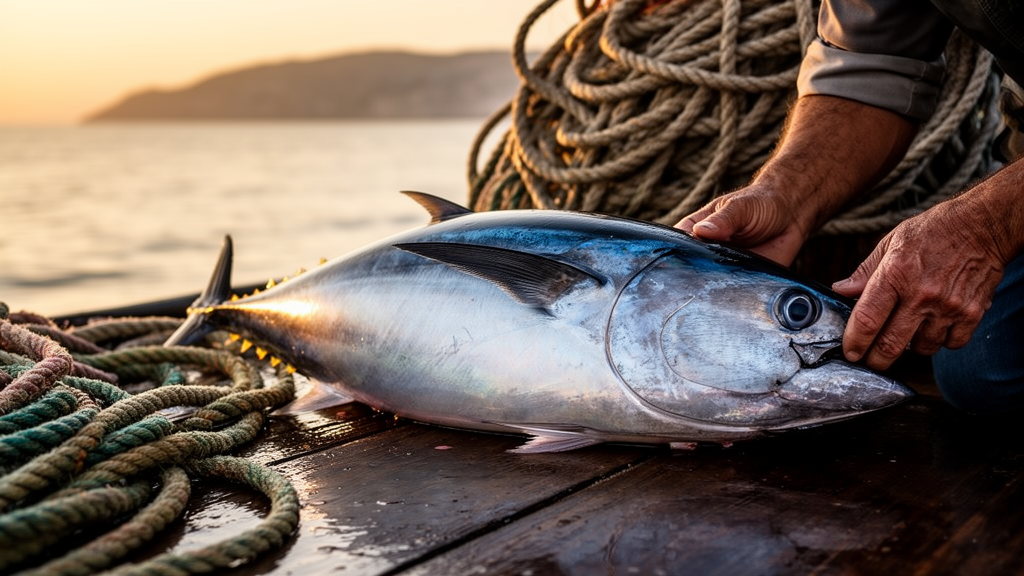
Two small tuna species share the same fishing grounds, the same purse seine fleet, and the same ports along the Tunisian coast, yet a new study shows they are heading in dangerously different directions. The first quantitative stock assessment of the little tunny, Euthynnus alletteratus, and the bullet tuna, Auxis rochei, in the central Mediterranean has found that one species is severely overfished while the other, though also overexploited, retains a far healthier population structure. The work, published in Acta Ichthyologica et Piscatoria, offers some of the clearest evidence yet that even data-poor fisheries can be assessed rigorously, and it arrives just as scientists warn that small tunas across the Mediterranean are slipping through the cracks of international management.
The research focused on Geographical Sub-Area 13, a fishing zone that encompasses Malta and the Lampedusa and Linosa islands and borders the Tunisian coast. At the heart of the assessment was the port of Teboulba, the single most important landing site for small tunas in the region. The harbor accounts for more than 15 percent of Tunisian marine fishery production and 71 percent of all declared fishery production within GSA 13, supporting over 2,800 direct jobs, many of them tied to the purse seine fleet that targets small tunas each spring and summer. Between March and November 2022, the researchers conducted 48 surveys at the port, measuring 916 individual fish taken directly from commercial landings: 408 little tunny and 508 bullet tuna.
What makes the study methodologically significant is its use of two complementary data-limited approaches, tools designed precisely for fisheries where the long, detailed datasets required by classical stock assessment models simply do not exist. The first, the Length-Based Bayesian Biomass method known as LBB, extracts surprisingly rich information from nothing more than the size distribution of caught fish. Because fish grow according to predictable patterns described by the von Bertalanffy growth function, the shape of a length-frequency distribution encodes how hard a stock is being hit. The descending slope of the distribution reflects total mortality, the position of the first peak reveals the size at which the gear begins catching fish, and the absence of large individuals signals that the oldest age classes have been stripped away. The second method, CMSY++, takes a completely different route: it reconstructs the trajectory of a stock from decades of catch records alone, using Bayesian Monte Carlo simulations to find the combinations of carrying capacity and intrinsic growth rate that could plausibly have produced the observed catches.
The two methods converged on a disturbing picture for the bullet tuna. LBB estimated that current biomass stands at just 8 percent of the unexploited level, with fishing mortality fifteen times higher than natural mortality, an extraordinary figure that leaves the population almost no buffer against environmental shocks. CMSY++, applied to 27 years of official landings from 1996 to 2022, confirmed the diagnosis: biomass sits at roughly half the level that would produce maximum sustainable yield, and fishing mortality exceeds the sustainable rate. In the language of the study’s classification scheme, the stock is not merely overfished but critically so, approaching collapse.
Equally alarming is what the size data revealed about the bullet tuna catch. Forty-two percent of the 508 specimens measured were smaller than the length at first maturity of 32.6 centimeters, meaning nearly half the catch consists of juveniles that have never had the chance to reproduce. The size distribution was bimodal, with peaks at 33 and 40 centimeters and a maximum observed length of just 44 centimeters, close to the species’ natural ceiling. This pattern suggests the fishery is intercepting fish during or even before the recruitment peak, putting the incoming generation directly under fishing pressure before it can contribute to stock renewal. Combined with the bullet tuna’s biology, which features rapid growth, early maturity, and a short lifespan that makes it dependent on successful annual recruitment, this juvenile harvest creates a recipe for the kind of boom-and-bust instability visible in the landings record, which swung from nearly 989 tonnes in 2003 to a mere 2 tonnes just two years later.
The little tunny tells a more nuanced story. Both assessment methods agree it is overfished and that overfishing is occurring, with CMSY++ placing biomass at three-quarters of the maximum sustainable yield level and fishing pressure about 39 percent above the sustainable rate. But its demographic structure is far healthier: only 2 percent of the sampled catch consisted of immature fish, and nearly all individuals captured had reached reproductive size. The fishery primarily takes medium-sized adults concentrated in the 55 to 59 centimeter class. Still, the study flagged a quieter warning sign: very large spawners exceeding 90 centimeters were rare in the samples, even though the species can grow to more than a meter in the Mediterranean. The researchers point to the well-documented importance of large, old, fecund females, which produce disproportionately more and better-quality offspring than younger fish. Their progressive disappearance erodes the resilience that the stock will need as fishing pressure continues.
The divergence between the two species is especially striking because they face identical fishing pressure, caught by the same purse seine fleet operating over the same grounds with the same gear. The researchers attribute the difference to a combination of life history traits and shifting fishing dynamics. Bullet tuna, which behaves more coastally and concentrates in predictable seasonal aggregations, is inherently vulnerable to concentrated purse seining. Little tunny, by contrast, appears to have benefited from the displacement of fishing effort that followed the introduction of strict quotas on Atlantic bluefin tuna, with Mediterranean landings peaking in 2016 and 2017, mirroring regional trends. Tunisia’s own record reflects this pattern: small tuna landings averaged around 2,813 tonnes between 1995 and 2010, with the bullet tuna and little tunny together accounting for roughly two-thirds of the catch.
The management implications are stark and species-specific. For the bullet tuna, the researchers recommend raising the minimum conservation reference size from the current 27 centimeters to 34 centimeters, the length that maximizes yield, alongside a genuine reduction in fishing effort and a seasonal closure during periods of high juvenile abundance in autumn and winter. For the little tunny, the priority is inverted: rather than protecting only the young, the fishery must protect the old. The study proposes prohibiting the landing of specimens larger than 80 centimeters and raising the minimum size from 54 to 66 centimeters, allowing fish to reach full reproductive potential. Remarkably, Tunisian legislation currently contains no minimum landing sizes or catch limits for either species, leaving them in a regulatory vacuum even as both are formally under the mandate of the International Commission for the Conservation of Atlantic Tunas, which has adopted no specific management measures for them either.
The study is not without uncertainties, and the authors are candid about them. Sampling covered a single year at a single landing site, retrospective analyses showed that the CMSY++ classification for the bullet tuna is sensitive to recent catch dynamics, and the absence of a Mediterranean-specific estimate of natural mortality for the species remains a critical data gap. Yet the core conclusions rest on unusually solid ground for a data-poor fishery: two independent methods built on entirely different data streams, length distributions and catch series, reached the same diagnosis for each species. The convergence itself demonstrates the feasibility of quantitative assessment for the many Mediterranean small tunas that have never been formally evaluated.
For a sea that holds 7 to 10 percent of the world’s marine species in less than 1 percent of the global ocean, the message extends well beyond two fish. Small tunas are vital sources of protein and income across the Mediterranean, and their transboundary migrations demand coordinated action through the GFCM and ICCAT frameworks. This study provides the scientific baselines that such coordination has lacked, and it delivers a clear deadline: without immediate, enforceable size limits and effort reductions, the bullet tuna of the central Mediterranean may become a cautionary tale of how quickly an overlooked species can slide toward collapse while everyone was watching the big tunas.
Subject of Research: Data-limited stock assessment of little tunny and bullet tuna in the central Mediterranean
Article Title: Stock assessment of small tunas, Euthynnus alletteratus and Auxis rochei ( Actinopterygii , Scombriformes , Scombridae ), in central Mediterranean (GSA 13): Implications for fishery management using data-limited approaches
Article References: Mili, S., Ennouri, R., Agrebi, S., Bejaoui, S., M. Morsi, M., Ben Ali, M., & Hedfi, A. (2026). Stock assessment of small tunas, Euthynnus alletteratus and Auxis rochei (Actinopterygii, Scombriformes, Scombridae), in central Mediterranean (GSA 13): Implications for fishery management using data-limited approaches. Acta Ichthyologica et Piscatoria, 56, 379-397. https://doi.org/10.3897/aiep.56.199776
Image Credits: AI Generated
Keywords: small tunas, stock assessment, Mediterranean, data-limited methods, Euthynnus alletteratus, Auxis rochei, fisheries management, overfishing, CMSY++, LBB, purse seine, Tunisia
Cite Scienmag News
Margaret Porter. (October 15, 2026). Data-Limited Methods Reveal One Small Tuna on the Brink of Collapse in the Central Mediterranean. Scienmag. https://scienmag.com/data-limited-methods-reveal-one-small-tuna-on-the-brink-of-collapse-in-the-central-mediterranean/
Margaret Porter. "Data-Limited Methods Reveal One Small Tuna on the Brink of Collapse in the Central Mediterranean." Scienmag, 15 October 2026, https://scienmag.com/data-limited-methods-reveal-one-small-tuna-on-the-brink-of-collapse-in-the-central-mediterranean/. Accessed 15 October 2026.
Margaret Porter. "Data-Limited Methods Reveal One Small Tuna on the Brink of Collapse in the Central Mediterranean." Scienmag. October 15, 2026. https://scienmag.com/data-limited-methods-reveal-one-small-tuna-on-the-brink-of-collapse-in-the-central-mediterranean/


