


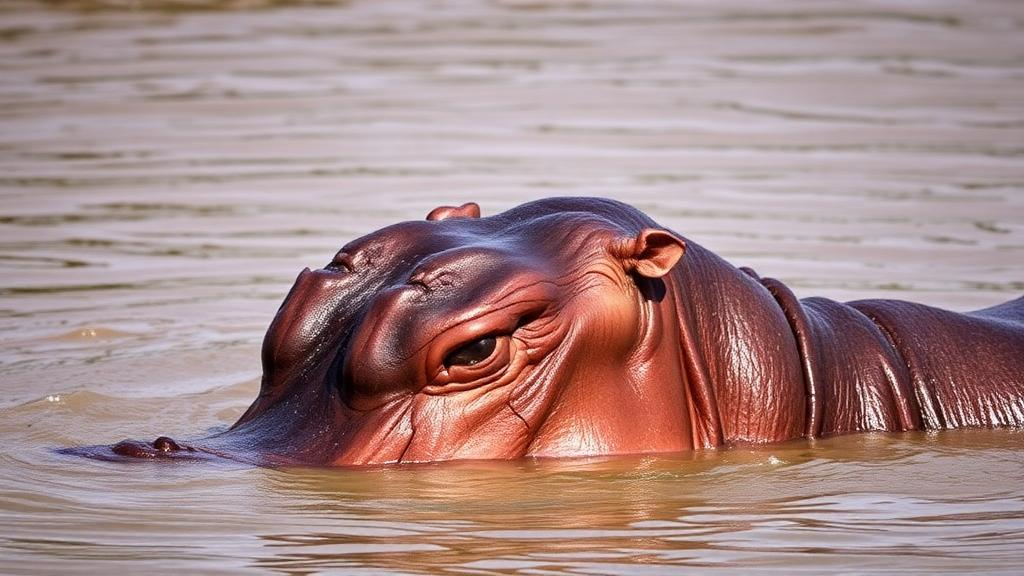
Along the Ruzizi River in eastern Democratic Republic of the Congo, the nightly routine of the hippopotamus has become a matter of life and death. The animals spend their days submerged in rivers, wetlands and the shores of Lake Tanganyika, then move onto land after dark to graze, often ploughing straight through cassava, maize, groundnut and bean fields. A new qualitative study published in Frontiers in Conservation Science documents how this overlapping use of land and water in the villages of Kamanyola and Katogota, in South Kivu Province, has produced human fatalities, injuries, catastrophic crop losses and retaliatory killings of a legally protected species. The researchers argue that the conflict cannot be understood as a simple clash between farmers and wildlife; it is also a story about power, governance and who bears the costs of conservation.
The research team, led by Esther Mufungizi Ahana of the Université Evangélique en Afrique in Bukavu, interviewed 63 stakeholders across the two conflict hotspots, including 56 farmers, two community leaders and five wildlife or institutional actors. A further 24 people from all of these categories took part in two focus group discussions, one in each village. Data collection ran from August to October 2025 and combined semi-structured interviews, focus groups and non-participant field observations of farms, wetlands, riversides and known conflict sites. Interviews were conducted in French, Swahili or Kifuliru, transcribed verbatim and analyzed thematically, with triangulation across sources, methods, member checking and peer briefing used to strengthen the credibility of the findings.
What emerged is a portrait of multidimensional vulnerability. Every single one of the 63 interviewees reported crop destruction by hippopotamuses, and 51 described fatal attacks on people. Participants said the animals destroy harvests, make nighttime and early-morning movement dangerous, and contaminate the river water that communities rely on for washing, fishing, livestock watering and, in some cases, domestic use. One resident of Katogota told the researchers that hippopotamuses constitute a permanent threat, attacking people in the fields and creating insecurity especially at night, and that after the animals pass through, the river water often becomes contaminated and causes illness among children and livestock. The authors stress that such statements capture perceived risks rather than verified health outcomes, since the study conducted no water testing, pathogen surveillance or veterinary assessment.
The timing of danger follows a biological logic that villagers often understand poorly. Hippopotamuses are herbivores that graze on land mainly under cover of darkness, and where agricultural fields sit directly on their feeding routes and wetland corridors, encounters are almost inevitable. Female hippos become exceptionally aggressive while nursing their young, perceiving any nearby human as a threat to their calves. Fifty-two of the 63 participants identified these reproductive and maternal-care periods as especially dangerous. One Kamanyola resident explained that when females are nursing, they attack anyone who approaches, causing damage and loss of human life. The researchers emphasize that this aggression is not random but rooted in defensive instincts, meaning that risk peaks predictably in precisely the zones where farming has expanded.
The legal framework compounds the tension. Hippopotamuses are protected under Congolese conservation law, and laws prohibiting retaliation place residents in what the authors call a moral and security dilemma: defending crops and lives can bring severe criminal penalties. A respondent in Kamanyola described how people who kill a hippopotamus that threatens them are immediately transferred to Bukavu and imprisoned. Forty-three participants said wildlife protection appears to take precedence over human safety, and fifty-seven felt that insufficient attention is paid to the risks and losses they endure. There is no compensation mechanism for affected households, and the researchers link this absence to deep institutional mistrust and to perceptions that the state prioritizes ecological and tourism values over community survival.
These grievances have a political-ecological dimension. The study deliberately pairs the One Health framework, which treats human, animal and ecosystem health as interdependent, with political ecology, which examines how power relations and institutional arrangements distribute environmental risks and benefits. The Ruzizi Plain lies at roughly 800 meters elevation between the Mitumba Mountains and the Congo-Nile Ridge, with semi-arid conditions and alluvial soils that support intensive farming. Earlier ecological surveys along the Ruzizi River recorded 145 hippopotamuses, alongside hundreds of feces, footprints and tracks, with activity concentrated in the Nyangara and Kahorohoro wetlands and damage hotspots including Katogota. Habitat fragmentation has accelerated through armed conflict, population displacement, agricultural expansion and urbanization, and despite legislation barring settlement within 100 meters of riverbanks and lakeshores, such settlement remains widespread.
The human consequences extend well beyond lost harvests. Sixty-one of the 63 respondents described substantial psychological and social effects: persistent fear, recurrent bereavement, trauma after deaths, and a feeling of abandonment by public authorities. One Katogota participant said it is impossible to go two years without witnessing deaths caused by hippopotamuses, and that neighbors, brothers, sisters, fathers and mothers become victims while communities feel ignored. Food insecurity deepens as agricultural income collapses, and residents reported resorting to improvised crop-protection measures and even gathering food in high-risk areas. The authors frame this as an unequal distribution of risk in which local communities absorb the costs of living with wildlife without adequate protection, a pattern they interpret through the lens of environmental justice.
Adaptation efforts so far have been only partially effective. Non-governmental organizations and state authorities have built protective enclosures, but residents told the researchers these structures cannot withstand the strength of hippopotamuses, eroding trust in state-led interventions. Other measures discussed included restoring public electricity services to light village perimeters and even providing food resources to divert animals from fields. Participants also mourned the erosion of traditional, non-lethal deterrence: night guarding, fires, shouting and drumming, practices that elders once used to keep animals away. Such techniques have lost effectiveness as animals habituate, while restrictive rules now forbid communities from acting, leaving them dependent on decisions made elsewhere. From a One Health standpoint, the authors argue, this exclusion of local knowledge undermines the community participation that integrated management requires.
The study’s recommendations are correspondingly structural rather than purely technical. The researchers call for policy revision, community co-management of hippopotamus populations, training of local eco-guards, fair compensation schemes for losses, and stronger coordination among health, veterinary and conservation services. They propose community-based monitoring committees that bring together health workers, veterinarians, customary authorities and conservation officers, alongside targeted training on zoonotic risks, injury prevention and trauma management, and participatory land-use planning that increases separation between farms, settlements and intense hippopotamus activity zones. Because agricultural fields near water points form recognized One Health hotspots globally, the authors argue that conservation policy which ignores water quality, wound infections and psychosocial stress will fail on its own terms.
Ultimately, the researchers conclude that the conflict in the Ruzizi Plain is not merely an ecological or agricultural problem but a manifestation of broader socio-political, health and environmental challenges. They are candid about the limits of their evidence: all findings on zoonotic exposure, water contamination and health impacts reflect stakeholder perceptions, and no epidemiological or environmental measurements were taken. They recommend future quantitative work on hippopotamus populations, agricultural losses and health-risk mapping to build an evidence base for coexistence strategies. Until then, the study stands as a warning that when strict conservation law meets desperate livelihoods with no compensation, no participation and no alternatives, the result is a cycle of grief, resentment and retaliatory killing that endangers both the people of South Kivu and one of Africa’s most iconic semi-aquatic mammals.
Subject of Research: Human-hippopotamus conflict and One Health governance in the Ruzizi plain, Democratic Republic of Congo
Article Title: Human-Hippopotamus conflicts and socio-ecological tensions in the Ruzizi plain: a one health and political ecology perspective
Article References: Ahana, E. M., Fadhili, M. S., Assumani, F. M., Muderhwa, C. Z., & Mushagalusa, G. N. (2026). Human-Hippopotamus conflicts and socio-ecological tensions in the Ruzizi plain: a one health and political ecology perspective. Frontiers in Conservation Science, 7, Article 1921310. https://doi.org/10.3389/fcosc.2026.1921310
Image Credits: AI Generated
DOI: 10.3389/fcosc.2026.1921310
Keywords: hippopotamus, human-wildlife conflict, One Health, political ecology, Ruzizi plain, South Kivu, Democratic Republic of Congo, conservation governance, crop damage, zoonotic risk, food security, community co-management
Cite Scienmag News
Margaret Porter. (October 15, 2026). Fatal Clashes Between Farmers and Hippos Expose a Conservation Governance Crisis in DR Congo. Scienmag. https://scienmag.com/fatal-clashes-between-farmers-and-hippos-expose-a-conservation-governance-crisis-in-dr-congo/
Margaret Porter. "Fatal Clashes Between Farmers and Hippos Expose a Conservation Governance Crisis in DR Congo." Scienmag, 15 October 2026, https://scienmag.com/fatal-clashes-between-farmers-and-hippos-expose-a-conservation-governance-crisis-in-dr-congo/. Accessed 15 October 2026.
Margaret Porter. "Fatal Clashes Between Farmers and Hippos Expose a Conservation Governance Crisis in DR Congo." Scienmag. October 15, 2026. https://scienmag.com/fatal-clashes-between-farmers-and-hippos-expose-a-conservation-governance-crisis-in-dr-congo/


