


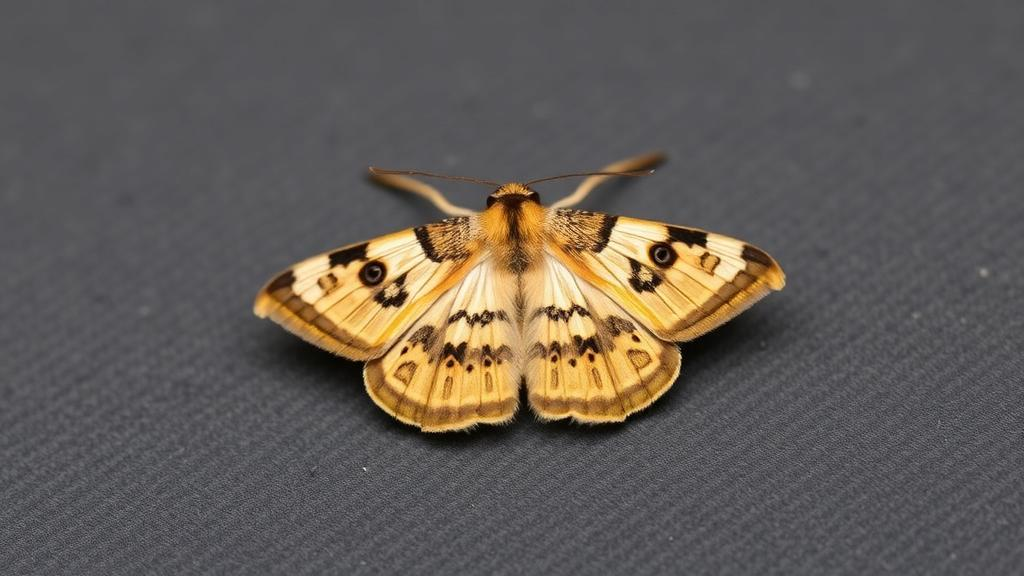
On a March evening at the forest edge of Okinawajima Island, a light trap caught something no entomologist had ever recorded in Japan: a member of Douglasiidae, one of the smallest and most obscure families of moths. The specimens, collected by researchers surveying the northernmost tip of the Oriental Region, turned out to belong to an entirely new species, now formally described as Tinagma nigripunctum in the journal Nota Lepidopterologica. The discovery marks the first record of the family Douglasiidae anywhere in Japan and, remarkably, the first confirmed living member of the family in the entire Oriental biogeographic region.
Douglasiidae is what taxonomists call a relictually small lineage: just two extant genera, Tinagma and Klimeschia, and 39 recognised species worldwide, with a distribution concentrated overwhelmingly in the Holarctic realm, particularly Europe. A single fossil genus and species has been described from Myanmar amber, hinting at a deeper tropical history, but no living species had ever been documented south and east of the Palearctic boundary. The family’s taxonomic position has also shifted over time; once placed within the superamilies Gracillarioidea or Yponomeutoidea, it is now treated as its own monobasic superfamily within the Apoditrysia, a lineage with no close relatives and few evolutionary hints about its origins.
The new moth is tiny even by micromoth standards. The male holotype has a wingspan of just 5.5 millimetres, with a forewing length of 2.5 millimetres, and the female paratype reaches 5.9 millimetres across the wings. That makes T. nigripunctum one of the smallest douglasiids known, comparable only to Tinagma minutissima, which spans roughly 4.5 to 6.5 millimetres. Its forewings are greyish brown with a faint pale fascia across the middle and, crucially, a dark fuscous spot at the wing apex — the feature that gives the species its name, derived from the Latin nigrum, meaning black, and punctum, meaning spot. The Japanese common name assigned to the species is kurohoshi-hime-moguriga, which translates roughly as the black-starred princess burrower moth.
Distinguishing species within Tinagma is notoriously difficult because most members share greyish-brown forewings with white to grey markings. The authors of the new study relied on a combination of external characters, subtle but diagnostic: the indistinct pale greyish-brown fascia, the apical dark spot, and the small overall size. The decisive evidence, however, came from the genitalia, the standard workhorses of lepidopteran taxonomy. In the male, T. nigripunctum resembles T. balteolella, T. klimeschi, and T. anchusella in possessing both a costal process and an articulated process on the valva, the paired claspers of the male genital apparatus. But the new species stands apart in having an acute, pointed tip to the valva and an uninterrupted pecten — a comb of thickened setae numbering about eighteen — running along the outer margin. Its relatives show a roundish tip with either an interrupted pecten or none at all. In the female, the elongated sterigma bears a U-shaped emargination on the ventral opening, as in T. balteolella and T. klimeschi, but unlike those species the sterigma is straight and of uniform width rather than bulging.
The morphological description reveals a suite of other anatomical details that flesh out the species’ character. The male lacks an uncus and gnathos, structures present in many moth families, and instead has a slightly sclerotised, triangular tegumen bearing microtrichia and two pairs of long subapical setae. The valvae are symmetrical and trapezoid, each with a short obliquely upward costal projection and an acuminate articulated process five times as long as its basal width. The phallus is long and slender, gently tapered, with no cornuti — the spiny structures found in many related moths. In the female, the ductus bursae is slender and weakly sclerotised over its posterior three-fifths, with six small sclerotised spinules marking the anterior border of the sclerotised region, and the oval corpus bursae carries a signum composed of numerous strong, slender sclerotised rods arranged in a striking radial pattern.
To test whether the morphology alone justified species status, the team turned to DNA barcoding. DNA was extracted from the abdomens of both type specimens, and a 658-base-pair fragment of the mitochondrial cytochrome c oxidase subunit I gene — the standard COI-5P barcode region — was amplified using the classic Folmer primer pair LCO1490 and HCO2198. The sequences, deposited in the BOLD database under a new barcode index number, BOLD:AGT4721, and in GenBank under accession numbers PX924406 and PX924407, matched each other with zero divergence between the male holotype and female paratype, confirming that both belonged to the same species.
The genetic results were unambiguous. The closest relative of T. nigripunctum is T. balteolella, known from Portugal, but even this nearest neighbour differs by an uncorrected pairwise distance of 9.7 percent — a vast gap by moth barcoding standards, where conspecific populations typically differ by well under 2 percent. The next closest match, T. anchusella from Austria, sits 10.6 percent away. Distances to the other thirteen Tinagma and Klimeschia species included in the comparison range up to 15.7 percent. By contrast, the genetic divergence observed among the other Holarctic species themselves spans only 2.7 to 12.5 percent. The new species is, in genetic terms, more different from its relatives than most of those relatives are from each other — a pattern consistent with a long period of isolation and a geographically distant origin relative to the Holarctic core of the family.
A neighbour-joining tree built from these uncorrected pairwise distances, with bootstrap support estimated over 1,000 replicates, placed T. nigripunctum nearest to T. balteolella and T. anchusella, although the authors caution that bootstrap values at these nodes were low. That tentative relationship is nevertheless reinforced by the shared genital morphology, particularly the presence of a single costal process on each valva. It also carries an ecological clue: both T. balteolella and T. anchusella feed as larvae on herbaceous members of the Boraginaceae, the borage family. Douglasiid caterpillars in general are poorly known, but Klimeschia species are leaf miners and Tinagma species mine flower petioles or bore into stems of plants in Boraginaceae, Rosaceae, and Lamiaceae. The biology of the new species remains unknown, but a Boraginacean host plant is considered plausible. A survey of herbaceous Boraginaceae at the type locality in April 2025, however, turned up no candidate host plants, leaving the caterpillar’s identity one of the species’ lingering mysteries.
Why has such a distinctive lineage gone unnoticed in Japan until now? The authors argue that the most likely explanation is not recent arrival but simple oversight: at five to six millimetres across the wings, the moth is precisely the sort of animal that slips through light-trap samples and general collections unrecognised. Supporting this view is a stray record from Thailand — a single female specimen, held in occurrence data from GBIF, that was identified as a species of Tinagma by Wolfram Gaedike, a leading authority on the family’s taxonomy. Together with the Okinawa discovery, that Thai specimen suggests that Douglasiidae may be quietly present at other Oriental localities, awaiting detection. The Myanmar amber fossil once cited as the family’s only tropical record may not even belong to Douglasiidae at all; the specimen shows five maxillary palpomeres, slender hair-like scales on the vertex, and bristle-like hairs beneath the labial palpus — features foreign to douglasiids and more reminiscent of Tineoidea families such as Tineidae and Meessiidae. The fossil’s family placement remains unresolved pending re-examination of the type specimen.
The underestimation of micromoth diversity in the Oriental Region is a well-documented phenomenon. Comparable gaps have been revealed in groups such as the Nepticulidae, the minute leaf-mining moths, and the Lecithoceridae, whose Oriental diversity has only recently begun to be fully catalogued. Douglasiidae now joins that list of lineages whose true ranges extend further into the tropics than taxonomy had acknowledged. For biogeographers, the Okinawa species raises intriguing questions about how a family anchored in the Holarctic reached a subtropical island at the boundary of the Oriental realm, and whether further isolated relatives are scattered across East and Southeast Asia. The specimens themselves are deposited at the Entomological Laboratory of Kyushu University, where they were collected at the type locality of Itokazu, in the city of Nanjo, Okinawa Prefecture, at the forest edge in late March. For now, T. nigripunctum stands as a reminder that even in one of the most intensively studied countries on Earth, an entire family of insects can hide in plain sight — a black-spotted speck of a moth, smaller than a grain of rice, rewriting the map of an ancient lineage.
Subject of Research: Taxonomic description of a new species of Douglasiidae moth from Okinawa, Japan, based on morphology and DNA barcoding
Article Title: Discovery of a new species of Douglasiidae Heinemann & Wocke, 1876 ( Lepidoptera ) in Japan
Article References: Yagi, S. (2026). Discovery of a new species of Douglasiidae Heinemann & Wocke, 1876 (Lepidoptera) in Japan. Nota Lepidopterologica, 49, 97-108. https://doi.org/10.3897/nl.49.186673
Image Credits: AI Generated
DOI: 10.3897/nl.49.186673
Keywords: Douglasiidae, Tinagma nigripunctum, new species, Lepidoptera, Okinawajima Island, Japan, Oriental Region, DNA barcoding, COI gene, micromoths, taxonomy, biogeography
Cite Scienmag News
Gavin Prescott. (October 15, 2026). Tiny New Moth Species Puts Obscure Insect Family on the Map in Japan. Scienmag. https://scienmag.com/tiny-new-moth-species-puts-obscure-insect-family-on-the-map-in-japan/
Gavin Prescott. "Tiny New Moth Species Puts Obscure Insect Family on the Map in Japan." Scienmag, 15 October 2026, https://scienmag.com/tiny-new-moth-species-puts-obscure-insect-family-on-the-map-in-japan/. Accessed 15 October 2026.
Gavin Prescott. "Tiny New Moth Species Puts Obscure Insect Family on the Map in Japan." Scienmag. October 15, 2026. https://scienmag.com/tiny-new-moth-species-puts-obscure-insect-family-on-the-map-in-japan/


