


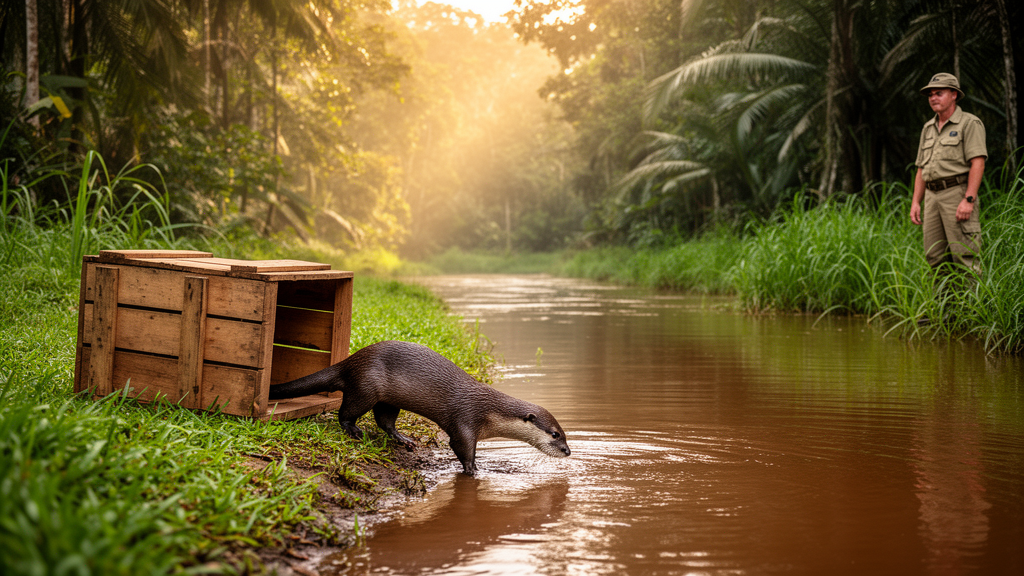
In a quiet lagoon on Santa Catarina Island in southern Brazil, conservation scientists have achieved something that has never before been documented with full methodological transparency for the Neotropical otter: the successful release of captive-born individuals into a declining wild population. On June 4, 2025, two young otters named after a carefully managed breeding program at Instituto Ekko Brasil slipped into the waters of Peri Lagoon, becoming pioneers in a structured reintroduction effort designed to reverse decades of population decline. The case study, published in Estuarine Management and Technologies, describes a three-phase protocol that could become a template for otter conservation across Latin America.
The Neotropical otter, Lontra longicaudis, is the most widely distributed otter species in the Neotropics, ranging from northwestern Mexico through Central America and across much of South America. As a semi-aquatic apex predator, it occupies rivers, streams, lakes, estuaries, mangroves, and coastal marine environments, regulating prey populations of fish and crustaceans through top-down control. Because the species demands unpolluted water, intact riparian vegetation, and abundant prey, its presence serves as a bioindicator of ecosystem health. The International Union for Conservation of Nature classifies the otter as Near Threatened globally, while regional assessments range from Data Deficient to Vulnerable, and several Brazilian state red lists list it as Vulnerable, reflecting localized declines driven by human pressure.
The threats facing the species are numerous and compounding. Habitat fragmentation from dam construction, deforestation, and urbanization isolates populations and reduces genetic flow. Agricultural runoff, industrial effluents, and domestic sewage contaminate waterways, reducing prey availability and exposing otters to bioaccumulated toxins. Vehicle collisions claim breeding adults, particularly where roads run close to water bodies. Uncontrolled domestic dogs transmit diseases such as canine distemper and parvovirus and can kill otters directly, especially in peri-urban areas. Illegal hunting persists despite legal protection, fueled by pelt demand and perceived competition with fisheries. Together these pressures have produced documented declines across multiple regions of the species’ vast range.
Peri Lagoon, located on southern Santa Catarina Island within the Atlantic Forest biome, became the focal point of the study after thirty-six years of monitoring revealed a consistent negative population trend. The mortality record is sobering: at least four otter deaths were registered in 2018 alone. One individual was recovered from the water intake system of the state water treatment company Casan, while a female and her cub drowned in a fish trap within the canal connecting the lagoon to the sea. Four more otters were found dead in similar traps in the canal linking Lagoa da Conceição to the ocean. Researchers caution that these figures likely underestimate true mortality, since detection limitations in aquatic environments obscure the full extent of losses. Yet the lagoon retains enormous ecological value, with eleven kilometers of protected coastline, seven active burrows, and a scientifically estimated carrying capacity of approximately eleven otters, or one individual per linear kilometer of shore.
Captive breeding offered a potential lifeline, but reintroduction of mustelids is notoriously difficult. Human imprinting can destroy the behavioral autonomy needed for independent survival, post-release survival rates are frequently low, and genetic mismatches can destabilize wild populations through outbreeding depression. Instituto Ekko Brasil occupies a unique position in this field: it is the only facility achieving consistent births of Lontra longicaudis under controlled conditions, with fifteen cubs born between 2016 and 2022 and sixty percent surviving to adulthood. The breeding program for this project paired a female named Nanã with a male named Lucky. Copulation was recorded on June 21, 2024, and after a ninety-day gestation, three cubs were born on September 27, 2024. One male cub died at about thirty days from natural developmental complications, but one male and one female survived under veterinary supervision to reach release age at approximately 250 days.
The first phase of the protocol focused on biological safety. Because no validated vaccination protocols exist for the species in translocation programs, pre-release management relied on clinical evaluation and sanitary screening. The only invasive procedure was anesthetic restraint using intramuscular ketamine, midazolam, and butorphanol for biometrics and sample collection. Laboratory examinations included complete blood counts, serum biochemistry, and testing for parvovirus, canine distemper, leptospirosis, and giardia. Genetic matching to local wild stock minimized the risk of outbreeding depression by ensuring the parents’ ancestry matched the lagoon’s historical demographic composition. At roughly thirty days of age, each cub received a subcutaneous microchip compatible with the ISO 11784/11785 standard, implanted in the interscapular region for permanent identification. A mandatory quarantine period with continuous veterinary monitoring completed the phase, and weaning occurred at about sixty-five days.
The second phase, predatory training and dehabituation, is where the protocol’s ingenuity is most visible. Cubs were gradually introduced to live Nile tilapia weighing 300 to 400 grams in a controlled aquatic environment, with feeding sessions three times daily at 08:30, 13:00, and 17:30 and daily food intake of ten to fifteen percent of body biomass. Maternal instruction taught swimming, diving, and apnea, with the cubs capable of autonomous live-prey capture from the sixth week onward; each individual performed more than twenty live captures before release, along with continued conditioning for roughly two hundred days and the introduction of commercial chicks as dietary enrichment. To prevent human imprinting, the team employed an ‘invisible keeper’ strategy: zero human contact during the first thirty days, neutral-colored coveralls, no vocalizations within fifty meters, opaque barriers, automated feeding chutes, and remote camera monitoring instead of direct observation. Aversion training involved simulated human approach trials at ten, five, and two meters, with food rewards reinforcing retreat behavior; progression to release required retreat in at least eighty percent of trials. Domestic dog exposure behind double fencing taught otters to avoid one of their most dangerous anthropogenic threats.
Release criteria were stringent: body mass exceeding eighty-five percent of wild reference values for the same age class, at least three successful live-prey captures, consistent avoidance behavior, absence of human habituation, appropriate swimming ability, and no clinically relevant abnormalities. On June 4, 2025, with authorizations from the state environmental institute IMA and the municipal foundation FLORAM, and with nautical support to minimize transport stress, both otters entered the lagoon voluntarily and displayed exploratory behavior. Post-release monitoring relied on twenty-one camera traps, three at each of seven known dens, using HC-801 trail cameras with 36-megapixel sensors operating around the clock. Over eighty-nine days of monitoring, researchers documented forty-seven independent detection events, a mean rate of 0.53 detections per station per day. Foraging behavior appeared in sixty-six percent of detections, den usage was confirmed at three of seven burrow sites, and both individuals were detected at least fifteen days after release with no mortality recorded. Behavioral milestones in development followed a clear trajectory: first aquatic exposure between days thirty and forty, solid food at day forty-five, and independent egress with rear buoyancy skills by day sixty.
The researchers compared their results with global benchmarks. Survival outcomes paralleled established Eurasian otter reintroduction programs in Europe and exceeded some reported for North American river otter translocations, which the team attributes to the emphasis on behavioral autonomy and minimal human contact. Historical programs in Indiana, Kentucky, Ohio, New Mexico, Utah, and Illinois show the pitfalls the Brazilian protocol was designed to avoid: Utah’s Provo River translocations suffered heavy early mortality, particularly among smaller and female otters, while New Mexico’s small founder group lost thirteen to twenty-one percent of its genetic diversity. The team acknowledges limitations, including the small sample size of two individuals, which makes this a proof-of-concept rather than a population model, and they recommend extending quarantine to thirty days, monitoring wild conspecifics’ health, and incorporating genetic augmentation in future releases. Because the protocol favors low-cost camera traps over expensive telemetry and is published with open multimedia documentation on Zenodo, it is deliberately designed for replication by resource-limited institutions across the Neotropics, provided that community engagement and threat mitigation, including dog control and safe road crossings, accompany the biology.
Subject of Research: Reintroduction of captive-bred Neotropical otters in southern Brazil
Article Title: From captive breeding to wild reintroduction: A case study of a protocol for the neotropical otter ( Lontra longicaudis ) in Southern Brazil
Article References: Tosatti, M., Esteves, P., Bez Birolo, A., & Carvalho Jr, O. (2026). From captive breeding to wild reintroduction: A case study of a protocol for the neotropical otter (Lontra longicaudis) in Southern Brazil. Estuarine Management and Technologies, 3, 149-167. https://doi.org/10.3897/emt.3.191084
Image Credits: AI Generated
DOI: 10.3897/emt.3.191084
Keywords: Neotropical otter, Lontra longicaudis, captive breeding, reintroduction, conservation translocation, Brazil, Atlantic Forest, dehabituation, camera traps, wildlife monitoring, IUCN guidelines, Peri Lagoon
Cite Scienmag News
Margaret Porter. (October 15, 2026). Captive-Born Otters Return to the Wild in Landmark Brazilian Reintroduction. Scienmag. https://scienmag.com/captive-born-otters-return-to-the-wild-in-landmark-brazilian-reintroduction/
Margaret Porter. "Captive-Born Otters Return to the Wild in Landmark Brazilian Reintroduction." Scienmag, 15 October 2026, https://scienmag.com/captive-born-otters-return-to-the-wild-in-landmark-brazilian-reintroduction/. Accessed 15 October 2026.
Margaret Porter. "Captive-Born Otters Return to the Wild in Landmark Brazilian Reintroduction." Scienmag. October 15, 2026. https://scienmag.com/captive-born-otters-return-to-the-wild-in-landmark-brazilian-reintroduction/


