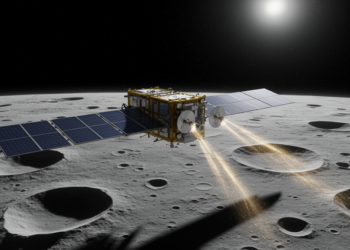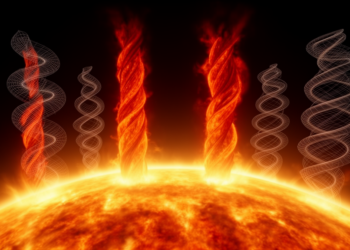
A hypothetical ninth planet hiding hundreds of times farther from the Sun than Earth may carry an unexpected beacon: the kinetic energy of dark matter particles raining down through its interior. In a new theoretical study published in Discover Space, physicist Tiberiu Harko calculates that, under a specific long-term capture model, dark matter heating could lift the surface temperature of Planet 9 to around 200 kelvin over roughly a billion years, making the object glow in the infrared with a peak wavelength of about 1.44×10^-3 centimeters. The result is a model-dependent prediction, not a detection, but it sketches a possible way to find a planet that may be far too dark to see in reflected sunlight.
The motivation comes from a long-standing puzzle in the outer Solar System. A population of eccentric Kuiper belt objects beyond Neptune’s orbit appears bunched together in the longitude of perihelion, with approximately aligned orbital axes and angular momentum vectors. A giant, still-unobserved planet on an inclined, eccentric orbit could explain this clustering, as well as the large perihelion distances of objects like Sedna, which circles the Sun once every roughly 11,400 years. A Markov Chain Monte Carlo analysis of the observational constraints estimated a mass of 6.2 (+2.2/-1.3) Earth masses, a semimajor axis of 380 (+140/-80) astronomical units, a perihelion near 300 (+85/-60) AU, and an inclination of 16 ± 5 degrees. Updated estimates from later survey analyses put the mass at 6.6 (+2.6/-1.7) Earth masses and the current distance at 550 (+250/-180) AU.
Planet 9 has never been seen, and the searches have been inconclusive. A custom pipeline built on full-frame images from NASA’s Transiting Exoplanet Survey Satellite can recover signals of Solar System bodies out to distances of about 150 AU without orbital information. A search using the second data release of the Pan-STARRS1 survey ruled out a Planet Nine with the reference parameter space to a 50 percent completion depth of V = 21.5, and combined with the Zwicky Transient Facility and Dark Energy Survey it excludes 78 percent of that reference population. In the far infrared, where thermal radiation falls off only with the square of distance rather than the fourth power that governs reflected sunlight, the AKARI all-sky survey flagged two possible candidates, and a comparison of the IRAS and AKARI catalogs, separated by 23 years, produced one good candidate whose source position changed between the surveys. Even so, infrared observations alone cannot determine the full orbit of any candidate, and the planet’s existence remains an open question.
The new work focuses not on gravity but on heat. Non-annihilating dark matter particles interact gravitationally with ordinary matter, and when they fall into the gravitational potential of a massive object they gain kinetic energy that can be deposited as heat. The mechanism, known as dark kinetic heating, depends on the total mass of accumulated dark matter and on the mass of the dark matter particle, and it has been proposed as a probe even for objects with low escape velocities, such as exoplanets and brown dwarfs. If such heating were ever observed, it would constitute evidence for dark matter concentrated near or inside an astrophysical body.
To quantify the effect for Planet 9, the study adopts a local dark matter density of 10^-18 grams per cubic centimeter, a value consistent with purely gravitational constraints obtained from tracking data of the asteroid Bennu gathered during the OSIRIS-REx mission, and a dark matter velocity of 250 kilometers per second. Assuming a planet of ten Earth masses and ten Earth radii, the maximum impact parameter of incoming dark matter particles works out to about 2.85×10^3 kilometers, and the mass rate of dark matter crossing the planet is about 6.37×10^6 grams per second for the reference density. The kinetic energy deposition rate reaches roughly 1.99×10^21 ergs per second, scaled by the fraction f of particles that actually become trapped. That fraction is the ratio of the dark matter-nucleon cross section to the saturation cross section at which every incoming particle is captured, here estimated at 3.57×10^-33 square centimeters for the assumed planet. Given experimental limits from XENON, CDMS, CRESST-II and LUX-ZEPLIN, which together suggest a cross-section range of roughly 10^-47 to 10^-40 square centimeters, the capture fraction lies between about 2.79×10^-15 and 2.79×10^-8.
In a static scenario the surface temperature scales as the fourth root of the energy deposition rate, and the study finds a reference value of about 16.2 kelvin for the assumed planet parameters, multiplied by the fourth root of the capture fraction. At f = 10^-8 the contribution of dark kinetic heating to the planet’s surface temperature is negligibly small. The picture changes dramatically in the dynamical model, in which captured dark matter increases the planet’s mass over time. Taking an initial mass of one Earth mass growing to ten Earth masses over 4.5 billion years, the model yields an exponential mass growth with a characteristic critical time of about 6.24×10^16 seconds for the reference parameters. The temperature then rises exponentially as well, but only after a long delay: in this model the planet’s temperature remains practically constant for the first 3 billion years, and efficient heating begins only after a long exposure to the dark matter flux.
The sensitivity of the outcome to the environment is striking. In the model’s calculations, the surface temperature depends extremely strongly on the local dark matter density, with very small changes in density producing drastic differences in temperature over billions of years. For a capture fraction of 10^-10 and a dark matter density of 1.32×10^-17 grams per cubic centimeter, the surface temperature can reach about 200 kelvin or higher in around a billion years of heating, with a blackbody spectrum peaking at a wavelength of 1.44×10^-3 centimeters and a frequency of 2.07×10^13 hertz, squarely in the infrared. In the most optimistic scenario of heating sustained over 4 to 5 billion years, the model predicts surface temperatures of roughly 1000 to 2000 kelvin, while 3 billion years of heating gives about 100 to 200 kelvin. Heating periods of two billion years or less contribute nothing significant. For comparison, the equilibrium temperature set by sunlight alone at Planet 9’s distance is only about 13 kelvin.
Whether such a faint glow could actually be seen is left open. Assuming the planet sits 500 astronomical units away with a surface temperature near 250 kelvin, the model gives a spectral flux density of about 5×10^-5 watts per cubic meter at a wavelength around 10^-5, and the paper notes it remains an observational problem whether present or future instruments could detect so low a flux. If detection were possible, the planet could serve as a tracer of the dark matter density distribution in the outer Solar System, potentially revealing overdensities and constraining the interaction between dark and ordinary matter. The study also contrasts this mechanism with an earlier proposal in which tidal heating of hypothetical satellites of Planet 9 could produce a thermal radio flux of about 2 microjanskys at 300 gigahertz, a process that would require the planet to have satellites in the first place.
The author is careful about the model’s assumptions and limits. The calculations depend on the unknown dark matter-ordinary matter interaction cross section, with all results expressed relative to the saturation value, and on a phenomenological mass growth law that assumes a constant radius and a linear mass-radius relation, an approximation the paper argues does not significantly alter the numerical estimates. The adopted capture fraction of 10^-10, drawn from earlier work on dark matter capture by stars, carries substantial uncertainties of its own. The physical nature of Planet 9 is itself unresolved: proposals range from a giant planet that migrated outward from closer to the Sun, to a captured object, a primordial black hole, an axion star, or a so-called dark exoplanet made of particles beyond the Standard Model. Future observations, including those from the Vera C. Rubin Observatory, may settle whether the ninth planet exists at all, and if it does, dark matter heating may provide one of the few signatures capable of revealing a world that reflects almost no light.
Subject of Research: A theoretical model of dark matter kinetic heating of the hypothetical Planet 9 and its predicted infrared observational signature
Article Title: Dark matter heating of Planet 9, and its observational implications
Article References: Harko, T. (2026). Dark matter heating of Planet 9, and its observational implications. Discover Space, 130(1), Article 10. https://doi.org/10.1007/s11038-026-09590-6
Image Credits: AI Generated
DOI: 10.1007/s11038-026-09590-6
Keywords: Planet 9, dark matter, dark kinetic heating, Kuiper belt objects, Trans-Neptunian objects, infrared astronomy, Solar System, blackbody radiation, dark matter capture, exoplanets, astrophysics, theoretical model
Cite Scienmag News
Grant Pearson. (October 29, 2026). Dark matter could warm a hidden Planet 9 into infrared view. Scienmag. https://scienmag.com/dark-matter-could-warm-a-hidden-planet-9-into-infrared-view/
Grant Pearson. "Dark matter could warm a hidden Planet 9 into infrared view." Scienmag, 29 October 2026, https://scienmag.com/dark-matter-could-warm-a-hidden-planet-9-into-infrared-view/. Accessed 29 October 2026.
Grant Pearson. "Dark matter could warm a hidden Planet 9 into infrared view." Scienmag. October 29, 2026. https://scienmag.com/dark-matter-could-warm-a-hidden-planet-9-into-infrared-view/