


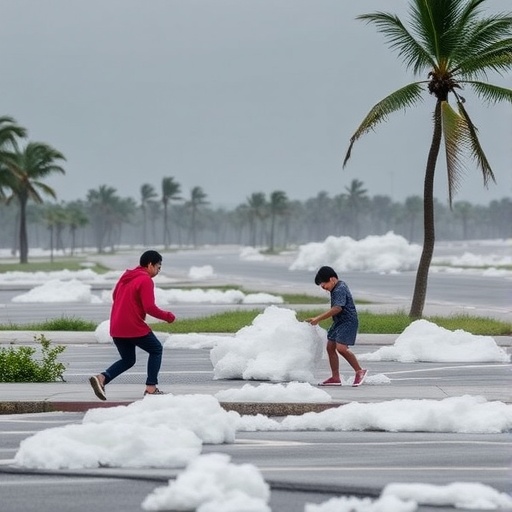
A groundbreaking observational study recently published in the esteemed open-access journal PLOS Medicine has spotlighted a critical and previously underexplored public health crisis: the profound vulnerability of children under five to tropical cyclones in low- and middle-income countries. Led by Renjie Chen from Fudan University in China, the research presents compelling evidence correlating cyclone exposure with elevated mortality risks in young children, illuminating the urgent need for enhanced disaster preparedness and targeted healthcare responses in the most affected regions worldwide.
Tropical cyclones, including hurricanes and typhoons, are among the most frequent and devastating natural disasters on the planet. Their increasing frequency and intensity—attributable largely to climate change—pose significant threats not only to infrastructure and economies but also to the most vulnerable populations, particularly young children. Children under five years of age are uniquely susceptible to the myriad direct and indirect impacts of these storms, including drowning, trauma from high-velocity winds and debris, infectious diseases related to water contamination, and interruptions in essential health services.
Previous investigations into the health impacts of cyclones often centered on isolated events or focused on higher-income regions with more robust healthcare systems. This leaves a critical knowledge gap regarding the consequences of cyclones in lower-resource settings, where infrastructure is fragile, and emergency services may be inadequate. This study is pioneering in its expansive scope—analyzing data across 34 low- and middle-income countries over a two-decade period—to quantify the mortality risk posed by cyclones specifically to children under five.
The researchers employed an innovative observational design using large-scale survey data, encompassing a staggering sample size: 100,798 deceased children under five alongside 247,445 surviving siblings. This sibling comparison approach allowed the researchers to estimate excess mortality attributable to cyclone exposure by examining survival patterns within families, thereby controlling for confounding socioeconomic and genetic factors that typically accompany demographic studies. Crucially, they identified deaths occurring within one month of cyclone exposure and contrasted these with survival outcomes among siblings, providing a robust linkage between cyclone events and elevated child mortality.
The spatial analysis involved georeferenced raster data at a high resolution (10 km by 10 km), mapping the incidence of cyclone-attributable deaths across vulnerable regions. This nuanced geographic representation reveals not only the intensity of risk in cyclone-prone coastal and island areas but also underscores regional disparities shaped by socioeconomic conditions and healthcare accessibility. By accounting for these multifactorial influences, the study offers a sophisticated understanding of where and why young children are most at risk.
From a statistical viewpoint, the study’s findings are sobering. Over the 20-year study period from 2000 to 2020, the researchers estimate that tropical cyclones contributed to approximately 850,000 deaths in children under five across the surveyed countries. This remarkable toll highlights the intersection of climate-driven natural disasters and global child health inequalities, signaling that without substantial intervention, these numbers could climb in coming decades.
Mechanistically, the increased mortality risk stems from a confluence of factors. Cyclone-related flooding exposes children to drowning hazards and waterborne pathogens. High winds and collapsing structures cause physical trauma and impede access to medical care. Disruption of clean water and sanitation infrastructure leads to outbreaks of diarrheal diseases, which are major contributors to child mortality. Moreover, the breakdown of routine healthcare delivery—including immunizations, nutritional support, and emergency treatments—exacerbates the vulnerability of affected populations, setting the stage for cascading health crises in the wake of storms.
Given the urgent societal implications, the study authors underscore the imperative to expand disaster preparedness programs in cyclone-prone, resource-limited settings. These initiatives must ensure safe water provision, improve sanitation, and maintain robust healthcare services during and after cyclone events. Incorporating early warning systems, resilient infrastructure, and community-based emergency response plans could mitigate the devastating health outcomes manifested in this vulnerable demographic.
This research also raises vital questions about the broader impact of climate change on global child mortality trends. As warming oceans fuel more intense cyclones, vulnerable populations in low- and middle-income countries may face worsening health inequities. The integrated approach adopted in this study—leveraging large-scale demographic data and geospatial analysis—serves as a model for future epidemiological investigations aimed at quantifying climate-sensitive health risks.
Beyond its epidemiological significance, the study exemplifies how collaboration among international researchers—hailing from China, the United States, and Tanzania—can generate data-driven insights with profound policy implications. By focusing on the most affected age group, the under-five population, it delivers a clarion call to global health agencies, policymakers, and humanitarian organizations to prioritize child health in climate adaptation strategies.
In sum, this comprehensive and methodologically rigorous study fills a critical void in our understanding of how tropical cyclones exact a deadly toll on young children in low- and middle-income countries. The estimated 850,000 child deaths over two decades reflect not only the brutal power of nature but also systemic vulnerabilities that amplify disaster impacts. Addressing these vulnerabilities through targeted preparedness and resilient healthcare frameworks is not merely a scientific challenge—it is a moral imperative to safeguard the lives of the world’s most vulnerable children facing the accelerating perils of a changing climate.
News Publication Date: September 25, 2025
Web References:
https://plos.io/3HYRfW2
References:
Guo Y, Zhu Y, He C, Gao Y, Zhou L, Bachwenkizi J, et al. (2025) Cyclone exposure and mortality risk of children under 5 years old: An observational study in 34 low- and middle-income countries. PLoS Med 22(9): e1004735. https://doi.org/10.1371/journal.pmed.1004735
Cite Scienmag News
Russell Cooper. (September 25, 2025). Cyclones Significantly Elevate Mortality Risk in Children Under Five. Scienmag. https://scienmag.com/cyclones-significantly-elevate-mortality-risk-in-children-under-five/
Russell Cooper. "Cyclones Significantly Elevate Mortality Risk in Children Under Five." Scienmag, 25 September 2025, https://scienmag.com/cyclones-significantly-elevate-mortality-risk-in-children-under-five/. Accessed 4 September 2026.
Russell Cooper. "Cyclones Significantly Elevate Mortality Risk in Children Under Five." Scienmag. September 25, 2025. https://scienmag.com/cyclones-significantly-elevate-mortality-risk-in-children-under-five/


