


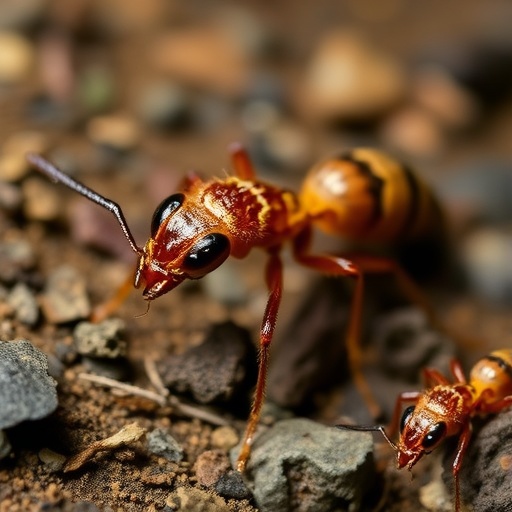
Fungus-farming termites represent a fascinating example of symbiosis and ecological complexity, where the insects cultivate mutualistic fungi to sustain their colonies. Recent research sheds light on their sophisticated defensive behaviors against invasive fungal pathogens, revealing a dynamic interaction between termites, their cultivated fungus, and microbial allies embedded in their environment. These findings not only deepen our understanding of insect agriculture but also inspire innovative strategies for biocontrol and sustainable pest management.
The species Odontotermes obesus exemplifies this intricate relationship, engaging in a mutualistic partnership with Termitomyces fungi. Termites nurture Termitomyces within specialized structures referred to as fungal combs—nutrient-rich matrices engineered by the termites to optimize fungal growth and maximize nutritional gain. These fungal gardens serve as both a vital food resource and a habitat, underpinning the colony’s health and longevity. However, the productivity and integrity of these fungal combs are threatened by opportunistic fungal invaders, most notably Pseudoxylaria, a rapidly proliferating fungal weed that jeopardizes the cultivated crop.
The invasion by Pseudoxylaria cascades into potential colony collapse if unchecked. Interestingly, experimental removal of termite workers results in unchecked Pseudoxylaria growth, underscoring the critical role of termite-mediated maintenance and defense in fungal garden health. This phenomenon highlights the termites’ active engagement in phytopathogen management, a process whose underlying mechanisms had remained obscure until now. Prior hypotheses suggested that termites leverage microbial agents as biological control factors, but the behavioral modalities of such selective suppression were not well characterized.
Aanchal Panchal and colleagues have unveiled that Odontotermes obesus termites demonstrate a remarkable plasticity in their behavioral repertoire to counteract fungal weed outbreaks. Their defense strategy is nuanced and contingent upon infection severity. When Pseudoxylaria presence is minimal, termites employ precise comb hygiene measures, excising infected material and transporting it away from the fungal garden. Subsequently, the contaminated fragments are buried beneath boluses of soil—small, compacted clumps enriched with a consortium of antagonistic microbes that reduce fungal viability by creating oxygen-poor microenvironments.
The defensive strategy scales impressively under conditions of severe fungal invasion. Termites orchestrate rigorous isolation protocols, segmenting heavily infested fungal comb zones from healthy regions to prevent pathogen dissemination. Entire sections may be engulfed within multifunctional soil boluses, effectively smothering the pathogen and serving as both physical and biological barricades. The discovery that these boluses harbor complex microbial assemblages—including termite-derived bacteria exhibiting fungistatic properties—provides compelling evidence for a symbiotic microbial-assisted defense mechanism beyond mere soil coverage.
Intriguingly, the deployment of fungistatic boluses is not indiscriminate but finely regulated according to comb health status. Healthy fungal gardens do not receive such treatments, indicating the termites’ capability to discriminate threat levels and allocate resources accordingly. This selective activation of microbial allies for weed suppression suggests an evolutionary adaptation honing the termites’ pest management to be both efficient and sustainable, sparing their beneficial fungal crop while eliminating competitors.
Such sophisticated biotic interactions underscore the termites’ use of microbial symbionts as integral components of a multifaceted pest management system. The microbial communities associated with soil boluses include bacteria capable of producing natural antifungal compounds, presenting opportunities for bioprospecting in pharmaceutical and agricultural domains. These compounds, inherently optimized through co-evolution with termite-fungus symbiosis, may serve as templates for developing novel antifungal agents or bioremediation tools.
Beyond ecological significance, the termite-fungus-microbe tripartite alliance exemplifies natural product discovery potential. Delving into the molecular dialogues and compound profiles within these interactions could unveil fungistatic molecules with broad-spectrum applicability. Moreover, understanding the impact of these biochemical interactions on termite colony fitness and resilience may illuminate evolutionary pressures shaping mutualistic networks and co-dependencies in microbial ecosystems.
The insights provided by Panchal et al. prompt reassessment of pest control paradigms, advocating for integrative approaches leveraging microbial symbiosis. Harnessing such bio-inspired strategies could mitigate reliance on chemical fungicides, reduce environmental impacts, and contribute to sustainable agriculture frameworks. Furthermore, dissecting microbial community structure and function in termite soil boluses may identify keystone species crucial for fungal garden defense, enriching our comprehension of microbial ecology in insect agronomy.
This research advances our grasp of how complex societies of insects manage agricultural pests and maintain crop integrity through behavioral plasticity and microbial collaboration. The dynamic interplay between termites, their fungal cultivars, invasive pathogens, and microbial allies manifests a finely balanced system with profound implications for ecology, evolution, and biotechnology. As interdisciplinary studies continue, the termite-fungal symbiosis model stands poised to inform biomimetic innovations addressing global challenges in food security and environmental stewardship.
Future investigations may focus on the genomics of the microbial consortia inhabiting soil boluses, the biochemical characterization of antifungal compounds, and the signaling pathways termites utilize to detect and respond to fungal threats. Unraveling these mechanisms at molecular and behavioral levels promises to bridge gaps between entomology, microbiology, and applied sciences, potentially spawning novel interventions derived from ancient natural alliances.
In conclusion, the discovery that fungus-farming termites contain and suppress invasive fungal weeds by combining behavioral responses with microbial enlistment revolutionizes our perception of insect agriculture. This tripartite defense strategy, marrying selective hygienic behavior with microbial biocontrol, underscores the sophistication of natural pest management systems. By emulating and harnessing such mechanisms, we may unlock sustainable solutions for crop protection, antibiotic discovery, and ecosystem resilience.
News Publication Date: 25-Sep-2025
Web References: 10.1126/science.adr2713
Cite Scienmag News
Roger Howard. (September 25, 2025). Inside the Secret Defense: How Fungus-Farming Termites Guard Their Gardens from Invaders. Scienmag. https://scienmag.com/inside-the-secret-defense-how-fungus-farming-termites-guard-their-gardens-from-invaders/
Roger Howard. "Inside the Secret Defense: How Fungus-Farming Termites Guard Their Gardens from Invaders." Scienmag, 25 September 2025, https://scienmag.com/inside-the-secret-defense-how-fungus-farming-termites-guard-their-gardens-from-invaders/. Accessed 4 September 2026.
Roger Howard. "Inside the Secret Defense: How Fungus-Farming Termites Guard Their Gardens from Invaders." Scienmag. September 25, 2025. https://scienmag.com/inside-the-secret-defense-how-fungus-farming-termites-guard-their-gardens-from-invaders/


