


Osaka, Japan – Getting a molecule to do what you want it to do is not always easy. As an example, an organic molecule will absorb only certain wavelengths of light based on its arrangement of electrons, which can be difficult to fine tune. Even so, the ability to make substances that respond to only specific ranges of the spectrum could lead to important new applications.

Credit: Osaka University
Osaka, Japan – Getting a molecule to do what you want it to do is not always easy. As an example, an organic molecule will absorb only certain wavelengths of light based on its arrangement of electrons, which can be difficult to fine tune. Even so, the ability to make substances that respond to only specific ranges of the spectrum could lead to important new applications.
There is currently significant interest in the design of new organic semiconducting materials for high-tech applications such as solar cells and transistors. In particular, molecules that can absorb near-infrared light but not visible light, and so are colorless, have applications in everything from chemotherapy to photodetectors. Some such compounds have already been developed but so far there has been no systematic process for making these molecules.
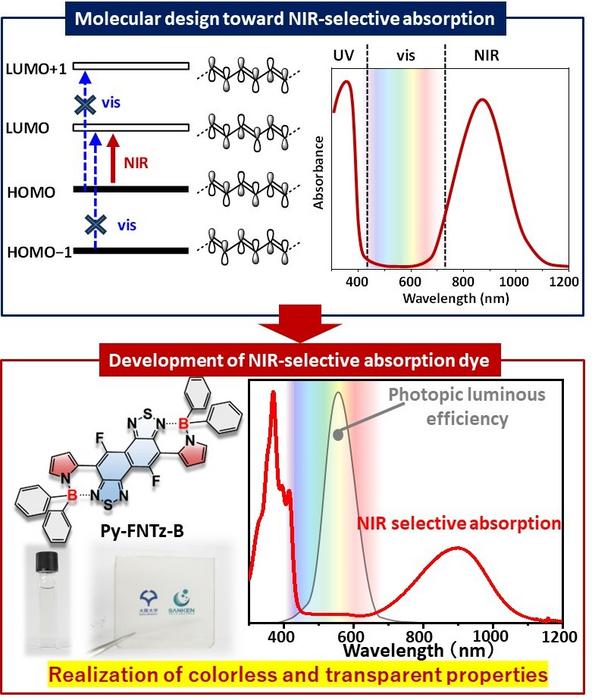
In a study recently published in Advanced Science, researchers from SANKEN at Osaka University were able to systematically design a large, complex molecule that does not absorb visible light, meaning that it is completely colorless and transparent, but do absorb near-infrared radiation. This was accomplished by carefully constructing molecules that have suitable arrangements of electrons.
The absorbance of light by an organic compound is based on electrons moving between regions around atoms known as orbitals. In this work, the researchers show a methodical approach to constructing molecules having orbitals that allow some ranges of light to be absorbed but not others.
“The main challenge was finding a rational approach to constructing molecules with the desired electronic transitions,” says lead author of the study Soichi Yokoyama. “To do so, we focused on large structures having many delocalized electrons, using theoretical calculations to guide our selections.”
These compounds were based on a so-called donor-acceptor-donor system and utilized a naphthobisthiadiazole group as the acceptor combined with either pyrrole or indenopyrrole donor groups along with boron bridges. This specialized structure allowed electrons to spread out over wider areas of the molecules, producing just the right type of light absorption. The new molecule was exhaustively characterized and were found not to absorb in the visible region of the spectrum but to absorb near-infrared light, as planned.
“A somewhat similar molecule absorbing near-infrared radiation was reported some time ago,” explains Yutaka Ie, senior author, “but this compound also absorbed visible light and so appeared blue. Our goal was to find a molecule that showed no color at all, to allow specific applications. A combination of an extended polyene structure and orbital symmetry were key.”
The molecule was found to act as semiconductors and the pyrrole-based compound could also be used to construct a phototransistor responsive to near-infrared light. Many uses for organic compounds that show unique optoelectronic properties and specific light absorption characteristics are yet to be explored. This work is expected to pave the way for the future design of transparent, colorless molecules that respond to near-infrared light and lead to many new applications.
###
The article, “Colorless Near-Infrared Absorbing Dyes Based on B-N Fused Donor-Acceptor-Donor π-Conjugated Molecules for Organic Phototransistors,” was published in Advanced Science at DOI:
About Osaka University
Osaka University was founded in 1931 as one of the seven imperial universities of Japan and is now one of Japan’s leading comprehensive universities with a broad disciplinary spectrum. This strength is coupled with a singular drive for innovation that extends throughout the scientific process, from fundamental research to the creation of applied technology with positive economic impacts. Its commitment to innovation has been recognized in Japan and around the world. Now, Osaka University is leveraging its role as a Designated National University Corporation selected by the Ministry of Education, Culture, Sports, Science and Technology to contribute to innovation for human welfare, sustainable development of society, and social transformation.
Website:
Journal
Advanced Science
Method of Research
Experimental study
Subject of Research
Not applicable
Article Title
Colorless Near-Infrared Absorbing Dyes Based on B-N Fused Donor-Acceptor-Donor π-Conjugated Molecules for Organic Phototransistors
Article Publication Date
14-Jun-2024
Cite Scienmag News
Bethany Barker. (June 17, 2024). Custom-made molecules designed to be invisible while absorbing near-infrared light. Scienmag. https://scienmag.com/custom-made-molecules-designed-to-be-invisible-while-absorbing-near-infrared-light/
Bethany Barker. "Custom-made molecules designed to be invisible while absorbing near-infrared light." Scienmag, 17 June 2024, https://scienmag.com/custom-made-molecules-designed-to-be-invisible-while-absorbing-near-infrared-light/. Accessed 4 September 2026.
Bethany Barker. "Custom-made molecules designed to be invisible while absorbing near-infrared light." Scienmag. June 17, 2024. https://scienmag.com/custom-made-molecules-designed-to-be-invisible-while-absorbing-near-infrared-light/

