


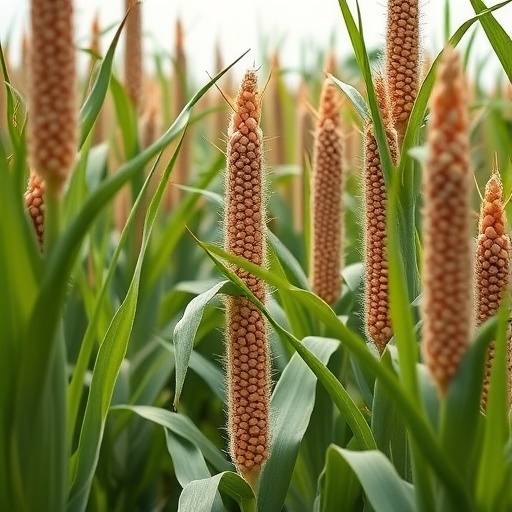
In the relentless pursuit of global food security, the resilience of staple crops under changing climate regimes has never been more critical. A groundbreaking study led by Zhang, L., Bai, Z., Xi, W., and their colleagues elucidates how maize cultivar evolution fundamentally governs the crop’s sensitivity to adverse climatic conditions. Published in Nature Communications in 2026, this research ventures deeply into the genetic and environmental interplay shaping yield outcomes in one of the world’s most vital cereal grains, revealing insights with far-reaching implications for agriculture, ecology, and climate adaptation strategies.
Maize, or corn, sustains billions globally, but it is notoriously vulnerable to climatic perturbations—heatwaves, droughts, erratic rainfall—that threaten its productivity. The study underscores that the evolutionary trajectory of maize cultivars—the distinct genetic varieties developed through selective breeding over decades—plays a pivotal role in how the crop responds to environmental stressors. By dissecting plant performance across diverse geographic zones and climatic backdrops, the research team deployed advanced phenotyping and genotyping methodologies to trace yield variability directly back to cultivar evolution.
Crucially, the study integrates field data with climate modeling, enabling a fine-grained analysis of genotype-by-environment interactions. This approach allows the researchers to untangle how specific genetic traits influence maize’s tolerance or susceptibility to temperature extremes, water scarcity, and pest pressures exacerbated by climate change. Their evidence indicates that certain cultivars, honed through historical breeding programs targeting high yield potential, may paradoxically entail heightened vulnerability under increasingly volatile climate conditions.
To reach these conclusions, Zhang et al. employed longitudinal agronomic data collected over multiple growing seasons, encompassing a wide array of hybrids and landraces. This temporal breadth lent statistical power in identifying consistent patterns of yield stability or decline correlated with drought and heat stress. Molecular analysis revealed that key loci associated with stress response mechanisms had undergone selection in recent decades, but with trade-offs that affect resilience depending on environmental context.
The team’s findings challenge the prevailing assumption that modern breeding universally enhances climate resilience. Instead, they paint a nuanced picture: while breeding efforts have substantially increased average maize yields under stable or moderate conditions, evolutionary shifts in cultivar genetics have inadvertently heightened sensitivity to climate extremes. This paradoxical outcome underscores the urgent need for breeding programs to explicitly incorporate resilience traits alongside productivity metrics.
By harnessing next-generation sequencing techniques and genome-wide association studies (GWAS), the study identifies several candidate genes and regulatory networks central to stress adaptation. These genetic elements govern physiological traits such as stomatal conductance, root architecture, and heat shock protein expression—critical determinants of plant performance under thermal and hydric stress. The elucidation of these genetic underpinnings opens avenues for precision breeding strategies that could reconcile high yield with climate robustness.
Moreover, the spatial dimension of the research highlights regional disparities in maize cultivar performance and vulnerability. For instance, cultivars thriving in temperate zones exhibited divergent responses compared to those adapted to tropical environments, reflecting localized evolutionary pressures and crop management practices. This geographic mosaic suggests that climate-smart agriculture must be context-specific, leveraging regionally tailored cultivar development rather than a one-size-fits-all approach.
Importantly, the study integrates socio-economic considerations, acknowledging that farmers’ choices in cultivar adoption are influenced by market forces, accessibility, and agronomic knowledge. The authors advocate for participatory breeding schemes involving farmers and local stakeholders to ensure new cultivar developments align with practical needs and constraints, thereby enhancing adoption rates and impact.
The methodological innovation visible in this research lies also in its deployment of machine learning algorithms to process vast genotypic and phenotypic datasets. These computational tools enabled predictive modeling of yield sensitivity under future climate scenarios projected by the IPCC. This predictive capacity equips breeders and policymakers with foresight crucial to mitigating crop failures and securing food supply chains.
Despite its focus on maize, the revelations about cultivar evolution as a double-edged sword for yield stability resonate beyond a single crop. They raise fundamental questions about the adaptability of modern agricultural systems to global environmental change. The necessity emerges for paradigm shifts toward integrating evolutionary ecology principles into breeding strategies, fostering genetic diversity, and promoting ecosystem-based approaches to crop resilience.
The study’s implications extend into policymaking, where agricultural subsidy frameworks and research funding must prioritize resilience-oriented crop improvement. Strategic investments in biotechnology, phenomics, and farmer education can enable a transition toward climate-hardened food systems. International collaboration will be essential, given maize’s global cultivation footprint and interlinked trade networks vulnerable to climate-induced disruptions.
In sum, Zhang et al. provide a clarion call to the agricultural research community: to navigate climate adversity, we must embrace the complexity of cultivar evolution as a central factor shaping crop performance. Their work heralds a new frontier in agrigenomics, one that melds cutting-edge genetic insights with ecological realism to safeguard the future of maize—and, by extension, global food security.
As climate variability intensifies, such integrative research offers a beacon of hope. It demonstrates how understanding the evolutionary past of crops informs not only present-day agriculture but also forecasts the trajectories that will define food systems decades from now. Cultivar evolution is not merely an academic curiosity; it is the key to unlocking resilient harvests in a warming world.
This seminal study represents a milestone in the quest to decode plant-environment interactions under climate stress and serves as an invaluable resource for scientists, breeders, and farmers committed to cultivating a sustainable agricultural future. As the planet warms, the ability to breed maize varieties that balance yield potential with robustness could prove the linchpin that secures food availability for generations.
Cite Scienmag News
Alan Morgan. (March 28, 2026). Cultivar Evolution Shapes Maize Yield Under Climate Stress. Scienmag. https://scienmag.com/cultivar-evolution-shapes-maize-yield-under-climate-stress/
Alan Morgan. "Cultivar Evolution Shapes Maize Yield Under Climate Stress." Scienmag, 28 March 2026, https://scienmag.com/cultivar-evolution-shapes-maize-yield-under-climate-stress/. Accessed 4 September 2026.
Alan Morgan. "Cultivar Evolution Shapes Maize Yield Under Climate Stress." Scienmag. March 28, 2026. https://scienmag.com/cultivar-evolution-shapes-maize-yield-under-climate-stress/


