


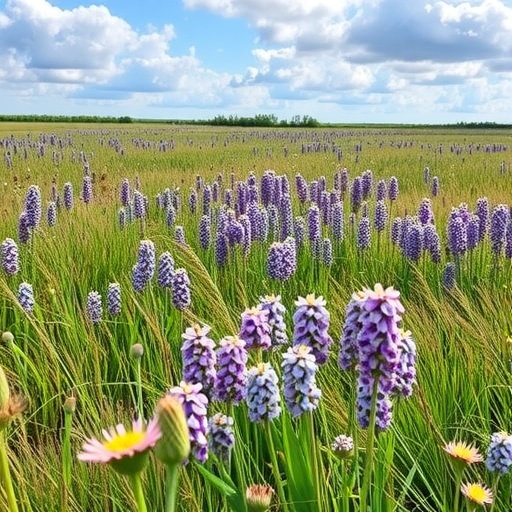
In a groundbreaking study recently published in Nature Communications, researchers have unveiled compelling evidence that crop fields play a significant and complementary role in enhancing biodiversity within permanent grassland ecosystems across Europe. This study, led by Florian A. Boetzl and colleagues, challenges prevailing assumptions that intensive agricultural landscapes invariably diminish ecological diversity, revealing a more nuanced interaction between cropland and natural habitats. The findings hold profound implications for biodiversity conservation strategies, agricultural policies, and landscape management across the continent.
Permanent grasslands have long been recognized as critical reservoirs of biodiversity, harboring diverse plant and animal communities adapted to relatively stable environmental conditions. Historically, conservation efforts have prioritized the protection and restoration of these grasslands, often viewing surrounding agricultural areas simply as threats due to their tendency for habitat fragmentation, pesticide use, and soil disturbance. Boetzl et al.’s work, however, suggests that the mosaic of land uses common in European landscapes, including crop fields, can be managed to support and even enhance native biodiversity, provided that the ecological interactions and spatial configurations are properly understood and leveraged.
The researchers conducted an extensive analysis across multiple European sites, integrating ecological data on species richness and community composition from permanent grasslands interspersed with adjacent crop fields. Utilizing state-of-the-art environmental DNA sampling, remote sensing technologies, and sophisticated landscape modeling, the team was able to capture comprehensive biodiversity metrics that encompass not only above-ground organisms but also subterranean microbial communities. This multi-dimensional approach allowed for an unprecedentedly detailed assessment of how biotic communities respond to the juxtaposition of cropland and grassland habitats.
Intriguingly, the study reveals that many taxonomic groups exhibited increased species richness and functional diversity in landscapes where crop fields adjoined permanent grasslands, compared to landscapes dominated solely by grasslands. This relationship was particularly pronounced for pollinators, soil invertebrates, and certain bird species. The presence of crop fields introduced heterogeneity in habitat structure and resource availability, creating microhabitats and ecological niches that were otherwise scarce or absent in uniform grassland environments. In practical terms, crop fields acted as supplementary habitats that supported the spillover of organisms into grasslands, thereby bolstering local biodiversity.
Central to these positive biodiversity outcomes is the temporal and spatial heterogeneity induced by cropping practices. Different crop types, varied planting and harvesting schedules, and associated management activities generate dynamic habitat mosaics that enhance landscape complexity. This complexity facilitates ecological processes such as dispersal, recolonization, and resource partitioning, which are vital for maintaining diverse biological communities. Boetzl and colleagues detail how strategic agricultural planning, including crop rotation and reduced chemical inputs, can amplify these beneficial effects, transforming farmlands into active components of conservation landscapes.
The implications of this research extend beyond academic circles, offering tangible pathways for reconciling agricultural productivity with biodiversity conservation in Europe’s highly modified landscapes. Policymakers are increasingly challenged to craft frameworks that balance food security with environmental sustainability. Findings from this study advocate for integrative land-use policies that recognize the complementary roles of crop fields and permanent grasslands, moving away from dichotomous perspectives that consider these land types in isolation. Such integrated approaches could be pivotal in meeting ambitious targets under frameworks like the EU Biodiversity Strategy for 2030.
Moreover, the study highlights the importance of scale in biodiversity assessments and management. While local conservation efforts remain indispensable, landscape-scale planning that accounts for the spatial configuration and connectivity between habitat patches—including both natural and agricultural lands—emerges as a critical determinant of ecological outcomes. This perspective aligns with emerging paradigms in landscape ecology and conservation biology, which emphasize the value of habitat networks and permeability in supporting resilient ecosystems.
On a methodological front, the research underscores advances in biodiversity monitoring facilitated by environmental DNA technology. This non-invasive sampling method enables the detection of a broad spectrum of taxa, from microbes to macrofauna, across diverse habitats. Combined with high-resolution remote sensing, these tools provide unprecedented opportunities for scientists and land managers to monitor ecosystem health, detect early signs of degradation or recovery, and refine management interventions accordingly.
However, the authors caution against uncritical extrapolation of these findings. The positive role of crop fields in complementing grassland biodiversity is contingent upon specific agricultural practices, crop types, and regional ecological contexts. For instance, monoculture systems with heavy pesticide use and soil degradation will likely undermine biodiversity, whereas diversified cropping systems with ecological considerations integrated into management regimes show promising potential. Consequently, adaptive management and site-specific assessments remain essential components of effective biodiversity conservation in agricultural landscapes.
The study also illuminates potential feedback loops between agricultural productivity and biodiversity conservation. Diverse biological communities contribute to ecosystem services such as pollination, pest control, and soil fertility, which in turn can enhance crop yields and sustainability. By fostering an agricultural matrix that supports these biodiversity-driven ecosystem services, farmers and society at large stand to benefit economically and ecologically.
Furthermore, the research prompts a reevaluation of traditional land classification schemes that segregate natural and agricultural ecosystems. The ecological interdependencies unveiled by Boetzl et al. demonstrate that crop fields, when managed with biodiversity in mind, are integral parts of multifunctional landscapes. This recognition could inspire novel landscape management frameworks that integrate ecological, agricultural, and socio-economic objectives more holistically.
In conclusion, this seminal work by Boetzl and colleagues marks a pivotal advancement in our understanding of how agricultural land use interacts with natural ecosystems to shape biodiversity patterns. By revealing that crop fields can act as valuable complements to permanent grasslands, the study offers a hopeful narrative amid global concerns about biodiversity loss and agricultural intensification. Leveraging these insights to inform policy and practice could pave the way for more sustainable and biodiverse European landscapes where food production and nature conservation coexist synergistically.
As Europe grapples with the dual challenges of feeding a growing population and preserving its rich natural heritage, scientific revelations such as these are critical. They provide empirical foundations for designing landscapes that are productive, resilient, and biodiverse—echoing a vision where human activity and natural systems are not adversaries but collaborators in pursuit of shared sustainability goals. Future research spurred by this study will likely explore the mechanistic underpinnings of these biodiversity benefits and expand the geographic scope to refine our understanding further.
This integrative approach represents an exciting frontier in environmental science and landscape management, illustrating the power of interdisciplinary research to address complex socio-ecological challenges. By embracing the multifaceted roles of crop fields, the conservation and agricultural communities are poised to unlock innovative strategies that foster coexistence, resilience, and thriving ecosystems across Europe’s diverse biomes.
Cite Scienmag News
Margaret Porter. (June 13, 2026). Crop Fields Enhance Biodiversity in European Grasslands. Scienmag. https://scienmag.com/crop-fields-enhance-biodiversity-in-european-grasslands/
Margaret Porter. "Crop Fields Enhance Biodiversity in European Grasslands." Scienmag, 13 June 2026, https://scienmag.com/crop-fields-enhance-biodiversity-in-european-grasslands/. Accessed 4 September 2026.
Margaret Porter. "Crop Fields Enhance Biodiversity in European Grasslands." Scienmag. June 13, 2026. https://scienmag.com/crop-fields-enhance-biodiversity-in-european-grasslands/


