


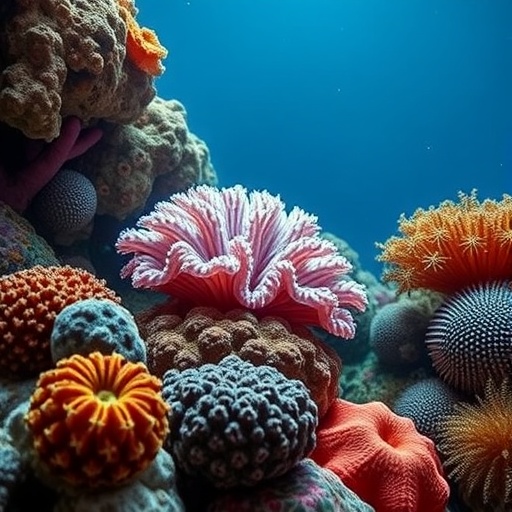
For the first time, scientists have mapped the intricate hormone cycles underlying coral reproduction, uncovering a rhythmic biological process that closely parallels those of vastly different animals, including humans. This groundbreaking three-year study tracked steroid hormones in Acropora eurystoma, a critical reef-building coral species native to the northern Red Sea’s Gulf of Aqaba. Published in iScience, the findings illuminate how internal hormonal signals govern coral reproductive timing—a revelation with significant implications for reef conservation amid escalating environmental stressors.
Coral spawning is an awe-inspiring natural event during which entire reef communities simultaneously release eggs and sperm into the ocean in a coordinated burst. This synchronization is vital for reproductive success and, ultimately, reef survival. However, until now, understanding has been limited mainly to external environmental cues, such as temperature and lunar cycles. The internal physiological mechanisms prompting corals to perfectly time this event remained largely enigmatic.
Led by PhD student Chen Azulay and Professor Maoz Fine from the Hebrew University and the Interuniversity Institute for Marine Sciences in Eilat, alongside Dr. Karine Kleinhaus from Stony Brook University, this pioneering study took a deep dive into coral endocrinology. By sampling coral colonies over multiple years, the research team constructed a first-ever timeline of steroid hormone fluctuations during gamete development, revealing an internally regulated reproductive rhythm that had gone unnoticed.
Contrary to longstanding hypotheses, estrogen—previously thought to peak immediately before spawning—actually surged months earlier during the initial phases of egg formation. This protracted estrogen peak suggests that corals prepare their gametes well in advance, tuning their reproductive physiology long before visible spawning occurs. Meanwhile, progesterone levels remained comparatively steady throughout the spawning season but notably increased several months post-spawning, hinting at a role in kickstarting the subsequent reproductive cycle.
Perhaps the most startling insight from the study was the identification of sunlight exposure, rather than water temperature, as the predominant environmental driver influencing hormone levels. Measurements revealed that variations in day length and ultraviolet radiation strongly correlated with estrogen fluctuations across all three years. This challenges the prevalent focus on rising sea temperatures as the primary reproductive cue and underscores the critical influence of solar cycles on coral biology.
Delving deeper within the coral colonies, researchers found that hormone distributions were remarkably uniform. However, the central zones of colonies exhibited a much higher concentration of developing eggs compared to their outer edges. This pattern indicates that localized factors—possibly chronological age of polyps, energy availability, or developmental stage—determine reproductive responsiveness to hormonal signals. Such spatial heterogeneity offers new perspectives on coral reproductive strategies and colony dynamics.
Recognizing that reproductive success underpins reef resilience, these findings present a powerful tool for conservationists. Hormone patterns mapped in this study could serve as early biomarkers of reproductive health, signaling stress or dysfunction ahead of visible spawning anomalies. As climate change and anthropogenic pressures increasingly threaten coral ecosystems worldwide, the ability to monitor subtle physiological cues offers a proactive avenue for intervention and management.
The researchers emphasize that understanding the internal hormonal language of corals complements existing knowledge of external spawning signals, providing a more comprehensive picture of coral reproductive ecology. This dual insight may pave the way for innovative monitoring techniques that detect reproductive disruptions well before catastrophic reef declines occur. Additionally, knowing that sunlight—not temperature—dominates hormonal regulation could redirect conservation focus toward managing factors that affect light penetration and quality in reef habitats.
Looking forward, the team plans to expand their research to include other coral species across diverse geographic regions. Confirming the presence of similar steroid hormone dynamics elsewhere could establish these cycles as universal features of coral reproduction. Such a breakthrough would not only deepen scientific understanding but also enable standardized hormonal monitoring protocols to assess reef health globally.
This study marks a crucial advance in coral biology, intertwining endocrinology, ecology, and environmental science to illuminate the hidden rhythms driving one of nature’s most spectacular reproductive phenomena. By revealing the temporal orchestration of hormones and their environmental determinants, the research opens new frontiers for safeguarding coral reefs—ecosystems fundamental to marine biodiversity and human livelihoods.
As reefs continue to face unprecedented threats from climate-driven bleaching, pollution, and overfishing, deciphering the subtleties of coral reproduction becomes ever more urgent. The elucidation of these hormonal mechanisms equips scientists and conservationists with vital knowledge to anticipate and mitigate reproductive failures, thereby enhancing efforts to preserve these fragile underwater cities for generations to come.
News Publication Date: 2-Jun-2026
Web References: http://dx.doi.org/10.1016/j.isci.2026.116205
Cite Scienmag News
Violet Maxwell. (June 8, 2026). Corals Possess a Hormonal Clock Strikingly Similar to Ours. Scienmag. https://scienmag.com/corals-possess-a-hormonal-clock-strikingly-similar-to-ours/
Violet Maxwell. "Corals Possess a Hormonal Clock Strikingly Similar to Ours." Scienmag, 8 June 2026, https://scienmag.com/corals-possess-a-hormonal-clock-strikingly-similar-to-ours/. Accessed 4 September 2026.
Violet Maxwell. "Corals Possess a Hormonal Clock Strikingly Similar to Ours." Scienmag. June 8, 2026. https://scienmag.com/corals-possess-a-hormonal-clock-strikingly-similar-to-ours/


