


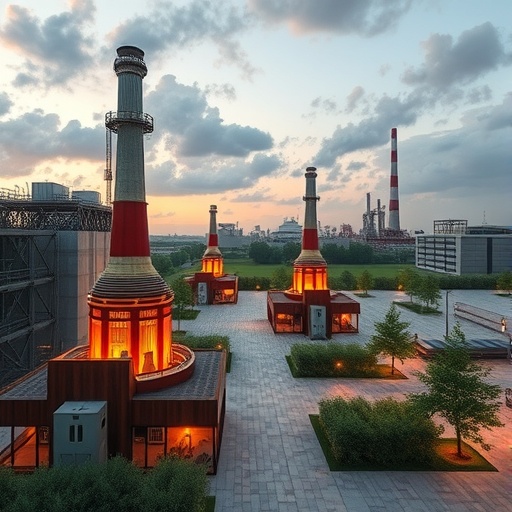
As urban environments continue to expand at an unprecedented pace, the challenge of harmonizing ecological sustainability with industrial development has become increasingly intricate. Researchers Z. Fang, Z. Huang, and C. Cheng, contributing to a groundbreaking study published in npj Urban Sustainability in 2026, have proposed an innovative framework that seeks to choreograph the delicate dance between ecological integrity and industrial growth. Their work introduces an adaptive spatial governance model, emphasizing dynamic, context-sensitive policymaking as a mechanism to achieve a sustainable urban-industrial synergy.
At the heart of this research lies the concept of “ecological-industrial synergy,” a term describing the optimized coexistence where natural ecosystems and industrial activities enhance rather than hinder each other. Traditionally, urban-industrial systems have been developed with little regard for their environmental cost, leading to severe degradation, resource depletion, and social disparities. The framework advanced by Fang and colleagues, however, advocates for a paradigm shift—one that perceives ecosystems and industrial zones not as adversaries but as potential collaborators within the urban fabric.
This innovative governance model capitalizes on the principles of adaptation and spatial analysis, leveraging cutting-edge geospatial technologies alongside ecological modeling. The authors argue that spatial governance—policies and strategies that regulate land use and development—must transcend static zoning plans. Instead, they propose an agile approach responsive to environmental feedback loops and changing industrial demands. This flexibility enables the recalibration of land-use priorities, balancing ecosystem services such as carbon sequestration, biodiversity, and water regulation with energy production, manufacturing, and logistics.
Technologically, the study details the deployment of high-resolution spatial datasets combined with machine learning algorithms to monitor and predict ecological and industrial patterns. By integrating remote sensing data with ground-based observations, the system constructs a real-time dynamic map of resource flows and environmental impacts. This sophisticated spatial intelligence then informs policymakers in managing land allocations and regulatory mechanisms that promote circular economies and minimize ecological footprints.
A pivotal element in the framework is stakeholder collaboration, encompassing government bodies, private corporations, local communities, and environmental organizations. The researchers highlight that adaptive governance flourishes only when diverse actors communicate effectively, sharing data, goals, and constraints. Mechanisms for collaborative decision-making include online platforms for knowledge exchange and simulation tools for scenario testing, which enable stakeholders to anticipate the ripple effects of proposed urban-industrial projects on ecosystems.
The study also underscores the importance of resilience, emphasizing that ecosystems and industrial infrastructures must withstand and recover from shocks such as climate extremes or economic upheavals. Adaptive spatial governance integrates resilience metrics, ensuring that urban configurations are robust and redundant enough to maintain essential functions under stress. This perspective challenges the traditional linear growth models by incorporating feedback from environmental monitoring into planning cycles, fostering systems that evolve harmoniously with both ecological and economic demands.
Among the methodological advances showcased is the use of agent-based modeling (ABM) to simulate interactions between industrial actors and ecological systems. ABM allows researchers to observe emergent behaviors resulting from individual and collective decisions, thereby revealing pathways towards synergy or conflict. Such simulations facilitate understanding how minor policy tweaks or technological innovations in one sector may cascade into broad systemic effects, enabling proactive interventions that embed sustainability into industrial development trajectories.
The researchers further illustrate their framework’s practical applications through case studies in rapidly urbanizing regions, where ecological degradation and industrial expansion frequently collide. These cases demonstrate that adaptive spatial governance supports multifunctional landscapes—a concept wherein single geographic parcels serve overlapping purposes, such as habitat conservation alongside manufacturing hubs, achieved through innovative design and management. Multifunctionality not only boosts land-use efficiency but also strengthens urban biodiversity and social well-being.
Economic considerations also occupy a central role in the proposed governance model. By aligning environmental regulations with economic incentives such as green financing, tax breaks for sustainable technologies, and pollution credit trading, the system encourages industries to invest in clean technologies and circular processes. The research highlights how integrating ecological costs into economic decision-making reshapes industrial behaviors and promotes long-term sustainability over short-term gains.
Critically, the authors confront the political complexities inherent in spatial governance, noting that power asymmetries can hinder equitable and effective policy implementation. Adaptive spatial governance must therefore include measures that enhance transparency, accountability, and inclusive participation, preventing domination by special interest groups and ensuring that marginalized communities benefit from sustainability initiatives. The framework advocates institutional reforms that open governance channels and facilitate co-creation of urban futures.
Importantly, the study’s foresight stretches beyond current urban-industrial paradigms, envisioning a future where spatial governance is augmented by emerging technologies such as Internet of Things (IoT) sensors, blockchain for transparent resource tracking, and artificial intelligence-driven predictive analytics. Such technological integration amplifies the framework’s capability to react promptly and precisely to spatial dynamics and stakeholder inputs, fostering continuous improvement of urban sustainability.
The significance of Fang et al.’s work is amplified in light of urgent global challenges like climate change, biodiversity loss, and resource scarcity. Their adaptive spatial governance framework offers a replicable blueprint for cities globally, potentially guiding transformation toward low-carbon, resilient, and inclusive urban-industrial ecosystems. This approach represents a departure from fragmented policy-making, aligning ecological health directly with industrial vitality.
Moreover, by promoting ecological-industrial synergy, the framework encourages a holistic understanding where industry does not merely coexist with the environment but participates actively in ecosystem stewardship. This reframing sparks innovative imaginaries about how cities might be designed and managed, merging technical sophistication with social responsibility, and delivering prosperity without ecological sacrifice.
The research also opens new avenues for academic inquiry and interdisciplinary collaboration. Integrating fields such as ecology, urban planning, economics, political science, and computer science, the adaptive spatial governance framework exemplifies systemic thinking necessary for addressing complex urban sustainability challenges. It invites further refinement of tools and policies to ensure its efficacy and scalability.
As urban populations swell and industrial activities intensify, the imperative to choreograph an ecological-industrial symphony grows stronger. The adaptive spatial governance framework articulated by Fang, Huang, Cheng, and their colleagues sets a visionary yet practical stage for orchestrating this balance. In doing so, it charts a pioneering path toward urban futures that are not only sustainable but also vibrant, resilient, and equitable.
Cite Scienmag News
Courtney Benton. (June 8, 2026). Designing Adaptive Spaces for Eco-Industrial Synergy. Scienmag. https://scienmag.com/designing-adaptive-spaces-for-eco-industrial-synergy/
Courtney Benton. "Designing Adaptive Spaces for Eco-Industrial Synergy." Scienmag, 8 June 2026, https://scienmag.com/designing-adaptive-spaces-for-eco-industrial-synergy/. Accessed 4 September 2026.
Courtney Benton. "Designing Adaptive Spaces for Eco-Industrial Synergy." Scienmag. June 8, 2026. https://scienmag.com/designing-adaptive-spaces-for-eco-industrial-synergy/


