


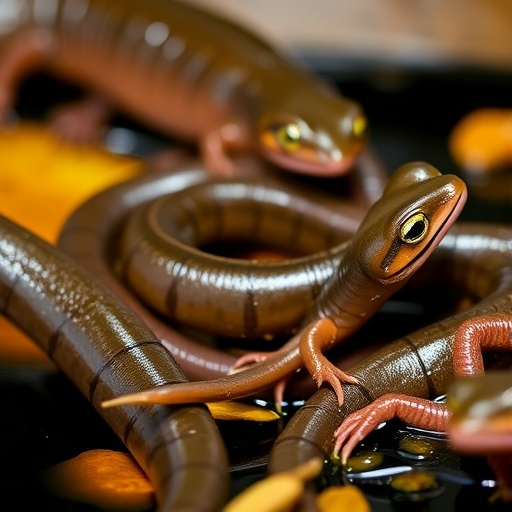
In a finding that underscores how little we still know about the vulnerabilities of the world’s most threatened vertebrate class, researchers at Simon Fraser University have shown that even trace amounts of copper in freshwater can be devastating to Northwestern salamander larvae—and that water chemistry can shift the danger by more than a factor of forty. The study, published in the Archives of Environmental Contamination and Toxicology, provides some of the first rigorous toxicity data for a caudate amphibian, a group conspicuously absent from most ecological risk assessments.
Copper is a paradoxical pollutant. It is an essential micronutrient for nearly every living organism, playing indispensable roles in mitochondrial respiration, enzyme function, and oxygen transport. Yet beyond narrow homeostatic limits it becomes a potent toxicant, capable of disrupting ion regulation, generating oxidative stress, and damaging gill and epithelial tissues in aquatic animals. As global demand for copper surges—driven by electrification, renewable energy infrastructure, and the expansion of mining operations—copper is increasingly entering rivers, lakes, and wetlands through stormwater runoff, industrial effluent, and leaching from vehicles and infrastructure. For amphibians, whose permeable eggs and aquatic larvae make them exquisitely sensitive to waterborne contaminants, this rising background exposure represents a mounting threat layered on top of the habitat loss, disease, and climate change already driving population declines worldwide.
Lead author Blake E. G. Danis and colleagues, including Vicki L. Marlatt, set out to close a striking data gap. While frogs and toads—the anuran amphibians—have featured in hundreds of copper toxicity studies, salamanders and newts, the caudates, have been almost entirely overlooked. Regulatory frameworks that set water quality guidelines for protecting freshwater life rely heavily on toxicity databases dominated by fish, invertebrates, and a handful of anuran species. If salamanders respond to copper differently than these better-studied organisms, current guidelines may leave them unprotected. The Northwestern salamander, a large, pond-breeding species native to the Pacific Northwest, offered an ideal candidate for testing that concern.
The team’s experimental design was elegantly dual-pronged. First, they conducted acute exposure trials, in which salamander larvae were subjected to a range of copper concentrations over a short period to determine the lethal concentration for fifty percent of the population, the LC50. Crucially, they ran these trials under two contrasting water hardness regimes: soft water, which mimics the ion-poor streams and ponds typical of the coastal Pacific Northwest, and moderately hard water, which contains higher concentrations of dissolved calcium and magnesium. Water hardness matters profoundly in metal toxicology. Calcium and magnesium ions compete with dissolved copper for binding sites on the gills and other epithelial surfaces, effectively buffering organisms against copper uptake. The biotic ligand model, a widely used framework in regulatory toxicology, formalizes this interaction by predicting that softer waters—where those protective ions are scarce—amplify metal bioavailability and toxicity.
The results bore this out dramatically. In moderately hard water, the acute LC50 for Northwestern salamander larvae was 1,383 micrograms of copper per liter—a concentration well above levels typically encountered even in polluted systems. But in soft water, the LC50 plummeted to just 33.16 micrograms per liter, a more than fortyfold reduction in tolerance. That figure is alarming when placed in environmental context. In British Columbia, where the study species lives, provincial water quality guidelines for copper are formulated to account for site-specific hardness precisely because soft-water systems demand far stricter limits. The new data suggest the salamander is among the more copper-sensitive amphibians tested to date, reinforcing the argument that species-specific toxicity data, rather than extrapolation from fish or frogs, must underpin protective standards.
The second phase of the study probed the subtler, longer-term consequences of copper exposure. In subchronic trials lasting thirty-five days, larvae were reared in copper concentrations spanning environmentally relevant ranges. The outcomes were sobering even at low doses: survival declined, growth was inhibited, and development was delayed. The thirty-five-day LC50 came in at 28.97 micrograms per liter—strikingly close to the soft-water acute value, meaning that copper concentrations capable of killing half of exposed larvae over a short window in soft water were equally lethal over a longer exposure. Delayed development carries cascading consequences for amphibians. Larvae that linger longer in ponds face prolonged exposure to predators and drying habitat, and size at metamorphosis is tightly linked to terrestrial survival and future reproductive success. An animal that emerges smaller and later is, in effect, paying a life-long tax for the contamination it experienced as a juvenile.
To understand the molecular machinery behind these effects, the researchers measured gene expression in exposed larvae, focusing on a panel of markers spanning metal detoxification and endocrine function. The standout signal came from metallothionein 1, a gene encoding a small, cysteine-rich protein that binds copper, zinc, and cadmium ions, sequestering them and limiting cellular damage. Metallothioneins are the canonical first responders of vertebrate metal defense, and their dramatic upregulation in copper-exposed salamander larvae confirms that this ancient detoxification pathway operates in caudates just as it does in fish and frogs. The finding validates metallothionein as a biomarker—a measurable molecular fingerprint of metal exposure that can be deployed in environmental monitoring programs, even before mortality or growth effects become visible.
Just as telling were the genes that did not respond. The researchers examined thyroid hormone receptor genes, thra and thrb, along with an estrogen receptor gene, esr1α, and a deiodinase gene, dio1—components of the endocrine systems that orchestrate amphibian metamorphosis. Thyroid hormones drive the wholesale transformation from aquatic larva to terrestrial juvenile, and previous studies in anurans such as the Chinese toad have linked chronic copper exposure to disrupted thyroid signaling and inhibited metamorphosis. Yet in the Northwestern salamander, expression of these endocrine genes remained unchanged even as development slowed. This disconnect is scientifically fascinating and practically important. It suggests that copper may retard salamander development through mechanisms independent of thyroid hormone signaling—or that the endpoints measured capture only part of a more complex endocrine picture. Either way, it cautions against assuming that toxicological mechanisms documented in frogs translate neatly to their tailed relatives.
That species-specificity emerged as the study’s central theme. Comparing the new salamander data against the extensive literature on anurans revealed both similarities and divergences in copper sensitivity across the amphibian tree. Some frog species tolerate orders of magnitude more copper; others falter at comparable concentrations. Population history appears to matter as well, with larvae from metal-contaminated sites sometimes displaying enhanced tolerance, suggesting local adaptation. For regulators, this heterogeneity is a warning: a water quality guideline calibrated to protect the average amphibian may protect no particular amphibian at all. For conservation biologists, it highlights the peril faced by salamanders breeding in soft-water, glacially fed systems of the Pacific Northwest, where the natural chemistry that defines their habitat also strips away their principal chemical defense against dissolved metals.
The research carries broader resonance at a moment when amphibians are in crisis. A landmark 2023 assessment in Nature documented ongoing declines across the world’s amphibian fauna, with disease, habitat loss, and agriculture implicated as leading drivers—but contaminants remain a persistent, underappreciated pressure. Copper exposures rarely produce the dramatic die-offs that make headlines. Instead, they act insidiously, shrinking tadpole and larval cohorts, slowing growth, and quietly eroding population resilience. Because salamander larvae are also prey for fish, birds, and other predators, contaminants that weaken them ripple through wetland food webs.
What makes this study especially valuable is its demonstration of how environmental context modulates toxicity. The same copper concentration that is benign in a hard-water prairie pond can be lethal in a soft-water mountain stream. Modern regulatory science increasingly embraces this realism through hardness-based and biotic ligand approaches, but those models are only as good as the species data feeding them. By supplying acute LC50 values, a subchronic LC50, growth and developmental endpoints, and molecular biomarker responses for a representative caudate, the Simon Fraser team has added a genuinely new data point to a sparse table. Their work gives water quality regulators in Canada and beyond a salamander-specific benchmark, gives ecotoxicologists a confirmed biomarker for field monitoring, and gives conservationists one more piece of evidence that protecting amphibians requires understanding them species by species, stream by stream. As copper mining and electrification accelerate worldwide, the quiet chemistry of soft-water ponds may become an increasingly consequential frontier in the fight against the global amphibian decline.
Cite Scienmag News
Sloane Callahan. (September 8, 2026). Copper Exposure Effects on Northwestern Salamander Assessed. Scienmag. https://scienmag.com/copper-exposure-effects-on-northwestern-salamander-assessed/
Sloane Callahan. "Copper Exposure Effects on Northwestern Salamander Assessed." Scienmag, 8 September 2026, https://scienmag.com/copper-exposure-effects-on-northwestern-salamander-assessed/. Accessed 8 September 2026.
Sloane Callahan. "Copper Exposure Effects on Northwestern Salamander Assessed." Scienmag. September 8, 2026. https://scienmag.com/copper-exposure-effects-on-northwestern-salamander-assessed/


