
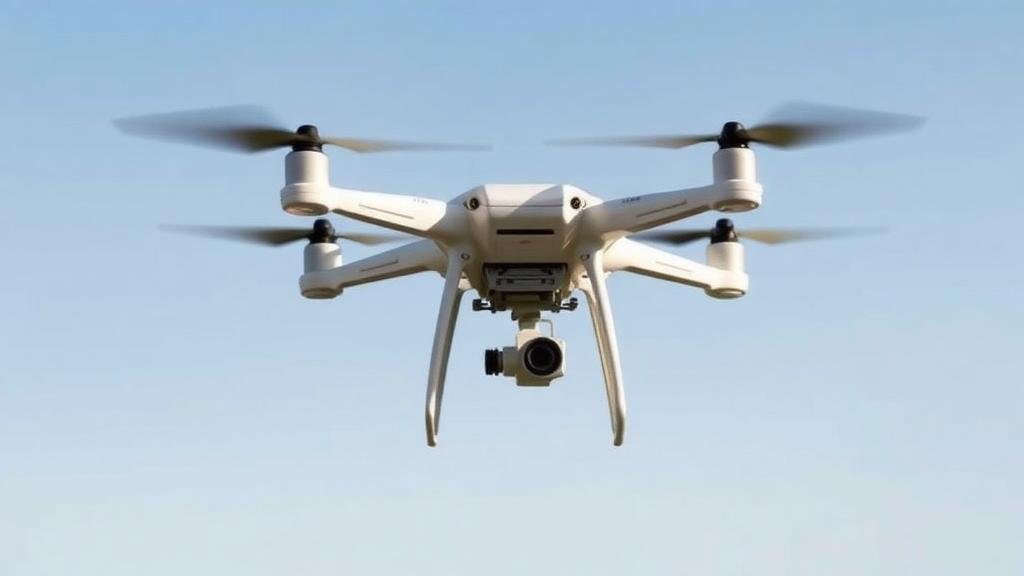
A team of researchers has unveiled a framework that lets a small swarm of unmanned aerial vehicles work together to shield a moving target from radar detection, coupling high-precision direction finding with a physics-aware scheme for dividing jamming power among the drones. The study, published as an open-access original article in Autonomous Intelligent Systems on 12 May 2026, reports that in Python-based numerical simulations the combined approach delivered interference suppression gains of roughly 3 to 5 decibels in the jamming-to-signal ratio compared with conventional allocation strategies, along with a markedly higher probability of suppressing the radar’s detection function.
The work addresses a persistent shortcoming in electronic warfare research: most existing methods for coordinating multiple jammers treat target localization and jamming power distribution as separate problems to be solved one after the other, without a tight, real-time feedback loop between them. According to the authors, that decoupled design, combined with high computational complexity and discrete execution modes, limits effectiveness in complex electromagnetic environments where geometry between drones, target and radar changes continuously. Their answer is a closed-loop system in which sensing directly drives power decisions within each operating cycle.
The sensing half of the framework rests on the MUSIC algorithm, short for Multiple Signal Classification, a classic high-resolution technique for estimating the direction from which a signal arrives. Each jammer drone carries a multi-channel receiver array. The system computes a covariance matrix from the received signals, separates the noise subspace through eigenvalue decomposition, constructs a spatial spectrum over the angular field, and detects its peaks to yield estimates of the radar’s azimuth angles. With two drones observing the same radar from different positions, two angles are obtained, and simple triangular geometry, using the law of sines and the law of cosines, converts those angles plus the known baseline distance between the drones into the distances from each jammer to the radar and from the protected target to the radar.
Those distances then feed the second half of the framework, a path loss-aware weighted allocation algorithm the authors call PLW. Its guiding principle is physically intuitive: electromagnetic waves attenuate as they propagate, and the radar equation shows that jamming power arriving at the radar falls off with the square of the jammer-to-radar distance, while the target echo suffers a round-trip loss proportional to the fourth power of the target-to-radar distance. The PLW algorithm therefore assigns each jammer a weight based on its distance ratio relative to the radar, so the drone closer to the radar receives proportionally more transmit power, where each watt of jamming does the most damage. The scheme explicitly incorporates a path loss term, adaptable to a free-space exponent of two or harsher urban exponents of three or four, and enforces minimum power constraints so that no jammer is starved into ineffectiveness.
The overall optimization maximizes an objective derived from the interference suppression coefficient, the ratio of jamming power to target echo power at the radar receiver, subject to five constraints. Total swarm power cannot exceed a system budget; each jammer’s power lies between hardware-defined limits; the estimated azimuth angles must define a valid triangular geometry; the inter-jammer spacing must stay within a deployment range set in the simulations at 200 to 600 meters; and each jammer receives a minimum allocation scaled to its relative path loss. The authors describe the total power cap as a tactical choice balancing jamming effectiveness against the swarm’s electromagnetic signature and finite energy.
Coordination is orchestrated by a time-cycle-driven mechanism. Each 100-millisecond cycle begins with the positioning stage, followed by a 5-millisecond guard interval, after which the power allocation stage runs on the freshly computed geometry. Dual-buffer atomic swapping at the end of each cycle hands positioning results to the jamming decision stage without read-write conflicts, forming what the authors characterize as a real-time closed-loop control system. They acknowledge a deliberate trade-off: the 100-millisecond cycle is substantially faster than significant geometric change in typical engagement scenarios, but extreme kinematics or larger swarms would exacerbate latency effects, motivating future integration of predictive state estimation.
The simulation campaign compared PLW against two benchmark allocation strategies drawn from the literature: a greedy algorithm that preferentially allocates power to the nearest or most immediately effective jammer, and an auction mechanism that models allocation as a market where jammers bid for power resources according to their path loss conditions. Across the full tested range of inter-jammer spacings from 200 to 600 meters, the proposed algorithm maintained a higher interference suppression coefficient and a higher radar suppression probability than both baselines, with the performance margin growing more pronounced at larger distances where signal attenuation is more severe. The authors report approximately 10 percent higher interference suppression efficiency relative to the other allocation algorithms and an additional 3 percent gain compared with other dynamic allocation approaches.
The simulations also probed the framework’s limits, and the authors are candid about them. When the number of jammers increased, suppression probability declined, a result the team attributes to power fragmentation under a fixed total power budget and to degradation of the swarm’s collective geometry, which raises average path loss in ways the current allocation strategy cannot compensate. Similarly, as the path loss exponent increased, modeling more severe attenuation in urban-like scenes with an exponent of four, suppression probability fell significantly, because the algorithm cannot fully offset exponential signal decay. These findings, the authors note, indicate that future scalability will require joint power and trajectory optimization to actively create favorable spatial configurations rather than merely reacting to existing ones.
Scalability of the coordination architecture itself is another acknowledged constraint. The centralized mechanism proposed in the work is effective for small to medium-scale swarms, but the authors state that scaling to larger swarms may be limited by communication overhead, computational load, time synchronization demands and the need for a reliable control link, which could become a bottleneck in contested environments. They flag decentralized or hierarchical optimization strategies as a priority for future work. Within its tested scope, however, the framework supports any number of jammers of two or more through normalized geometric weighting, and the authors argue that multiple jammers provide wider angular coverage and greater jamming flexibility than traditional single-jammer architectures.
It is important to note that all reported performance figures come from numerical simulations with specified parameter settings, not from hardware demonstrations or field trials; the code is withheld for confidentiality reasons, though the dataset is described as publicly available. Even so, the study’s contribution lies in demonstrating, within a physically grounded model, how tightly binding real-time geometric perception to path-loss-aware resource decisions can outperform strategies that sense and allocate in isolation. By letting MUSIC-derived angles and triangulated distances flow directly into power weights that respect the physics of radar propagation, the framework offers what the authors describe as a scalable pathway for real-time target protection in contested spectral environments, and a concrete baseline against which future decentralized multi-UAV jamming schemes can be measured.
Subject of Research: Multi-UAV cooperative radar localization and jamming power allocation
Article Title: Multi-UAV cooperative MUSIC localization and PLW power allocation for radar jamming
Article References: Zhou, J., Fang, W., Ma, T., Yi, P., Gong, W., & Liu, Q. (2026). Multi-UAV cooperative MUSIC localization and PLW power allocation for radar jamming. Autonomous Intelligent Systems, 6(1), Article 10. https://doi.org/10.1007/s43684-026-00134-3
Image Credits: AI Generated
DOI: 10.1007/s43684-026-00134-3
Keywords: UAV swarms, MUSIC algorithm, direction of arrival estimation, radar jamming, power allocation, path loss, electronic warfare, closed-loop control, interference suppression, numerical simulation, target protection, autonomous systems
Cite Scienmag News
Denise Maddox. (October 29, 2026). Coordinated Drone Jammers Use MUSIC Localization to Blind Radars in Simulation. Scienmag. https://scienmag.com/coordinated-drone-jammers-use-music-localization-to-blind-radars-in-simulation/
Denise Maddox. "Coordinated Drone Jammers Use MUSIC Localization to Blind Radars in Simulation." Scienmag, 29 October 2026, https://scienmag.com/coordinated-drone-jammers-use-music-localization-to-blind-radars-in-simulation/. Accessed 2 November 2026.
Denise Maddox. "Coordinated Drone Jammers Use MUSIC Localization to Blind Radars in Simulation." Scienmag. October 29, 2026. https://scienmag.com/coordinated-drone-jammers-use-music-localization-to-blind-radars-in-simulation/