


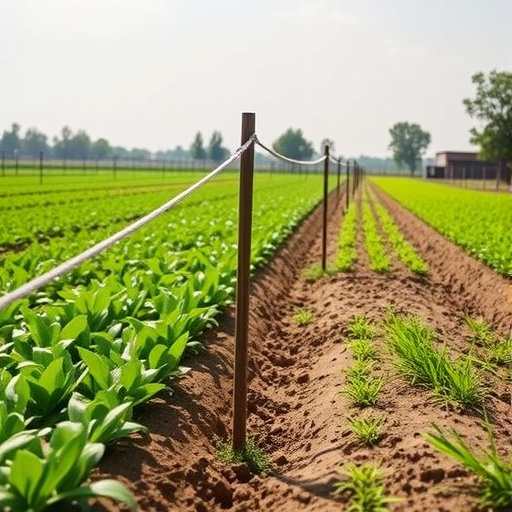
In the face of mounting climate change challenges, the agricultural landscape across the globe is rapidly evolving, with communities experimenting with various irrigation models to maintain productivity and sustainability. A recent study by Fiaz and colleagues delves into the intricacies of irrigation management, comparing community-managed and government-managed irrigation systems in Punjab, Pakistan. Their research positions itself as a significant contribution to understanding the resilience of these systems under the stress of climate shocks, offering crucial insights that could potentially inform policy decisions and agricultural practices.
Climate change is no longer a theoretical concern but a pressing reality that impacts weather patterns, water availability, and crop yields. In regions like Punjab, where agriculture is the backbone of the economy, the way water resources are managed can determine food security and livelihoods. Community-managed irrigation systems have emerged as a compelling alternative to traditional government-controlled models, raising questions about their effectiveness in mitigating climate-related risks. The objective of the study was to evaluate these two divergent approaches to irrigation management in light of recent environmental changes.
The research conducted by Fiaz et al. employs a robust methodology, drawing upon extensive field data, interviews, and statistical analysis. By concentrating on key metrics such as water efficiency, crop diversity, and resilience against droughts, the authors paint a comprehensive picture of how each system performs when confronted with adverse weather conditions. The significance of their findings transcends local contexts and resonates with broader global trends in agricultural adaptation and resilience.
Community-managed irrigation systems are characterized by local participation and decision-making, often reflecting the unique needs and knowledge of the surrounding communities. These systems leverage indigenous practices, local expertise, and community engagement, thereby promoting a sense of ownership among farmers. Fiaz and colleagues document numerous advantages associated with this model, including the flexibility to adapt quickly to environmental changes and the ability to incorporate local ecological knowledge into irrigation practices.
In contrast, government-managed systems can often be bureaucratic and rigid, potentially leading to inefficiencies and disconnection from local realities. Many farmers in Punjab have reported dissatisfaction with the maintenance of government irrigation infrastructure, which can fail to meet their needs during critical periods of drought or flooding. The research highlights incidents where government systems, despite their scale, have struggled to provide adequate water during times of stress, leading to crop failures and economic hardship for farmers.
The authors further segment their analysis by considering the ecological impacts of both irrigation systems. Community-managed systems frequently exhibit a lower environmental footprint, as they prioritize sustainable practices and conservation over sheer productivity. This approach not only supports agricultural resilience but also promotes biodiversity within the region—an essential factor as ecosystems face unprecedented challenges from habitat loss and climate change.
In a groundbreaking finding, the study reveals that community-led irrigation systems demonstrate greater overall robustness when confronted with climate shocks. Farmers utilizing these models reported higher yields in the face of drought conditions, underscoring the effectiveness of local management and innovation. The adaptability of community-managed systems enables farmers to experiment with crop varieties and irrigation techniques that best suit the changing climate, a luxury that many government-managed systems cannot afford.
However, the research does not shy away from discussing the challenges associated with community-managed systems. Issues such as coordination among farmers, resource allocation, and initial setup costs can pose significant hurdles to sustainability. While these systems demonstrate resilience, there is a need for supporting frameworks that can facilitate knowledge sharing and resource distribution among community members. Fiaz and colleagues suggest that effective support from both governmental and non-governmental organizations can empower communities to overcome these challenges and optimize their irrigation systems.
The implications of this study extend beyond Punjab, offering lessons for other regions grappling with similar issues. With many developing countries facing a heightened risk of climate-induced agricultural productivity loss, understanding the effectiveness of different irrigation management approaches is crucial. Fiaz et al. call for a paradigm shift in how policymakers view irrigation management, advocating for increased investment in community-managed systems as a solution for enhancing resilience and sustainability.
As the world continues to grapple with the ramifications of climate change, the need for innovative agricultural practices has never been more urgent. The findings from this research provide a springboard for further discussions around climate resilience in agriculture, highlighting the vital role that community involvement plays in ensuring food security amidst environmental volatility. The authors propose that future studies should further explore the intersection of local knowledge, technology, and governance to develop holistic models that support sustainable agricultural practices worldwide.
In light of these insights, hopes are pinned not only on the resilience of farming communities but also on the willingness of institutions to adapt to evolving realities. A concerted effort from governments, research institutions, and local communities can catalyze a transformation in irrigation management, ultimately leading to better outcomes for farmers and the environment alike. Harnessing the power of local knowledge and ensuring equitable access to resources presents an opportunity to redefine how societies approach agricultural irrigation, moving towards a future that is both sustainable and resilient.
In summary, Fiaz and colleagues have highlighted a vital narrative that underscores the strengths and weaknesses of both community-managed and government-managed irrigation systems. Their work presents a clarion call for rethinking agricultural resilience in the face of climate shocks and emphasizes the critical importance of community engagement in managing water resources effectively. The conversation around irrigation management continues to evolve, and studies like this pave the way for innovative approaches to agricultural challenges that are anticipated to grow in complexity.
The future of agriculture depends on our ability to adapt to changing conditions and leverage local knowledge. Fiaz et al.’s evaluation stands as a testament to the potential benefits of community-managed systems, illuminating pathways for researchers and policymakers alike to foster agricultural systems that thrive even under pressure.
Fiaz, K., Irfan, M., Yaseen, M. et al. Evaluating the robustness of community-managed irrigation systems compared to government-managed systems under climate shocks in Punjab, Pakistan.
Discov Sustain (2026). https://doi.org/10.1007/s43621-026-02622-1
Cite Scienmag News
Sloane Callahan. (January 27, 2026). Comparing Resilience: Community vs. Government Irrigation Systems. Scienmag. https://scienmag.com/comparing-resilience-community-vs-government-irrigation-systems/
Sloane Callahan. "Comparing Resilience: Community vs. Government Irrigation Systems." Scienmag, 27 January 2026, https://scienmag.com/comparing-resilience-community-vs-government-irrigation-systems/. Accessed 4 September 2026.
Sloane Callahan. "Comparing Resilience: Community vs. Government Irrigation Systems." Scienmag. January 27, 2026. https://scienmag.com/comparing-resilience-community-vs-government-irrigation-systems/


