


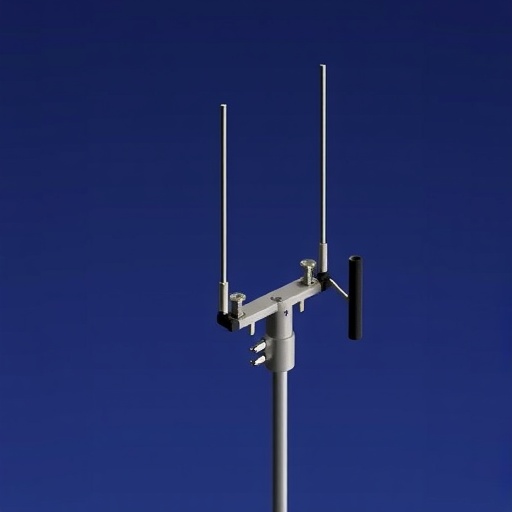
In a groundbreaking advancement poised to significantly impact the fields of wireless communication and radar systems, researchers Tran-Huy, Nguyen-Thi, Nguyen-Manh, and colleagues have unveiled a novel antenna design that combines compactness, dual-band functionality, and dual-circular polarization within a single-layer structure. Published recently in Scientific Reports, this innovative antenna architecture leverages proximity-coupling feed patches to achieve performance metrics traditionally challenging to reach simultaneously in an integrated form factor. This breakthrough holds promise for a new generation of communication devices that require efficient, multi-frequency, and polarization-diverse antennas without the bulk and complexity of multilayer designs.
The evolution of antenna technology has long been driven by the demand for devices that are smaller, more efficient, and capable of handling multiple frequency bands with varied polarization schemes. Circular polarization, in particular, is critical in mitigating multipath interference and polarization mismatch, thereby enhancing signal reliability in mobile and satellite communications. The dual-circular polarization capability is especially valuable, enabling antennas to transmit and receive right-hand circular polarization (RHCP) and left-hand circular polarization (LHCP) signals concurrently. However, achieving this feature in a compact, low-profile form factor is notoriously difficult, especially when designers aim for dual-band operation, which caters to different frequency ranges for diverse applications.
The innovative concept introduced by this research centers on proximity-coupling feed patches integrated into a single-layer antenna substrate. Rather than adopting the conventional multi-layer stacked structures or complex feeding networks commonly used to realize dual polarization and dual-band functionalities, this design employs closely placed feeding patches that interact electromagnetically in precise configurations. This proximity coupling allows energy transfer and manipulation of current paths to excite orthogonal modes necessary for circular polarization, while simultaneously isolating frequency bands to maintain dual-band performance. The meticulous engineering of these feed patches is key to harmonizing the antenna’s radiative properties with its compact physical dimensions.
One of the most impressive technical achievements described by the authors is the antenna’s ability to maintain excellent impedance matching across both frequency bands. Roughly speaking, impedance matching maximizes power transfer and minimizes signal reflection, which are crucial for maintaining high efficiency in real-world applications. Typically, when multiple bands and polarizations are integrated, the impedance bandwidths narrow considerably, which limits practical usability. In this work, through precise geometrical tuning of the feed patches and substrate material selection, the authors have achieved a balanced performance profile that ensures reliable operation over dual frequency ranges.
To quantitatively assess the antenna’s circular polarization, the research presents detailed analyses of axial ratio bandwidths within both bands. The axial ratio is a key indicator of the quality of circular polarization, where lower values close to unity represent near-perfect circular polarization. Impressively, the antenna exhibits a sufficiently broad axial ratio bandwidth in both frequency ranges, indicating stable dual-hand polarization performance. This finding is especially remarkable considering the antenna’s minimalist single-layer design, highlighting the effectiveness of proximity coupling in supporting complex electromagnetic modes.
Beyond polarization characteristics and impedance matching, the antenna demonstrates strong radiation efficiency and gain values that rival those of more complex multi-layer antennas. These parameters reflect how effectively the antenna converts input power into usable radio waves and the directionality of its radiation pattern. The balance struck between compact physical size and high performance underscores the potential for this design to replace bulkier, multi-layer alternatives in a variety of technological domains, including mobile base stations, satellite receivers, and emerging Internet-of-Things (IoT) devices where space and power consumption are constrained.
Another noteworthy technical detail involves the antenna’s fabrication. Employing standard printed circuit board (PCB) manufacturing techniques, the antenna can be realized at relatively low cost and with high reproducibility. Single-layer antennas are inherently advantageous in mass production contexts because they simplify assembly and reduce the likelihood of fabrication defects associated with layer misalignment. This practical consideration significantly boosts the real-world viability of the design, accelerating the pathway from laboratory prototype to commercial deployment.
Simulations and experimental validations presented in the study corroborate the antenna’s performance claims. The team used full-wave electromagnetic simulation software to model the antenna’s behavior under various operating conditions and validated these models through physical prototyping and measurement. The close agreement between numerical and experimental results adds robustness to their findings, offering confidence that the design principles can be reliably reproduced and adapted for new applications and frequency bands as needed.
Importantly, the study highlights the flexibility of the proximity-coupling methodology as a generalizable framework for antenna development. By adjusting parameters such as patch size, spacing, and feed point locations, designers can tailor the antenna to different frequency bands and polarization requirements. This adaptability is vital in the modern wireless landscape, where frequency allocations and communication standards continue to evolve rapidly, necessitating antenna technology that can pivot accordingly.
Furthermore, the ability to support dual-circular polarization in a compact form opens doors in polarization diversity schemes, which enhance communication link robustness by exploiting variations in polarization channels to reduce fading and interference. This is particularly valuable in cluttered urban environments and for satellite-to-ground links, where signals can undergo unpredictable polarization changes due to reflections and atmospheric conditions.
One futuristic implication of this work is its potential integration within phased array systems, where densely packed antenna elements must maintain isolation, consistent polarization, and high efficiency. The simplified architecture of the single-layer dual-band dual-circularly polarized antenna could streamline phased array design, enabling enhanced beamforming capabilities for 5G and beyond wireless networks, as well as radar and sensing applications with high spatial resolution demands.
Moreover, the environmentally frugal design aligns well with the growing emphasis on sustainable electronics. By minimizing materials, fabrication complexity, and power losses typically associated with complex multi-layer structures, the antenna reduces the ecological footprint of manufacturing and operating new wireless hardware. This consideration is increasingly significant as global demand surges for wireless connectivity and sensing technologies, coupled with the imperative to address environmental impact.
In essence, this research by Tran-Huy et al. represents a compelling confluence of theoretical innovation, practical engineering, and forward-thinking application. The capacity to deliver dual-band, dual-circular polarization within a single-layer compact form factor is a milestone achievement that challenges conventional design paradigms. As wireless technology ecosystems expand and diversify, antennas that embody such versatility and efficiency will form the backbone of next-generation communication infrastructures.
Ultimately, the insights drawn from this study set a precedent for future work in antenna research, encouraging exploration of proximity-coupling mechanisms and simple layered structures to unlock complex wave manipulation capabilities. This paradigm shift could inspire new material choices, feeding strategies, and novel antenna topologies that further compress size, weight, and cost without compromising performance. The impact on consumer electronics, aerospace, defense, public safety, and IoT sectors could be transformative as hardware designers leverage these principles to meet escalating demands for bandwidth, reliability, and polarization agility.
This remarkable engineering feat not only addresses pressing technical challenges but also exemplifies how subtle electromagnetic interactions, when harnessed creatively, can revolutionize established technology spaces. With its robust experimental validation and clear design methodology, the single-layer compact dual-band dual-circularly polarized antenna stands out as a technological beacon charting the path toward smarter and more adaptable wireless communication solutions worldwide.
Cite Scienmag News
Denise Maddox. (May 22, 2026). Compact Dual-Band Dual-Polarized Antenna with Proximity Coupling. Scienmag. https://scienmag.com/compact-dual-band-dual-polarized-antenna-with-proximity-coupling/
Denise Maddox. "Compact Dual-Band Dual-Polarized Antenna with Proximity Coupling." Scienmag, 22 May 2026, https://scienmag.com/compact-dual-band-dual-polarized-antenna-with-proximity-coupling/. Accessed 4 September 2026.
Denise Maddox. "Compact Dual-Band Dual-Polarized Antenna with Proximity Coupling." Scienmag. May 22, 2026. https://scienmag.com/compact-dual-band-dual-polarized-antenna-with-proximity-coupling/


