


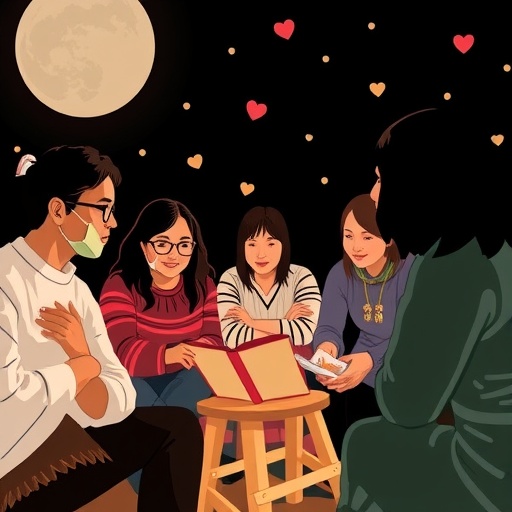
In a groundbreaking qualitative study that uncovers the intricate layers of heart health within Indigenous communities in Canada, researchers have employed an innovative method to amplify community voices: sharing circles. This approach, deeply embedded in Indigenous traditions, serves not only as a data collection tool but also as a conduit for authentic storytelling, fostering a culturally safe space where participants can openly discuss the complexities influencing their cardiovascular health. The findings, published in the journal CJC Open by Elsevier, highlight the profound impact of emotional, spiritual, social, and systemic factors on heart health outcomes. Notably, trauma emerges as a pivotal element shaping how individuals engage with and trust healthcare systems.
The study’s pioneering art-based report format marks a significant departure from conventional biomedical approaches, offering a rich visual narrative that encapsulates the lived experiences and perspectives of Indigenous patients. This format harnesses the power of artwork and narrative, transcending traditional textual barriers to communicate the depth of community resilience and vulnerability. By integrating qualitative arts-based methods with empirical analysis, the researchers present a multifaceted understanding of heart disease—one that is deeply entwined with cultural identity, historical trauma, and social determinants of health.
At the core of the study is the recognition that heart disease among Indigenous peoples is not solely a physiological condition but a phenomenon influenced profoundly by historical and ongoing systemic inequities. The use of sharing circles—a communal, dialogic method in which participants share experiences in a respectful and egalitarian environment—facilitated nuanced discussions about the interconnectedness of trauma and heart health. This method aligns with Indigenous epistemologies, privileging relationality and collective knowledge over isolationist scientific inquiry. The insights gained illuminate how entrenched distrust in healthcare institutions, stemming from generational trauma and systemic marginalization, manifest in reduced access to and utilization of cardiovascular care.
The multi-dimensional factors influencing heart health, as revealed in this study, defy reductionist interpretations common in cardiac research. Emotional well-being surfaced as a critical determinant of cardiovascular function, with participants articulating how grief, stress, and unresolved trauma exert tangible physiological effects. Spirituality, often sidelined in biomedical discourse, was foregrounded as a source of strength and healing. Participants recounted how spiritual practices and connection to land serve as protective factors that mitigate heart disease risk and foster holistic wellness.
Social determinants, including socioeconomic status, education, and community cohesion, emerged as vital influences on heart health trajectories. The study underscores how systemic barriers—ranging from geographic isolation to culturally incongruent healthcare services—compound health disparities. Structural racism, as an insidious element embedded within healthcare delivery and policy, restricts equitable access and engenders mistrust, further exacerbating cardiovascular morbidity and mortality among Indigenous populations.
The research also critically evaluates the healthcare system’s role, illustrating how clinical encounters often fall short of addressing the complex social and emotional contexts of Indigenous patients. Participants expressed feelings of alienation and invisibility within healthcare settings, reinforcing the necessity for culturally safe practices and trauma-informed care models. This points to an urgent need for systemic reform that acknowledges and integrates Indigenous worldviews, promotes cultural competence among healthcare providers, and dismantles institutional biases.
By adopting an arts-based knowledge translation approach, this study transcends the limitations of traditional academic dissemination. The visual narratives complement qualitative data, enabling a visceral connection with readers and stakeholders, fostering empathy and understanding. This methodology not only enriches the academic literature but also serves as a vehicle for advocacy, empowering Indigenous communities to reclaim their health narratives and influence policy.
The findings emphasize the imperative of contextualizing cardiovascular health within a broader socio-cultural and historical framework. Researchers advocate for future interventions that are community-driven and culturally tailored, recognizing the distinct lived realities of Indigenous peoples. Such strategies are essential for improving trust, engagement, and ultimately health outcomes.
Furthermore, the study’s innovative methodological fusion challenges the dominant paradigms of health research, proposing a model that honors Indigenous knowledge systems while maintaining rigorous scientific inquiry. This balance facilitates a more equitable research landscape where Indigenous voices are not merely subjects but active contributors to knowledge creation.
In conclusion, this novel research illuminates the intricate fabric of factors shaping heart health in Indigenous communities. It calls for an expansive understanding of cardiovascular disease that integrates emotional, spiritual, social, and systemic dimensions, with trauma as a critical lens. By embracing sharing circles and arts-based methods, this work not only enhances the scientific discourse but also advances reconciliation efforts by centering Indigenous experiences and perspectives in health research.
As this study garners attention within the scientific and Indigenous communities alike, it sets a precedent for future research to adopt culturally resonant methods that promote healing and equity. The combination of traditional practices and contemporary science offers a pathway toward more inclusive, effective, and compassionate healthcare systems for Indigenous peoples.
This transformative approach represents a shift toward holistic health paradigms that honor the complexity of human experience. It invites scientists, clinicians, and policymakers to rethink cardiovascular health beyond biomedical metrics and to engage with the profound interconnections of mind, body, spirit, and community woven through the Indigenous experience of health and illness.
Cite Scienmag News
Courtney Benton. (June 11, 2026). Community-Led Visual Storytelling and Sharing Circles Illuminate Pathways to Indigenous Heart Health. Scienmag. https://scienmag.com/community-led-visual-storytelling-and-sharing-circles-illuminate-pathways-to-indigenous-heart-health/
Courtney Benton. "Community-Led Visual Storytelling and Sharing Circles Illuminate Pathways to Indigenous Heart Health." Scienmag, 11 June 2026, https://scienmag.com/community-led-visual-storytelling-and-sharing-circles-illuminate-pathways-to-indigenous-heart-health/. Accessed 4 September 2026.
Courtney Benton. "Community-Led Visual Storytelling and Sharing Circles Illuminate Pathways to Indigenous Heart Health." Scienmag. June 11, 2026. https://scienmag.com/community-led-visual-storytelling-and-sharing-circles-illuminate-pathways-to-indigenous-heart-health/


