


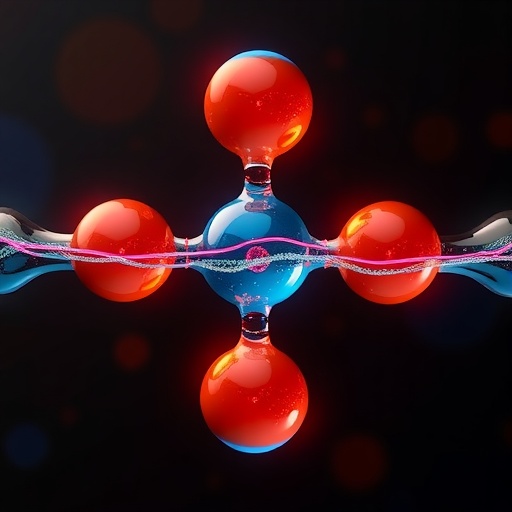
Water is often described as the universal solvent, but that familiar label captures only part of its importance. In living systems, geological environments and laboratory reactions, water is also an active participant that helps chemical transformations occur. One of its most remarkable capabilities is proton transport, the rapid movement of hydrogen ions through networks of hydrogen-bonded molecules. This process underlies acid–base chemistry and contributes to energy conversion in biology, atmospheric reactions and many forms of aqueous catalysis. Now, researchers from East China Normal University have identified what may be the smallest structural arrangement capable of switching on this collective behavior: a closed ring made of three water molecules.
The study, published in the National Science Review, addresses a deceptively simple question that has challenged physical chemists for years: how many water molecules are needed before water begins to behave as a cooperative catalytic system rather than as a collection of individual molecules? To answer it, the team examined water clusters containing between two and five molecules. Using femtosecond reaction microscopy together with ab initio molecular dynamics simulations, the researchers followed the formation of hydronium-containing products on timescales shorter than one trillionth of a second. Their measurements allowed them to distinguish how rapidly proton-transfer chemistry unfolds in clusters of different sizes and, crucially, to identify the point at which the reaction dynamics change abruptly.
The central result was a dramatic “kinetic collapse.” In a cluster containing two water molecules, the overall formation process required approximately 259 femtoseconds. When a third water molecule was added, the reaction time fell to roughly 70 femtoseconds. Larger clusters remained similarly fast, indicating that the decisive transition occurs between the dimer and trimer. Rather than gradually improving as more molecules are introduced, the catalytic behavior appears to switch on suddenly when a three-molecule network becomes possible. The result identifies the water trimer as the minimal functional unit for efficient charge separation under the conditions examined by the researchers.
At the molecular level, the reaction begins with proton transfer between neighboring water molecules. One molecule accepts an additional proton and becomes hydronium, H₃O⁺, while another is left in a hydroxyl-like state. Proton motion in hydrogen-bonded water is often described through the Grotthuss mechanism, in which the proton does not simply drift through the liquid as an isolated particle. Instead, the identities of hydrogen-bonded molecules continually rearrange, allowing the excess proton to move through a changing molecular network. In the tiny clusters studied here, the same general principles are compressed into a highly controlled environment, where individual hydrogen bonds and molecular orientations can be observed with unusual clarity.
The simulations revealed that the initial proton jump is not the feature that distinguishes slow and fast clusters. That elementary transfer is already extremely rapid, even when only two water molecules are present. The critical difference appears afterward, when the system must prevent the newly produced positive and negative fragments from collapsing back together. In a two-molecule cluster, hydronium and hydroxyl remain strongly connected. Their separation requires the system to move through an energetically unfavorable configuration, creating a barrier that encourages charge recombination. The proton may move quickly, but the products are not necessarily stabilized long enough for the reaction to become productive.
A linear chain containing three water molecules does not fully solve this problem. Although the additional molecule provides another hydrogen bond and a possible route for rearrangement, an open chain lacks the geometric constraints needed to stabilize the separated charges efficiently. The system can still encounter an energetic obstacle as it attempts to pull hydronium and hydroxyl apart. This finding is important because it shows that the number of molecules alone is not sufficient. The topology of the hydrogen-bond network—the way the molecules are connected in space—determines whether the cluster can act cooperatively.
The decisive structure is a cyclic trimer, in which three water molecules form a closed hydrogen-bonded ring. According to the team’s analysis, this arrangement eliminates the energy barrier associated with separating and stabilizing the reaction products. The ring provides a coordinated pathway for hydrogen-bond rearrangement, allowing molecular motions to support charge separation rather than drive immediate recombination. Each water molecule contributes to the network, and the response of one bond is linked to changes in the other two. This cooperative geometry effectively functions as a structural switch: below it, proton transfer remains vulnerable to back reaction; once it forms, the entire network can rapidly reorganize around the new charge distribution.
The distinction between proton transfer and product separation offers a broader insight into how water catalyzes reactions. It is tempting to assume that a catalyst works by accelerating the first chemical step, but in many systems the more important role is to stabilize a transition state or prevent reactive products from returning to their starting configuration. In the water trimer, the initial proton movement is already fast. The catalytic advantage comes from controlling what happens in the following moments. By lowering the energetic cost of charge separation, the cyclic network increases the probability that hydronium and hydroxyl will persist as distinct species instead of recombining.
To obtain this picture, the researchers combined experiment with theory. Femtosecond reaction microscopy provided time-resolved measurements of cluster chemistry, making it possible to compare the evolution of hydronium formation across different cluster sizes. Ab initio molecular dynamics simulations then tracked atomic motion while calculating how the electronic structure and energetic landscape changed during the reaction. This combination is particularly valuable for proton-transfer chemistry, because hydrogen atoms are light, hydrogen bonds are constantly rearranging and the relevant events occur on ultrafast timescales. Experimental observations reveal the reaction speed, while simulations help connect that speed to specific molecular geometries and energy barriers.
The water clusters in the study existed in the gas phase, isolated from the surrounding liquid environment. That setting is far removed from bulk water, where every molecule is influenced by many neighbors and where fluctuations continually reshape the hydrogen-bond network. Yet the isolation is also what makes these clusters scientifically powerful. In a confined, size-selected system, researchers can identify the contribution of a precise number of molecules and compare alternative structures such as cyclic and linear trimers. The findings suggest that local topology can control charge separation even before a large solvent environment develops. In natural aqueous chemistry, similar small-scale motifs may appear transiently within larger, disordered networks, helping explain how collective proton transport emerges from microscopic hydrogen-bond arrangements.
The discovery of a three-water-molecule threshold does not mean that all proton chemistry in bulk water is governed by a single fixed structure. Real liquids contain constantly changing networks, and temperature, electric fields, solutes and surrounding molecules can alter reaction pathways. Instead, the study provides a microscopic blueprint for the minimum cooperative unit capable of producing a major kinetic advantage. It shows that water’s catalytic power begins not simply with more molecules, but with the right arrangement of molecules. By revealing how a tiny cyclic network can transform an ultrafast proton jump into effective charge separation, the work offers a new way to think about the molecular origins of aqueous chemistry—and identifies a remarkably small ring as the point where water first becomes a true collective catalyst.
Web References: https://doi.org/10.1093/nsr/nwag443
References: National Science Review, DOI: 10.1093/nsr/nwag443
Keywords
Water clusters, proton transfer, hydronium, hydrogen bonds, Grotthuss mechanism, cyclic water trimer, charge separation, ultrafast chemistry, femtosecond reaction microscopy, ab initio molecular dynamics, aqueous catalysis
Cite Scienmag News
Bethany Barker. (August 13, 2026). Three Water Molecules Reveal the Minimal Switch Enabling Ultrafast Proton Transport. Scienmag. https://scienmag.com/three-water-molecules-reveal-the-minimal-switch-enabling-ultrafast-proton-transport/
Bethany Barker. "Three Water Molecules Reveal the Minimal Switch Enabling Ultrafast Proton Transport." Scienmag, 13 August 2026, https://scienmag.com/three-water-molecules-reveal-the-minimal-switch-enabling-ultrafast-proton-transport/. Accessed 4 September 2026.
Bethany Barker. "Three Water Molecules Reveal the Minimal Switch Enabling Ultrafast Proton Transport." Scienmag. August 13, 2026. https://scienmag.com/three-water-molecules-reveal-the-minimal-switch-enabling-ultrafast-proton-transport/


