


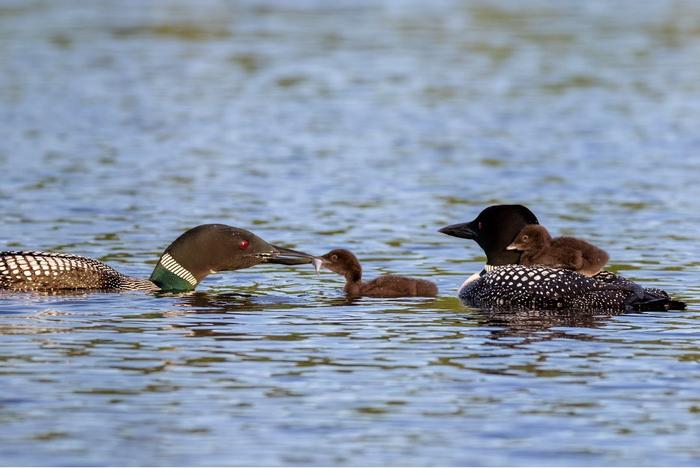
The Common Loon, an icon of the northern wilderness, is under threat from climate change due to reduced water clarity, according to a new study authored by Chapman University professor, Walter Piper. The study, published April 1 in Ecology, followed up an earlier paper that showed substantial reproductive decline in the author’s study area in northern Wisconsin.

Credit: Linda Grenzer
The Common Loon, an icon of the northern wilderness, is under threat from climate change due to reduced water clarity, according to a new study authored by Chapman University professor, Walter Piper. The study, published April 1 in Ecology, followed up an earlier paper that showed substantial reproductive decline in the author’s study area in northern Wisconsin.
The paper is the first clear evidence demonstrating an effect of climate change on this charismatic species. Specifically, the paper shows that July rainfall results in reduced July water clarity in loon territories. Reduced water clarity, in turn, makes it difficult for adult loons to find and capture their prey (mainly small fishes) under water, so they are not able to meet their chicks’ metabolic needs. The result is low chick weight and higher chick mortality. Since loons use the same foraging mode across their breeding range, the impact of water clarity on loon breeding success found in Wisconsin is likely to be echoed from Alaska to Iceland.
Piper, in collaboration with Max Gline and Kevin Rose from Rensselaer Polytechnic Institute, reports several important findings. Over the past 25 years, there has been a consistent decline in water clarity. During the same period, body weights of adult males, adult females, and chicks have also declined. By searching among a large number of environmental variables, the authors were able to pinpoint mean water clarity during the month of July – the month of most rapid growth in chicks – as the strongest predictor of body weight. In a separate analysis, the authors found that rainfall in July impacts water clarity negatively. That is, heavy rainfall in July results in reduced water clarity, whereas light rainfall leads to high clarity and good foraging conditions for loons. Consequently, the rise in rainfall observed in recent decades, attributed to climate change, poses challenges for adult loons in feeding their offspring and diminishes chick survival rates.
The precise way in which rainfall leads to reduced water clarity is currently under investigation. The authors suggest that rain might carry dissolved organic matter (DOM) into lakes from adjacent streams and shoreline areas. But it is also possible that nutrients (such as fertilizers used on lawns by lake residents), pet waste, or even leaks from septic systems might be to blame.
This study represents a unique partnership between diverse fields. Piper’s three-decade-long study of loon behavioral ecology in northern Wisconsin intersects with Gline and Rose’s use of Landsat imagery to calculate freshwater lake clarity. Combining data from these sources has illuminated the cause behind the sharp decline in breeding success in northern Wisconsin. It is now evident that both the loss of water clarity – as well as increasing populations of black flies, which have increased due to greater rainfall – are to blame for the population downturn.
“Few animals on Earth are at once so beloved and so poorly understood as Common Loons”, Piper said. “This partnership between a loon behaviorist and lake ecologists who collect satellite data on water clarity has given us a unique and powerful window onto foraging efficiency and the loon population as a whole that might help us conserve the species.”
Piper is in the process of establishing a second marked study population of loons, equal in size to the first, in Minnesota. There he will determine whether the recent decline in loon breeding success recorded by the Minnesota Department of Natural Resources results from a loss of water clarity, as in Wisconsin.
Journal
Ecology
DOI
Article Title
Climate change-associated declines in water clarity impair feeding by common loons
Article Publication Date
31-Mar-2024
Cite Scienmag News
Sloane Callahan. (April 5, 2024). Common loons threatened by declining water clarity. Scienmag. https://scienmag.com/common-loons-threatened-by-declining-water-clarity/
Sloane Callahan. "Common loons threatened by declining water clarity." Scienmag, 5 April 2024, https://scienmag.com/common-loons-threatened-by-declining-water-clarity/. Accessed 3 September 2026.
Sloane Callahan. "Common loons threatened by declining water clarity." Scienmag. April 5, 2024. https://scienmag.com/common-loons-threatened-by-declining-water-clarity/

