


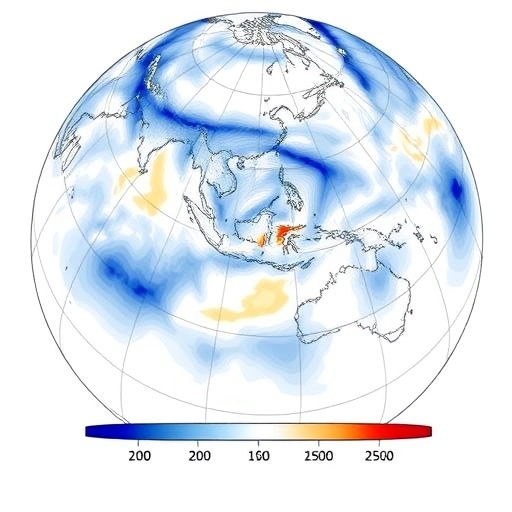
Recent advancements in climate modeling have led to new insights regarding the alarming trend of snow drought in the Northern Hemisphere. Researchers Hu, Yang, and He, along with their team, delved deep into the latest findings by utilizing bias-corrected simulations emerging from the Coupled Model Intercomparison Project Phase 6 (CMIP6). These simulations provide an unprecedented level of clarity and detail, helping to illuminate the profound implications of snow drought on ecosystems, water resources, and socio-economic stability.
Snow drought refers to the phenomenon where snow accumulation is significantly lower than normal, leading to reduced snowpack and its consequential effects. This recently observed trend poses risks to water supply, particularly in regions that rely on snowmelt for freshwater resources. The investigative work of the research team analyzed various climate models to determine regions most susceptible to snow drought and the consequent shifts in hydrological cycles expected in the coming decades.
The underpinning technology behind the simulations—the bias correction—plays a crucial role in making climate models more accurate. Traditional models often exhibit systematic errors due to limitations in representing complex climate processes. By employing bias-correction techniques, researchers can rectify these inaccuracies, providing a more reliable forecast of snow conditions. The focus was primarily on Northern Hemisphere regions where the impact of temperature increases and changing precipitation patterns has been strikingly evident.
In their thorough analysis, the research team explored the historical context of snowpack data, revealing a striking decline in snow cover over recent decades. This decline is linked not only to rising temperatures but also to changing weather patterns, including altered precipitation regimes that have direct implications for winter and spring. The interplay between these factors creates a challenging environment for both natural ecosystems and human-managed water systems.
One of the standout conclusions from this study was the identification of a direct correlation between warm winters and diminished snow cover. Specifically, the team noted how rising temperatures can lead to more precipitation falling as rain rather than snow, resulting in less moisture being stored in the freeze-thaw cycles typical of colder months. This change not only hampers fresh water availability in downstream regions but also disrupts the ecological balance critical to various species whose lifecycles are intricately tied to seasonal snow patterns.
Furthermore, the team’s simulations revealed alarming projections for the upcoming decades, indicating that several regions may experience a significant increase in the frequency and intensity of snow droughts. The methodology employed allowed for a more nuanced understanding of localized climatic impacts, a vital aspect for stakeholders in agriculture, hydrology, and urban planning. While the broader picture of climate change tends to focus on macro trends, this research underscores the necessity of localized studies to inform regional climate adaptation strategies effectively.
Additionally, the socio-economic implications of snow drought cannot be overstated. Areas that depend heavily on snowmelt for irrigation and drinking water are particularly vulnerable, as declining snowpack can lead to water scarcity and heightened competition over limited resources. The multifaceted nature of snow drought’s impacts presents a complex challenge for policymakers, who must navigate the interplay between safeguarding natural ecosystems and ensuring the resilience of agricultural and urban water systems.
In a world increasingly affected by climate change, understanding the nuances of snow drought is essential. The collaboration among researchers in this study brought together expertise in climatology, hydrology, and environmental science, leading to a comprehensive understanding of the implications of reduced snowpack. Such interdisciplinary approaches are crucial for developing effective mitigation and adaptation strategies.
The implications of their findings extend beyond geographical borders, with potential ripple effects impacting global water equity and food security. The snowmelt critical for agriculture and urban needs is increasingly uncertain, posing challenges not just for the Northern Hemisphere but, given the interconnectedness of water systems, the global community as well. This emphasizes the urgency for international cooperation in climate adaptation efforts and technology transfer to bolster resilience.
Another critical area highlighted in this research concerns the ecological ramifications of snow drought. Ecosystems have evolved in tandem with historical snow patterns; thus, changes to snow cover can disrupt habitat conditions. Species dependent on snow for insulation or hunting—such as certain mammals—may face dire consequences. The research team’s model projections include potential shifts in population dynamics for these species, driving home the point that protecting biodiversity is intrinsically linked to climate stability.
In conclusion, the findings from Hu, Yang, and He provide vital insights into the ramifications of snow drought, emphasizing a significant paradigm shift in how we view and approach climate adaptation. The innovative use of bias correction in simulations empowers researchers to decipher complex climatic phenomena, laying a groundwork for improved policy decisions and educational initiatives related to climate change and water resources management.
As snow drought increasingly becomes a critical issue across the Northern Hemisphere, the research serves as a clarion call for stakeholders to reconsider resource management and conservation strategies. As this phenomenon poses greater threats, the need for robust action plans grounded in reliable scientific data grows ever more significant. These revelations underscore a pressing narrative: to combat the challenges posed by a warming climate, we must not only understand the present but also anticipate the future and prepare for it.
Thus, as communities grapple with the consequences of snow drought, the research provided by these scientists offers a beacon of hope. Their findings advocate for proactive measures that could mitigate the impending impacts of climate change. As the dialogue around climate adaptation continues, studies like these remind society of the interconnected nature of environmental, economic, and social systems, carving a path toward a sustainable future.
Hu, Y., Yang, X., He, Z. et al. New insights from the bias-corrected simulations of CMIP6 in Northern Hemisphere’s snow drought.
Commun Earth Environ (2026). https://doi.org/10.1038/s43247-026-03187-7
Cite Scienmag News
Violet Maxwell. (January 13, 2026). CMIP6 Reveals New Insights on Northern Hemisphere Snow Drought. Scienmag. https://scienmag.com/cmip6-reveals-new-insights-on-northern-hemisphere-snow-drought/
Violet Maxwell. "CMIP6 Reveals New Insights on Northern Hemisphere Snow Drought." Scienmag, 13 January 2026, https://scienmag.com/cmip6-reveals-new-insights-on-northern-hemisphere-snow-drought/. Accessed 4 September 2026.
Violet Maxwell. "CMIP6 Reveals New Insights on Northern Hemisphere Snow Drought." Scienmag. January 13, 2026. https://scienmag.com/cmip6-reveals-new-insights-on-northern-hemisphere-snow-drought/


