


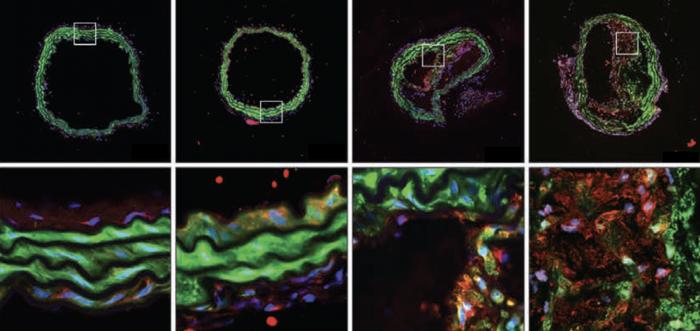
NEW YORK, NY–Columbia University researchers have found cells inside clogged arteries share similarities with cancer and aggravate atherosclerosis, raising the possibility that anticancer drugs could be used to treat atherosclerosis and prevent heart attacks.

Credit: Columbia University Irving Medical Center (Pan et al.)
NEW YORK, NY–Columbia University researchers have found cells inside clogged arteries share similarities with cancer and aggravate atherosclerosis, raising the possibility that anticancer drugs could be used to treat atherosclerosis and prevent heart attacks.
Their study found that smooth muscle cells that normally line the inside of our arteries migrate into atherosclerotic plaques, change their cell identity, activate cancer genes, and proliferate inside the plaques.
“Our study shows that these transformed muscle cells are driving atherosclerosis, opening the door to new ways to treat the disease, potentially with existing cancer drugs,” says Muredach Reilly, MD, the Florence and Herbert Irving Endowed Professor of Medicine at Columbia University Vagelos College of Physicians and Surgeons and director of Columbia’s Irving Institute for Clinical and Translational Research.
The study, published April 30 in Circulation, was led by Reilly and Huize Pan, now an assistant professor of medicine at Vanderbilt University Medical Center, who conducted the research when he was an associate research scientist at Columbia.
DNA damage, hyperproliferation
Atherosclerosis is the major cause of heart attacks and stroke around the world and occurs when fat deposits build up inside the arteries. Atherosclerosis can be reduced with a healthy diet or drugs called statins that slow or reverse the buildup of deposits.
Previous studies had found that smooth muscle cells metamorphose into different types of cells inside these atherosclerotic plaques and multiply to make up most cells within the plaques.
Yet until now, few studies had examined the cancer-like properties of the cells and if these changes contributed to atherosclerosis. To learn more, Reilly and Pan closely tracked the development of transformed smooth muscle cells in mice with atherosclerosis and sampled plaques of people with atherosclerosis.
They found striking parallels between changes in the smooth muscle cells and tumor cells, including hyperproliferation, resistance to cell death, and invasiveness.
DNA damage, another hallmark of cancer, accumulated in the mouse and human smooth muscle cells and appears to accelerate atherosclerosis, the researchers found. The researchers could further accelerate atherosclerosis in mice by introducing a genetic mutation that increased DNA damage within the smooth muscle cells. Vascular tissue from healthy mice and people had no signs of smooth muscle cells with the DNA damage found in atherosclerotic plaques.
Reilly adds that they found no evidence of metastasis. “The cells stay inside existing plaques, which makes us think that they behave mostly like benign tumor cells, but more work needs to be done in humans and animal models to address this hypothesis,” he says.
Treating atherosclerosis like cancer
If atherosclerosis is driven by cancer-like cells, anticancer therapies may be a potential new way to treat or prevent the disease.
The researchers explored that idea by treating atherosclerotic mice with a common cancer drug, niraparib, that targets cells with DNA damage. The drug significantly decreased the size of the atherosclerotic plaques and improved plaque stability (stable plaques reduce the odds of having a heart attack).
“This suggests that cancer drugs like niraparib could both prevent the buildup of plaques and treat atherosclerosis once its established,” Reilly says. “But it’s important to note that the experiment with niraparib was proof of a principle and does not directly translate to clinical use.”
Other cancer drugs may also have benefits. “We need more work to select the best targets, safest targeted therapies, and vascular delivery strategies,” Reilly says. “And we need to determine if different people have different types of DNA damage and mutations that drive the disease, and, if so, we can use that information to develop personalized therapies to treat atherosclerosis,” Reilly says.
“Statins are very effective in many people at reducing atherosclerosis and preventing hearts attacks, but some people still have substantial cardiovascular risk. We think more research into the cancer-like properties of atherosclerosis will lead to new treatment options for these patients.”
More information
“Atherosclerosis Is a Smooth Muscle Cell-Driven Tumor-Like Disease” was published April 30 in the journal Circulation.
All authors (from Columbia unless noted): Huize Pan (Vanderbilt University), Sebastian E. Ho, Chenyi Xue, Jian Cui, Quinian S. Johanson, Nadja Sachs (Technical University, Munich), Leila S. Ross, Fang Li, Robert A. Solomon, E. Sander Connolly Jr., Virendra I. Patel, Lars Maegdefessel (Technical University, Munich), Hanrui Zhang, and Muredach P. Reilly.
###
Columbia University Irving Medical Center (CUIMC) is a clinical, research, and educational campus located in New York City. Founded in 1928, CUIMC was one of the first academic medical centers established in the United States of America. CUIMC is home to four professional colleges and schools that provide global leadership in scientific research, health and medical education, and patient care including the Vagelos College of Physicians and Surgeons, the Mailman School of Public Health, the College of Dental Medicine, the School of Nursing. For more information, please visit cuimc.columbia.edu.
Journal
Circulation
Method of Research
Experimental study
Subject of Research
Animals
Article Title
Atherosclerosis Is a Smooth Muscle-Cell Tumor-Like Disease
Article Publication Date
30-Apr-2024
COI Statement
No conflicts
Cite Scienmag News
Nathaniel Bowman. (May 1, 2024). Clogged arteries worsened by cells that behave like cancer cells. Scienmag. https://scienmag.com/clogged-arteries-worsened-by-cells-that-behave-like-cancer-cells/
Nathaniel Bowman. "Clogged arteries worsened by cells that behave like cancer cells." Scienmag, 1 May 2024, https://scienmag.com/clogged-arteries-worsened-by-cells-that-behave-like-cancer-cells/. Accessed 4 September 2026.
Nathaniel Bowman. "Clogged arteries worsened by cells that behave like cancer cells." Scienmag. May 1, 2024. https://scienmag.com/clogged-arteries-worsened-by-cells-that-behave-like-cancer-cells/

