


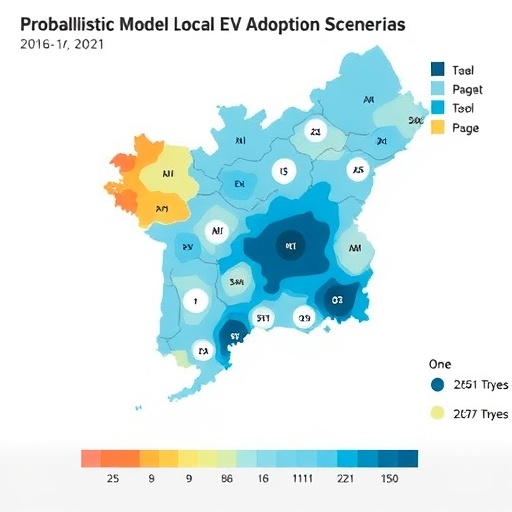
In recent years, the transition to electric vehicles (EVs) has emerged as a critical component of global efforts to combat climate change and reduce greenhouse gas emissions. However, understanding how EV adoption will unfold at granular, neighborhood levels remains a complex challenge that has eluded researchers and planners alike. Traditional forecasting models often rely on aggregate data and broad assumptions, which fail to capture the nuanced, localized dynamics that drive adoption patterns in urban environments. Addressing this gap head-on, a groundbreaking study by Flower, Li, and Padget introduces a novel probabilistic forecasting framework designed specifically for disaggregating EV adoption scenarios down to the neighborhood scale, promising unprecedented accuracy and actionable insights for policymakers and urban planners.
The core innovation of this framework lies in its ability to incorporate multiple layers of uncertainty and heterogeneity into the prediction process. Unlike deterministic models that offer single-point estimates, this probabilistic approach embraces the inherent variability in consumer behavior, infrastructure availability, socio-economic factors, and policy impacts. By generating a distribution of possible outcomes, the framework allows stakeholders to understand not just the most likely adoption trajectory but also the range of less probable but still consequential scenarios. This, in turn, can inform more resilient and adaptable policy decisions tailored to specific neighborhoods and their unique characteristics.
At the heart of the methodology is a sophisticated data assimilation process that integrates diverse data streams, including demographic statistics, historical adoption rates, charging infrastructure deployment, and regional incentives. Machine learning algorithms are employed to uncover latent patterns and correlations within this high-dimensional data space, enabling the model to learn from past adoption events and predict future trends with remarkable granularity. Crucially, the framework maintains interpretability, allowing analysts to trace how different factors influence adoption probabilities at the micro-level.
This neighborhood-level lens is especially important given the spatial heterogeneity observed in EV uptake. Factors such as income disparities, housing types, vehicle ownership norms, and access to charging infrastructure vary dramatically across urban landscapes. For example, areas with higher proportions of single-family homes and private garages typically exhibit higher adoption rates, owing to easier home charging access. Conversely, densely populated urban centers dominated by rental housing present unique challenges that require targeted interventions. The probabilistic model captures these subtleties by encoding neighborhood-specific attributes directly into the forecasting process.
Moreover, the framework accounts for temporal dynamics, recognizing that adoption patterns evolve over time as technologies mature, consumer awareness shifts, and policy landscapes develop. By modeling adoption as a stochastic process influenced by time-dependent covariates, the approach can simulate plausible future scenarios under different assumptions about regulatory changes, market incentives, and technological advances. This dynamic forecasting capability equips decision-makers with a forward-looking tool that adapts alongside the rapidly changing EV ecosystem.
An additional strength of this research lies in its multi-scale applicability. While the primary focus is neighborhood-level disaggregation, the framework can aggregate predictions upward to city, regional, or even national scales without losing fidelity. This flexibility enables comprehensive planning strategies that align local actions with broader climate and energy goals. Furthermore, it supports equity-focused analyses by identifying neighborhoods at risk of lagging behind in EV adoption, thus helping to direct resources and incentives where they are most needed.
The study’s empirical validation underscores the practical value of the model. Utilizing historical EV registration data from multiple metropolitan areas, Flower and colleagues demonstrate that the probabilistic forecasts consistently outperform baseline models in both accuracy and reliability. The model not only predicts the average adoption rates but also effectively quantifies prediction uncertainty, a crucial element for risk-averse policy environments. These promising results pave the way for real-world implementation and continuous refinement as new data becomes available.
Integrating this forecasting framework into urban planning paradigms can revolutionize the deployment of EV infrastructure. For example, utilities and city agencies can prioritize the installation of charging stations in neighborhoods projected to experience rapid adoption growth, thereby avoiding the inefficiencies and costs associated with under- or over-provisioning infrastructure. This targeted approach can enhance user experience, reduce range anxiety, and ultimately accelerate the transition to electric mobility.
Beyond infrastructure, the insights gleaned from neighborhood-level probabilistic forecasts can inform tailored outreach and education programs. Understanding which communities are less likely to adopt EVs due to socio-economic or informational barriers allows for the design of customized incentives, financing schemes, and awareness campaigns. Such micro-targeted interventions are critical for achieving equitable access to clean transportation and avoiding exacerbation of existing social inequalities.
From a technological standpoint, the modeling framework leverages advances in Bayesian inference and probabilistic graphical models to maintain a balance between computational tractability and model complexity. This ensures that the system can handle the vast volumes of data involved in city-scale applications without sacrificing interpretability or transparency. Additionally, the modular architecture of the framework makes it amenable to future incorporation of emerging data sources, such as real-time telematics, social media sentiment, and peer-to-peer adoption influences.
The implications of this research extend well beyond EV adoption forecasting. The probabilistic approach exemplifies a broader paradigm shift toward incorporating uncertainty explicitly in urban system modeling and decision support tools. As cities become increasingly instrumented and data-rich, frameworks that embrace probabilistic reasoning will be indispensable for managing complexity and uncertainty in domains ranging from energy consumption to transportation demand and public health interventions.
Looking ahead, potential extensions of the framework include coupling with traffic simulation models to better capture interactions between vehicle type selection, travel behavior, and urban form. Incorporating feedback loops whereby adoption patterns influence infrastructure deployment and vice versa could yield even more robust forecasts. Furthermore, integration with climate impact models would allow assessment of the environmental benefits realized under different EV adoption trajectories, helping to connect local actions with global sustainability objectives.
The timely introduction of this probabilistic forecasting framework arrives as governments worldwide accelerate their commitments to electric mobility and climate neutrality. By providing a scientifically rigorous and practically deployable tool for dissecting EV adoption at neighborhood scales, Flower, Li, and Padget empower stakeholders with the predictive foresight necessary to optimize investments, policies, and community engagement. This represents a significant leap forward in the quest to electrify transportation systems in a just and effective manner.
In sum, the ability to anticipate electric vehicle adoption with high spatial and temporal resolution opens new frontiers in sustainable urban planning and policy formulation. This pioneering research underlines the importance of embracing uncertainty and heterogeneity not as obstacles but as vital sources of information. As cities confront the twin challenges of climate change and social equity, tools such as this probabilistic framework will be crucial in crafting nuanced, resilient pathways toward an electrified transportation future.
Ultimately, the study by Flower, Li, and Padget marks a seminal contribution to the emerging field of probabilistic urban forecasting. By situating electric vehicle adoption within a rigorous statistical modeling context that accounts for neighborhood diversity and uncertainty, the work transcends traditional approaches and sets a new standard for how technology transitions can be understood and guided at the human scale where they matter most.
Cite Scienmag News
Denise Maddox. (June 13, 2026). Probabilistic Model Maps Local EV Adoption Scenarios. Scienmag. https://scienmag.com/probabilistic-model-maps-local-ev-adoption-scenarios/
Denise Maddox. "Probabilistic Model Maps Local EV Adoption Scenarios." Scienmag, 13 June 2026, https://scienmag.com/probabilistic-model-maps-local-ev-adoption-scenarios/. Accessed 4 September 2026.
Denise Maddox. "Probabilistic Model Maps Local EV Adoption Scenarios." Scienmag. June 13, 2026. https://scienmag.com/probabilistic-model-maps-local-ev-adoption-scenarios/


