


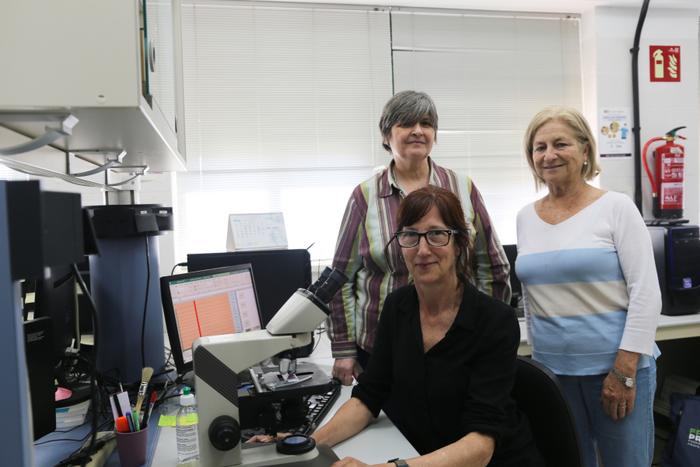
A study by the University of Cordoba analyzes trends in the blooming patterns of the genus Quercus in Andalusia, using pollen concentrations in the air and confirming their effects on allergies

Credit: University of Cordoba
A study by the University of Cordoba analyzes trends in the blooming patterns of the genus Quercus in Andalusia, using pollen concentrations in the air and confirming their effects on allergies
How does climate change affect pollen allergy? Relating the effects of global warming to variations in the blooming patterns of species of the genus Quercus in Andalusia was the objective of one of the latest efforts by the Systemic and Applied Botany research group at the University of Cordoba.
“We chose Quercus because it is the most representative tree in Andalusia in the natural environment, and it is an anemophilic tree (pollinated by the wind) found where there are very high concentrations of pollen in the atmosphere, so it is a good bioindicator to study the impact of climate change on blooming,” said researcher Pura Alcázar, who co-authored the work with fellow researcher Carmen Torres and Professor Carmen Galán, in collaboration with the universities of Seville, Jaén, Granada, and Malaga.
After analyzing data on the concentrations of pollen in the air in the eight Andalusian capitals, and studying their relationships with meteorological parameters for decades, the study shows a trend towards a longer and more intense pollen season for species of the genus Quercus, which includes a range of oaks: holm, cork, common, Portuguese and kermes.
“Fundamentally, there has been an increase in the blooming of these species, and in their intensity, because there is a higher concentration of pollen in Andalusia,” Alcázar explained. The pollen season has also been protracted. “We have to take into account that we are studying different species,” observes Professor Carmen Galán, “and species that bloom earlier, such as the holm oak, are more affected by the temperature, so an increase in that temperature means that they bloom earlier.” Although the earlier onset of the season is general, in Granada it was not observed, probably owing to the rains that occurred prior to the spring during several years of the study, according to the researchers.
Thus, the effects of climate change, such as increases in temperature, and higher concentrations of CO2 in the atmosphere, are directly related to these pollen seasons, with a tendency to prolong them and increase their intensity. On the one hand, the rise in temperature means that blooming begins earlier, lengthening the season, while the increase in C02 leads to more intense blooming and higher levels of pollen. “Plants need CO2 to photosynthesize; if more is available, they are more active.”
Although it is not among the allergens that affect the population the most, there are more and more studies that cite this type of pollen as an important one, and with a cross-reaction with grass pollen and other species,” such that these changes will have an impact on the sensitive population, as, if there are longer and more intense seasons, they will be more exposed to pollen,” said Alcázar. “If we are increasingly exposed and our immune system is more sensitive, the same thing can happen with other species, such as the cypress, which years ago featured a harmless pollen, and now represents the main problem in terms of winter allergy,” Galán explained.
The methodology matters
To obtain the series of data on pollen concentrations used for the study, “we have volumetric devices that suck in air, which hits an adhesive surface on which the pollen is deposited and, thus, we can gauge the daily concentrations of pollen per cubic meter in the air,” said Pura Alcázar. These stations belong to the Spanish Aerobiology Network (REA) and the Andalusian Aerobiology Network (RAA).
This study, part of the CLIMAQUER project, also highlights the importance of choosing a proper system to calculate the pollen season, and being able to compare results with other studies. To establish the start of the pollen season there are several methods; for example, considering the start when a certain amount of pollen grains in the air is reached, or when there is a specific amount of grains in the air for several consecutive days. Various methods were used in this study and, in all cases, the trend was towards an increase in the duration and intensity of the pollen season. However, the researchers stress the importance of having a clear definition of the start of the season when comparing different studies.
Reference
Alcázar, P., Torres, C., De Linares, C. et al. Impacts of climate change on airborne Quercus pollen trends in Andalusia region(southern Spain). RegEnviron Change 24, 50 (2024).
Journal
Regional Environmental Change
Method of Research
Observational study
Subject of Research
Not applicable
Article Title
Impacts of climate change on airborne Quercus pollen trends in Andalusia region (southern Spain).
Article Publication Date
20-Mar-2024
Cite Scienmag News
Sloane Callahan. (April 30, 2024). Climate change lengthens and intensifies the blooming of the holm oak and other Quercus species. Scienmag. https://scienmag.com/climate-change-lengthens-and-intensifies-the-blooming-of-the-holm-oak-and-other-quercus-species/
Sloane Callahan. "Climate change lengthens and intensifies the blooming of the holm oak and other Quercus species." Scienmag, 30 April 2024, https://scienmag.com/climate-change-lengthens-and-intensifies-the-blooming-of-the-holm-oak-and-other-quercus-species/. Accessed 3 September 2026.
Sloane Callahan. "Climate change lengthens and intensifies the blooming of the holm oak and other Quercus species." Scienmag. April 30, 2024. https://scienmag.com/climate-change-lengthens-and-intensifies-the-blooming-of-the-holm-oak-and-other-quercus-species/

