


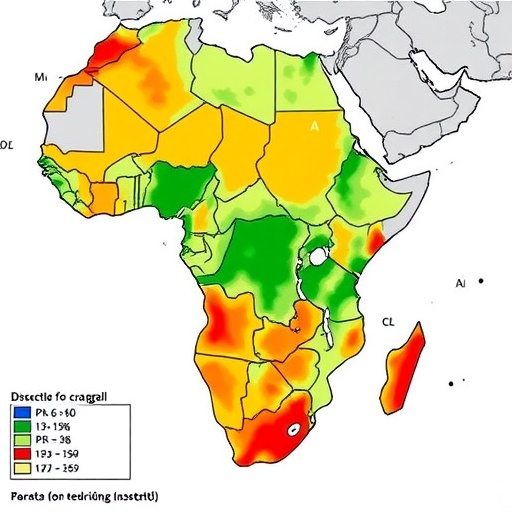
Malaria is the deadliest climate-sensitive infectious disease. Yet, researchers and public health officials have long argued over how climate change has shaped its spread. A new Nature study resolves this debate, providing the most comprehensive assessment to date. The study quantifies climate change’s historical and future impact in sub-Saharan Africa’s children, where most cases and deaths occur. It finds that climate change has slightly increased malaria overall. Looking ahead, rising temperatures could increase the malaria risk in southern and East Africa while reducing it where it is most rampant today as it becomes so hot that even mosquitos struggle to survive.
“Climate change isn’t just making malaria worse or better—it’s moving it,” says co-author Tamma Carleton, Faculty Head of Research for the Climate Impact Lab and an Assistant Professor at the University of California, Berkeley. “Whether a place sees elevated malaria risks or reduced burdens under climate change depends on how hot it is today. We see relief in the current hotspots and new risk nearly everywhere else.”
The study finds that climate change has slightly suppressed the spread of the disease in the warm, malaria hotbeds of today, and will continue to as it gets too hot for the disease to flourish—posing other human health threats. This is especially the case in many large West African nations (Nigeria, Burkina Faso, Mali), where climate change will reduce cases by 5 percent. In extremely hot Sahelian countries (Niger, Gambia, Guinea-Bissau, Somalia) the disease may actually be fully eliminated.
The opposite is true for cooler regions where malaria isn’t a significant problem today, such as southern Africa and high-elevation east Africa. In these areas, climate change is slowly making the temperature more suitable for mosquitoes to spread malaria, increasing cases by 5 percent in the Ethiopian highlands (Kenya, Burundi) and by similarly large increases in Angola, Zambia, and northeast South Africa. By 2100, the risk could increase by 20 percent in regions like the Rift Valley and coastal southern Africa, creating new malaria challenges.
But efforts to reduce emissions can change this trajectory. If the world is able to meet the 2°C warming threshold, this would avert 5 excess cases per 1,000 children in southern Africa and more in the east African highlands. It would also reduce the other widespread climate impacts that will be felt in central and western Africa as the planet continues to heat up. Further, while mitigation is crucial, so is adaptation. The southern and East African regions expected to be hit the hardest in the future are also regions that aren’t accustomed to needing to fight the disease today.
“Governments, health systems and communities must adapt to the evolving malaria threat,” says co-author Christopher Trisos, Director of the Climate Risk Lab and Principal Research Officer at the African Climate and Development Initiative at University of Cape Town. “That means getting ready now to implement more aggressive anti-malaria programs in cooler regions of sub-Saharan Africa where malaria risk is growing, and which can be less experienced at tackling it. Inclusive economic development, and global health financing of effective surveillance, disease control, and better healthcare will be crucial to help confront increased malaria rates caused by climate change in eastern and southern Africa.”
The authors make clear that both climate mitigation and adaptation actions, including malaria elimination strategies, will be needed.
“Malaria was one of the first health outcomes linked to climate change, but it’s taken a quarter century to be sure which direction things are headed,” says co-author Colin Carlson, Assistant Professor of Epidemiology at Yale University. “The big story here is the opportunity for action: so far, elimination efforts have counteracted climate change impacts by nearly 200-fold. Malaria elimination within a generation is not only possible, but one of the best ways to protect frontline populations from climate change impacts.”
The study is the first of its kind to identify where adaptation investments to help prevent and control malaria will be most needed in the future. It is part of a larger effort by the Climate Impact Lab to help decision-makers target adaptation investments. Learn more about the Lab’s Adaptation Roadmap series and view tested climate adaptation strategies in the Lab’s Adaptation Inventory.
Journal
Nature
Method of Research
Meta-analysis
Subject of Research
People
Article Title
The past and future impact of climate change on childhood malaria in Africa
Article Publication Date
29-Jul-2026
Hishamodien Hoosain
University of Cape Town – Faculty of Science
science-marketing@uct.ac.za
Journal
Nature
Method of Research
Meta-analysis
Subject of Research
People
Article Title
The past and future impact of climate change on childhood malaria in Africa
Article Publication Date
29-Jul-2026
Cite Scienmag News
Sloane Callahan. (July 29, 2026). Climate change is redrawing the malaria map in Africa, study finds. Scienmag. https://scienmag.com/climate-change-is-redrawing-the-malaria-map-in-africa-study-finds/
Sloane Callahan. "Climate change is redrawing the malaria map in Africa, study finds." Scienmag, 29 July 2026, https://scienmag.com/climate-change-is-redrawing-the-malaria-map-in-africa-study-finds/. Accessed 5 September 2026.
Sloane Callahan. "Climate change is redrawing the malaria map in Africa, study finds." Scienmag. July 29, 2026. https://scienmag.com/climate-change-is-redrawing-the-malaria-map-in-africa-study-finds/


