



view more
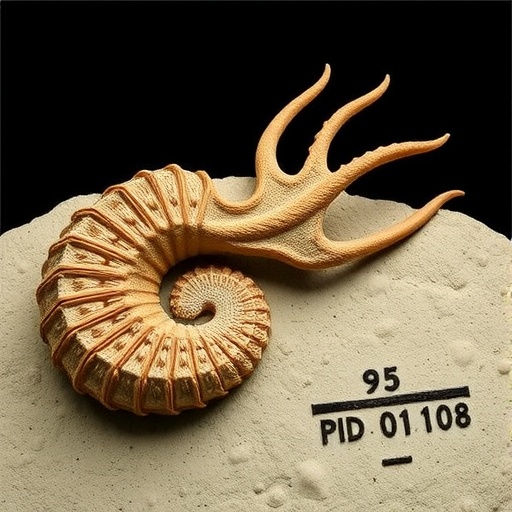
Credit: YANG Dinghua
Extant and ancient cephalopods—including octopuses, squids, extinct ammonites, cuttlefish, and nautiluses—have all had to solve the problem of buoyancy, whether they have hard external shells or not.
Among ancient cephalopods, internal structures such as the siphuncle, chambers, septa, and septal necks were used to regulate buoyancy. The siphuncle—a tube running through the shell chambers—is central to this system since it can be filled with water or gas to control buoyancy. It is regarded as one of the key evolutionary innovations that distinguishes cephalopods from other mollusks. Unfortunately, due to the lack of a continuous fossil record, the detailed evolution of the siphuncle has been unclear.
Now, an international research team has discovered the earliest known siphuncle-bearing cephalopod from the early Cambrian of South China, providing new insights into the group’s early origin and evolutionary history.
Dr. PAN Bing of the Nanjing Institute of Geology and Palaeontology, Chinese Academy of Sciences, in collaboration with researchers from China, the United Kingdom, and the United States under the leadership of Prof. GUO Junfeng of Chang’an University, discovered a new fossil species, Eoceras shaanxiense, which was recovered from the approximately 520-million-year-old Shuijingtuo Formation in South China.
The findings were published in Nature on July 29.
The earliest accepted cephalopod, Plectronoceras cambria, dates to the late Cambrian period about 30 million of years younger than the divergence time of cephalopods estimated by molecular clocks during the Cambrian Explosion (early Cambrian). Thus, the researchers have been trying to find more earlier fossil records of cephalopods, especially in the early Cambrian. The abundant multi-phylum microfossils known as “small shelly fossils” including diverse mollusks and their close relative groups occurred and distributed worldwide in early Cambrian rocks, and may offer great potential for discovering the earliest cephalopods.
Targeting at the small shelly fossils of the early Cambrian Shuijingtuo Formation as a potential resource, the researchers identified 32 specimens of E. shaanxiense and concluded it is an early cephalopod.
Using scanning electron microscopy (SEM) and micro-computed tomography (micro-CT), the researchers examined the specimens—which were preserved through different types of phosphatization—to reconstruct the overall external morphology and internal anatomy of the new species.
Eoceras is millimeter in size, with an orthoconic shell, an oblique apertural margin, multiple septa, and a ventrally situated segmented tube that appears to bridge the septa via minute canals. After making a comprehensive comparison of its internal structures with those of typical siphuncle-bearing cephalopods, the researchers concluded that the segmented tube of Eoceras is indeed a siphuncle—making these fossils the earliest known examples of siphuncle-bearing cephalopods. The researchers argue that Eoceras represents an intermediate evolutionary stage between earlier species with chambered shells and later species with more developed buoyancy systems.
The researchers also outlined a general early evolutionary pathway for cephalopods: First, early cephalopods originated from a taxon characterized by orthoconic shells and multiple septa. Second, cephalopods evolved a sealed, segmented siphuncle within the orthoconic shell. Third, they evolved a true siphuncle with septal necks and connecting rings.
Due to its primitive and simple buoyancy regulation system, Eoceras likely had a mostly benthic lifestyle. However, the fossil lacks features observed in later cephalopods, and its soft-body anatomy is unclear. The researchers note that additional Cambrian fossil discoveries are essential to further resolve the earliest stages of cephalopod evolution and the origin of their distinctive shell architecture.
This study was supported by the National Natural Science Foundation of China, the National Key Research and Development Program of China, and the Opening Foundation of the State Key Laboratory of Continental Evolution and Early Life.
Journal
Nature
Method of Research
Experimental study
Subject of Research
Animals
Article Title
Earliest siphuncle-bearing cephalopod from the early Cambrian
Article Publication Date
29-Jul-2026
LIU Yun
Nanjing Institute of Geology and Palaeontology
yunliu@nigpas.ac.cn
Journal
Nature
Method of Research
Experimental study
Subject of Research
Animals
Article Title
Earliest siphuncle-bearing cephalopod from the early Cambrian
Article Publication Date
29-Jul-2026
Tags
Cite Scienmag News
Gavin Prescott. (July 29, 2026). Early Cambrian fossil discovery sheds light on early cephalopod origin and evolution. Scienmag. https://scienmag.com/early-cambrian-fossil-discovery-sheds-light-on-early-cephalopod-origin-and-evolution/
Gavin Prescott. "Early Cambrian fossil discovery sheds light on early cephalopod origin and evolution." Scienmag, 29 July 2026, https://scienmag.com/early-cambrian-fossil-discovery-sheds-light-on-early-cephalopod-origin-and-evolution/. Accessed 4 September 2026.
Gavin Prescott. "Early Cambrian fossil discovery sheds light on early cephalopod origin and evolution." Scienmag. July 29, 2026. https://scienmag.com/early-cambrian-fossil-discovery-sheds-light-on-early-cephalopod-origin-and-evolution/

