


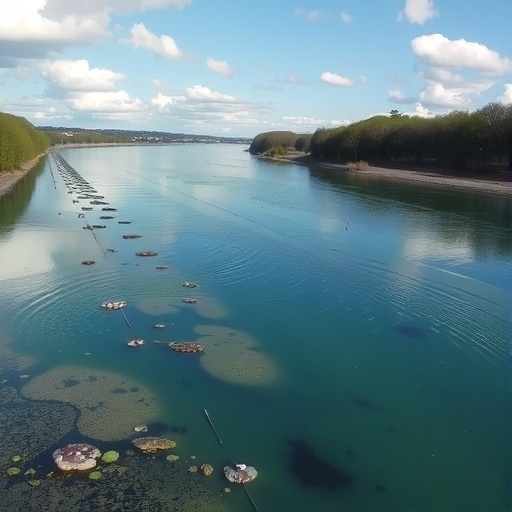
As global temperatures continue to rise due to climate change, the health of freshwater ecosystems worldwide is facing an unprecedented threat. Among the most critical factors affected is the concentration of dissolved oxygen (DO) in river waters, a vital determinant of aquatic life wellness and ecosystem functionality. Recent research has illuminated a troubling trend: increasing water temperatures are directly causing reductions in DO levels, with an associated escalation in the frequency and duration of hypoxic events – periods when oxygen levels fall below thresholds necessary for aquatic organisms to thrive. Scientists now warn that these developments could lead to a widespread ecological crisis in freshwater habitats across the globe.
In a groundbreaking study that integrates advanced computational modeling and extensive empirical data, researchers have explored the global dynamics of dissolved oxygen in rivers from 1980 through 2100. They employed a hybrid process-based and machine learning (ML) approach, harnessing the power of artificial intelligence together with conventional hydrological and biochemical processes to analyze more than 2.6 million observational data points. This unprecedented dataset, encompassing decades of measurements from diverse geographic locations and climatic conditions, enabled researchers to calibrate and validate their models with exceptional accuracy and predictive capability.
The fusion of process-based modeling with machine learning techniques represents a significant leap forward in environmental science. Process-based models detail the physical and biochemical mechanisms governing DO concentrations, such as temperature-dependent oxygen solubility, photosynthesis, respiration, and organic matter decomposition. However, traditional approaches often struggle with complex, non-linear interactions and spatial heterogeneity inherent in natural systems. By integrating machine learning, which excels at pattern recognition and handling vast, multifaceted data, the researchers transcended these limitations, capturing subtle local and temporal variations in DO dynamics that were previously elusive.
Model results paint a stark and alarming picture for the future. Projections indicate a consistent global decline in dissolved oxygen levels in rivers throughout the 21st century. This oxygen depletion is not merely a marginal shift but a profound physiological stressor for aquatic organisms, particularly fish and invertebrates that rely on a narrow oxygen window to sustain metabolic functions. The frequency of hypoxia – defined as low oxygen conditions detrimental to aquatic life – is expected to increase dramatically, with an average rise of 8.8 days per decade globally. These findings suggest that many riverine ecosystems will endure prolonged and repeated hypoxic episodes, exacerbating biodiversity loss and ecosystem degradation.
Understanding the drivers behind these oxygen declines involves recognizing how temperature fundamentally affects water chemistry. Warmer water holds less dissolved oxygen due to decreased gas solubility, a well-documented physical principle. Moreover, elevated temperatures accelerate biological metabolic rates, increasing oxygen demand within the ecosystem. This combined effect leads to a vicious cycle where higher temperatures simultaneously reduce oxygen supply and increase consumption, efficiently tipping the balance toward hypoxia. Compounding these effects, climate change influences hydrological regimes, altering river flow patterns, nutrient loading, and organic matter inputs, all of which interact to further modulate oxygen dynamics.
Aside from temperature, anthropogenic impacts such as nutrient pollution exacerbate oxygen depletion by stimulating eutrophication. Excess nutrients fuel algal blooms, which upon senescence decompose and consume oxygen through microbial respiration, depleting DO levels significantly. While nutrient loading remains a critical factor, this new research underscores that climate-driven warming itself is a powerful, global-scale driver intensifying hypoxia independently and synergistically with pollution. Hence, even in rivers with moderate pollution levels, warming alone threatens to induce widespread oxygen stress.
The geographic scope of the study spans rivers across varied climatic zones and continents, revealing that while oxygen depletion is a global phenomenon, its magnitude and timing vary regionally. Tropical and temperate rivers, which host a significant portion of freshwater biodiversity, are particularly vulnerable due to generally higher baseline temperatures and often higher anthropogenic pressures. Some high latitude rivers may initially witness milder decreases or transient fluctuations but are nonetheless projected to experience eventual declines as warming trends persist. These spatial heterogeneities highlight the necessity of localized monitoring and tailored management strategies.
Ecological consequences from prolonged hypoxia events are far-reaching and multifaceted. Oxygen stress reduces survival, growth, and reproduction rates of many aquatic species, disrupts food web interactions, and impairs ecosystem services such as water purification and nutrient cycling. Hypoxia can lead to fish kills, shifts in species composition towards more tolerant but often less desirable species, and overall community simplification. These changes degrade ecosystem resilience, reducing the ability of freshwater systems to recover and adapt to ongoing environmental stresses.
From a societal perspective, these ecological shifts threaten human livelihoods dependent on healthy freshwater ecosystems. Fisheries, recreation, and potable water resources are at risk from declining water quality and biodiversity loss. Additionally, hypoxic conditions can foster the proliferation of harmful algal species and increased greenhouse gas emissions from anaerobic decomposition, further contributing to global environmental challenges.
The study’s hybrid modeling approach provides valuable forecasting capabilities that enable proactive management and policy development. By simulating both historical trends and future projections, decision-makers gain insight into the temporal evolution of riverine oxygen conditions, allowing identification of hotspots and periods of heightened risk. These data-driven tools can guide interventions such as riparian restoration, nutrient management, and mitigation of thermal pollution along river corridors to buffer against hypoxia.
Yet, uncertainties remain. Challenges persist in fully capturing the complex interplay of climate, hydrology, and biogeochemistry across diverse river systems. The model relies on quality observational data, which may be sparse or inconsistent in certain regions, potentially affecting accuracy. Additionally, future socio-economic developments impacting land use, pollution levels, and water management practices could alter predicted trajectories, necessitating ongoing model refinement and data collection.
In conclusion, this pioneering research unveils a critical and emerging dimension of climate change impacts on freshwater systems: the inevitable rise in low oxygen and hypoxia in rivers worldwide. The integration of machine learning with process-based methods, combined with an unparalleled dataset, offers an unprecedented understanding of how warming waters imperil aquatic environments. These insights demand urgent scientific, conservation, and policy efforts to mitigate oxygen depletion and safeguard freshwater biodiversity and human well-being amid ongoing global change.
Overall, the study acts as a clarion call, signaling the need for enhanced global cooperation to monitor river oxygen levels and implement targeted management actions. As temperatures continue their relentless climb, preserving the delicate oxygen balance in rivers is paramount to maintaining the ecological integrity and services these freshwater ecosystems provide. Failure to address this emerging threat risks catastrophic losses to biodiversity, ecosystem function, and the countless human communities these rivers sustain.
Cite Scienmag News
Sloane Callahan. (November 11, 2025). Climate Change Boosts River Hypoxia and Low Oxygen. Scienmag. https://scienmag.com/climate-change-boosts-river-hypoxia-and-low-oxygen/
Sloane Callahan. "Climate Change Boosts River Hypoxia and Low Oxygen." Scienmag, 11 November 2025, https://scienmag.com/climate-change-boosts-river-hypoxia-and-low-oxygen/. Accessed 3 September 2026.
Sloane Callahan. "Climate Change Boosts River Hypoxia and Low Oxygen." Scienmag. November 11, 2025. https://scienmag.com/climate-change-boosts-river-hypoxia-and-low-oxygen/


