


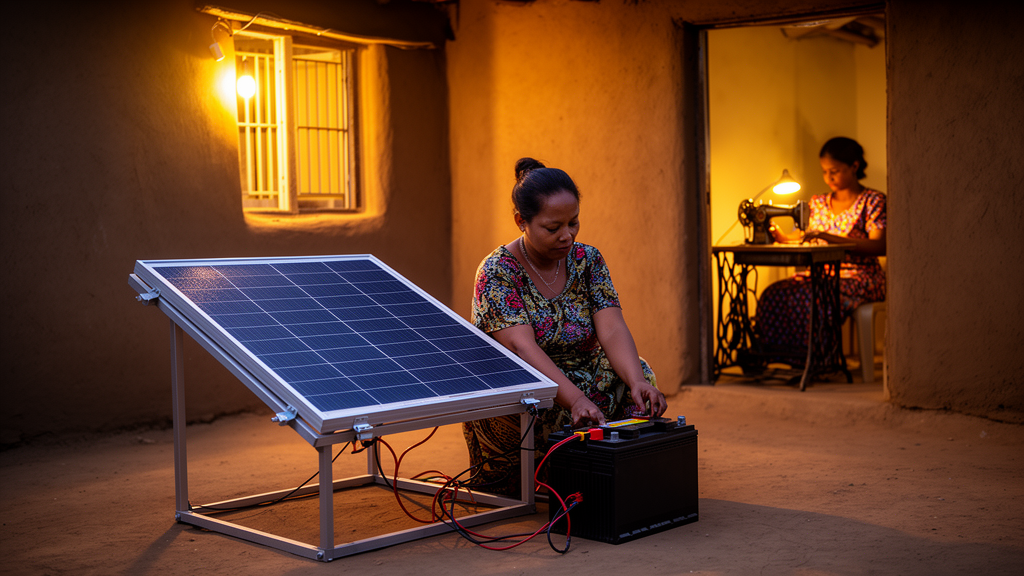
A cookstove might seem like an unlikely instrument of social revolution. Yet according to a new study published in Discover Sustainability, the humble kitchen stove—along with electricity access and sanitation—may be one of the most powerful tools available for advancing women’s rights across the world’s largest economies. The research, led by Md Absar Alam of C. M. College in Darbhanga, India, together with Reena Kumari of Motilal Nehru National Institute of Technology Allahabad and colleagues, provides some of the most comprehensive evidence to date that clean energy access is not merely an environmental issue but a fundamental driver of gender equality.
The study examined the G-20 countries, a group that includes both advanced economies such as the United States, Japan, and Germany and emerging economies such as India, Indonesia, and Brazil. Together these nations account for roughly 85 percent of global gross domestic product and about three-quarters of international trade. The researchers assembled panel data spanning 2000 to 2021, tracking three critical indicators of women’s empowerment: the Female Human Development Index (HDIF), which measures women’s achievements in health, education, and income; the Gender Development Index (GDI), which compares female and male human development; and the Gender Inequality Index (GII), which captures the extent of gender-based disadvantage in a society.
What makes the analysis technically significant is its use of fixed and random effects models, standard econometric tools for panel data that allow researchers to control for unobserved country-specific characteristics while examining causal relationships over time. The team also accounted for a battery of control variables—GDP per capita, female income, urbanization, trade openness, and foreign direct investment—that could otherwise confound the relationship between energy access and gender outcomes. This rigorous approach helps isolate the specific contribution of clean energy infrastructure from the broader effects of economic growth and globalization.
The results are striking. Access to clean cooking fuel, electricity, and sanitation was found to positively influence the HDIF and GDI while negatively affecting the GII. In practical terms, this means that when women gain access to clean energy, their health, education, and economic participation improve, and the structural inequalities they face diminish. The researchers emphasize that clean fuel plays a critical role in promoting women’s health, education, and economic participation—outcomes that ripple outward into broader sustainable development.
The mechanisms behind these findings are rooted in the daily realities of energy poverty. In many developing countries, women and girls spend hours each day collecting firewood and other solid fuels, a burden that limits their time for education, paid work, and community engagement. Traditional cooking methods also expose women disproportionately to indoor air pollution from burning biomass, contributing to respiratory illnesses, cardiovascular disease, and premature death. The World Health Organization estimates that household air pollution from cooking with solid fuels contributes to millions of premature deaths annually, with women and children bearing the greatest burden. Clean cooking fuel eliminates this exposure, while reliable electricity enables lighting for study, refrigeration for food safety, and access to digital technologies that expand economic opportunities.
The study’s authors stress that energy poverty disproportionately affects women, leading to adverse health and socio-economic outcomes. This is not simply a matter of convenience but of survival and dignity. When women lack access to clean energy, they are forced into time-consuming and dangerous fuel collection, exposed to toxic smoke in their own homes, and denied the economic opportunities that electricity enables. The research thus reframes energy access as a gender justice issue, not merely an environmental or economic one.
The findings carry significant policy implications for the G-20 nations. The researchers advocate for gender-responsive energy policies designed to achieve SDG 5 (gender equality) and SDG 7 (clean energy), two of the United Nations’ 17 Sustainable Development Goals adopted in 2015. They call for targeted interventions among G-20 countries to ensure equitable energy access, arguing that such measures would foster women’s empowerment and contribute to broader sustainable development goals. This is particularly relevant for emerging economies within the G-20, where energy access gaps remain substantial despite rapid economic growth.
The research also connects to a growing body of literature on energy justice and energy ethics, fields that examine how the benefits and burdens of energy systems are distributed across societies. By demonstrating that clean energy access measurably improves gender development indicators, the study provides empirical grounding for arguments that energy transition policies should be evaluated not only by their emission reductions but also by their social equity outcomes. The intersection of environmental sustainability and gender equality, the authors argue, is where the most transformative policy opportunities lie.
As the G-20 continues to navigate the global energy transition, this research offers a compelling case that clean energy is not just about reducing carbon emissions—it is about building more equitable societies. The study, published open access under a Creative Commons Attribution 4.0 license, received no external funding and was accepted for publication on 15 June 2026. Its message is clear: when women gain access to clean energy, they gain the foundation for health, education, and economic participation that empowers them to transform their own lives and communities. In the fight for gender equality, the kitchen stove may prove to be as important as the boardroom.
}
Subject of Research: Clean energy access and women's empowerment in G-20 countries
Article Title: Uncovering the role of clean energy in empowering women in G-20 Countries
Article References: Alam, M. A., Kumari, R., Alam, M. M., Kumar, V., & Tripathi, M. A. (2026). Uncovering the role of clean energy in empowering women in G-20 Countries. Discover Sustainability. https://doi.org/10.1007/s43621-026-03898-z
Image Credits: AI Generated
DOI: 10.1007/s43621-026-03898-z
Keywords: clean energy, women's empowerment, G-20 countries, gender equality, energy poverty, sustainable development goals, clean cooking fuel, gender inequality index, Uncovering, role, clean, energy
Cite Scienmag News
Faith Mcneil. (October 19, 2026). Clean Energy Access Emerges as a Powerful Driver of Women’s Empowerment in G-20 Countries. Scienmag. https://scienmag.com/clean-energy-access-emerges-as-a-powerful-driver-of-womens-empowerment-in-g-20-countries/
Faith Mcneil. "Clean Energy Access Emerges as a Powerful Driver of Women’s Empowerment in G-20 Countries." Scienmag, 19 October 2026, https://scienmag.com/clean-energy-access-emerges-as-a-powerful-driver-of-womens-empowerment-in-g-20-countries/. Accessed 19 October 2026.
Faith Mcneil. "Clean Energy Access Emerges as a Powerful Driver of Women’s Empowerment in G-20 Countries." Scienmag. October 19, 2026. https://scienmag.com/clean-energy-access-emerges-as-a-powerful-driver-of-womens-empowerment-in-g-20-countries/


