


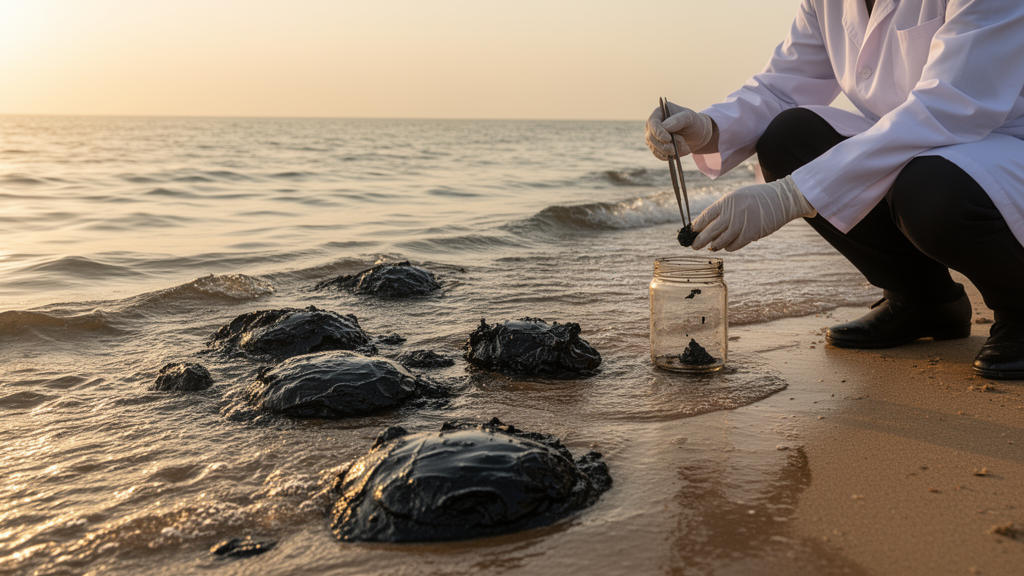
Along the west coast of India, the arrival of tarballs on sandy beaches has become an almost seasonal ritual, a sticky black signature of the shipping lanes and oil operations that crisscross the Arabian Sea. These weathered lumps of petroleum residue are more than a nuisance for beachgoers and tourism operators. A new six-year study of tarballs collected from both the open waters and the shoreline of the Eastern Arabian Sea shows that they act as concentrated carriers of polycyclic aromatic hydrocarbons, or PAHs, a family of compounds that includes some of the most well-characterized carcinogens in environmental chemistry. The research, published in Environmental Monitoring and Assessment, quantifies for the first time in this region how these toxic cargoes differ between tarballs still drifting at sea and those stranded on land, and the results carry an uncomfortable message: weathering does not neutralize the hazard.
The study, led by Pradeep Preethy and V. Suneel of the CSIR-National Institute of Oceanography in Goa together with G. V. M. Gupta of the Centre for Marine Living Resources and Ecology, drew on samples gathered between 2018 and 2024 from the Eastern Arabian Sea and adjacent coastal regions. Tarballs form when crude oil or heavy petroleum products spilled at sea are broken up by waves, lose their lighter volatile fractions through evaporation, and gradually aggregate into semi-solid masses that can drift for hundreds of kilometers. Earlier work by the same group used trajectory modeling to trace tarballs landing on the Goa and Gujarat coasts back to distant spill sources, establishing that these residues can travel far from where the oil first entered the water. The new study shifts the focus from where tarballs come from to what they carry and how dangerous that cargo remains.
The chemical analysis centered on PAHs, molecules built from fused benzene rings that form during incomplete combustion of organic matter and in the composition of crude oil itself. PAHs are typically divided by molecular weight into low, medium, and high molecular weight classes, and this division matters toxicologically. Low and medium molecular weight compounds such as naphthalene, phenanthrene, and their alkylated relatives tend to be more acutely toxic to marine organisms, interfering with larval development and cardiac function in fish embryos, while heavier compounds like benzo[a]pyrene are the ones most strongly associated with carcinogenicity. The team found that both pelagic and beached tarballs along the Eastern Arabian Sea are dominated by low and medium molecular weight PAHs, with phenanthrene consistently emerging as the single most abundant compound in the samples.
Phenanthrene’s dominance is ecologically significant in its own right. Laboratory studies have shown that this three-ringed compound can both stimulate and suppress the growth of key phytoplankton species depending on concentration, and that its toxic effects on benthic organisms intensify as water temperatures rise. Recent work on crustaceans has also linked phenanthrene exposure to immunosuppression of hemocytes, the cells that defend marine invertebrates against disease. A tarball saturated with phenanthrene is therefore not an inert lump of asphalt but a slow-release delivery system for a biologically active compound, dissolving its payload into seawater over weeks or months as it weathers, fragments, and is ingested by organisms ranging from barnacles to sea turtles.
One of the study’s clearest findings is a systematic difference between the two tarball populations. Total PAH concentrations were markedly higher in pelagic tarballs, those collected floating at sea, than in their beached counterparts. This pattern is consistent with what is known about the fate of PAHs in the marine environment. Once oil reaches the shoreline, tarballs experience intense sunlight, oxygen, and microbial attack. Photochemical reactions at the oil surface can degrade PAHs, and biodegradation by hydrocarbon-consuming bacteria removes additional compounds over time. Beached tarballs, exposed to repeated wetting and drying, burial and re-exposure, effectively undergo a more aggressive weathering regime than their floating cousins, and the analysis suggests this explains their comparatively depleted PAH inventories.
To probe these differences more rigorously, the researchers employed diagnostic PAH ratios and principal component analysis, two standard tools of petroleum fingerprinting. Diagnostic ratios compare the relative abundances of specific PAH pairs that degrade at different rates under sunlight or microbial action; shifts in these ratios reveal how long and how intensely a sample has weathered. Principal component analysis compresses the full chemical composition of each sample into a small number of axes, allowing clusters of similar samples to emerge visually. Together, the two approaches indicated that the compositional differences between pelagic and beached tarballs are consistent with the effects of environmental weathering rather than fundamentally different oil sources, although beached tarballs showed greater spatial variability in their PAH profiles, likely reflecting the heterogeneous conditions they encounter along different stretches of coast.
The most consequential part of the analysis concerns carcinogenic risk. The team assessed hazard using two complementary metrics. The first is the benzo[a]pyrene toxic equivalent, or BaP-TEQ, an approach formalized by Nisbet and LaGoy in 1992 in which the concentration of each carcinogenic PAH is multiplied by a toxic equivalency factor that expresses its potency relative to benzo[a]pyrene, the reference carcinogen of the family. The second metric is the carcinogenic PAH fraction, abbreviated cPAH%, which measures what proportion of the total PAH burden consists of compounds classified as carcinogenic. Both metrics pointed in the same direction: pelagic tarballs exhibited a higher carcinogenic potential than beached tarballs, meaning that the material still drifting in open water is, in relative terms, the more hazardous cargo.
Yet the persistence of carcinogenic compounds in both tarball types is arguably the study’s most sobering conclusion. Even after years of weathering at sea and on shore, carcinogenic PAHs remained detectable in every context examined, and some sampling locations showed notably elevated contributions from these heavier, more dangerous compounds. This resilience is not surprising from a chemical standpoint, since high molecular weight PAHs are hydrophobic, structurally stable, and resistant to biodegradation, particularly when locked inside a viscous tar matrix that limits oxygen and nutrient transfer. But it means that the assumption that time and tide will render stranded oil harmless is simply wrong. Beached tarballs function as persistent secondary sources of contamination, leaching toxic compounds into beach sediments and the shallow nearshore zone long after the original spill has faded from memory.
The study also frames pelagic tarballs as mobile vectors of carcinogenic hydrocarbons, a phrase with considerable implications for oceanography and management. A floating tarball is transported by surface currents and winds, and the Arabian Sea’s seasonal reversal of circulation, driven by the monsoons, means that contamination generated in one part of the basin can be delivered to coastlines hundreds or thousands of kilometers away. Tarballs have additionally been documented as rafting substrates that allow sessile organisms to disperse across ocean basins, adding an ecological dimension to their chemical one. Organisms that ingest tarball material, from intertidal crabs to seabirds that encounter oiled residues, accumulate PAH burdens that have been linked to embryotoxicity, immunosuppression, and impaired reproduction across a wide range of marine species.
The authors argue that their findings underscore the need for sustained monitoring and management of petroleum residues along coastal ecosystems, and the Eastern Arabian Sea presents particular challenges in this regard. Previous multi-technique investigations by the group have shown that a substantial share of the region’s oil pollution comes from invisible sources, including operational discharges from shipping and small, unreported spills that never attract satellite attention. Tarballs are the visible integrator of this diffuse chronic pollution, and their PAH chemistry now provides a way to quantify the hazard it represents. As coastal populations grow and tourism economies along the Indian west coast depend increasingly on clean beaches, the study suggests that tarball monitoring should be treated not as a cosmetic exercise in beach cleanup but as a genuine public health and ecotoxicological surveillance program, tracking the carcinogenic cargo that the sea keeps delivering to the shore.
Subject of Research: Distribution and carcinogenic potential of polycyclic aromatic hydrocarbons in beached and pelagic tarballs along the Eastern Arabian Sea
Article Title: Distribution and potential carcinogenicity of polycyclic aromatic hydrocarbons in beached and pelagic tarballs along the eastern Arabian Sea
Article References: Preethy, P., Suneel, V., & Gupta, G. V. M. (2026). Distribution and potential carcinogenicity of polycyclic aromatic hydrocarbons in beached and pelagic tarballs along the eastern Arabian Sea. Environmental Monitoring and Assessment, 198(11), Article 1223. https://doi.org/10.1007/s10661-026-16049-8
Image Credits: AI Generated
DOI: 10.1007/s10661-026-16049-8
Keywords: tarballs, polycyclic aromatic hydrocarbons, Arabian Sea, oil pollution, carcinogenicity, benzo[a]pyrene, weathering, marine pollution, phenanthrene, coastal monitoring, petroleum residues, toxic equivalency
Cite Scienmag News
Nathaniel Bowman. (October 19, 2026). Floating Tarballs Carry a Hidden Cargo of Cancer-Causing Chemicals Across the Arabian Sea. Scienmag. https://scienmag.com/floating-tarballs-carry-a-hidden-cargo-of-cancer-causing-chemicals-across-the-arabian-sea/
Nathaniel Bowman. "Floating Tarballs Carry a Hidden Cargo of Cancer-Causing Chemicals Across the Arabian Sea." Scienmag, 19 October 2026, https://scienmag.com/floating-tarballs-carry-a-hidden-cargo-of-cancer-causing-chemicals-across-the-arabian-sea/. Accessed 19 October 2026.
Nathaniel Bowman. "Floating Tarballs Carry a Hidden Cargo of Cancer-Causing Chemicals Across the Arabian Sea." Scienmag. October 19, 2026. https://scienmag.com/floating-tarballs-carry-a-hidden-cargo-of-cancer-causing-chemicals-across-the-arabian-sea/


