


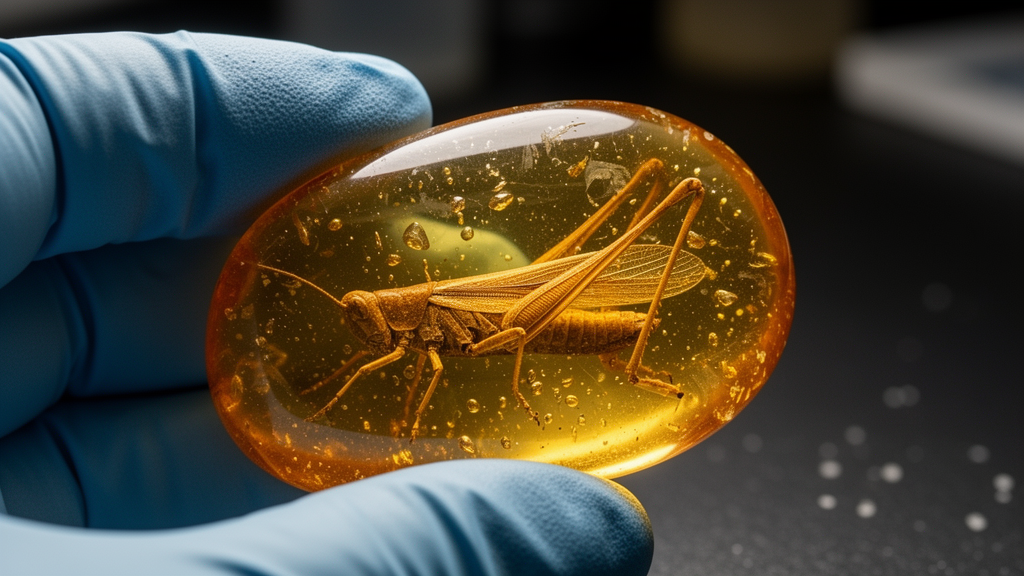
A tiny grasshopper trapped in Baltic amber some 40 million years ago is forcing scientists to rethink how pygmy grasshoppers lost their forewings. The fossil, described in the Journal of Orthoptera Research, represents an entirely new genus and species, Rusmithia gorochovi, and it breaks one of the most consistent rules of its family: modern pygmy grasshoppers that can fly carry only vestigial, scale-like forewings, yet this Eocene insect sported forewings stretching nearly half the length of its powerful hind legs. The discovery, made by an international team of orthopterists, is being hailed as a rare snapshot of an evolutionary transition that has otherwise vanished from the living world.
Pygmy grasshoppers, scientifically known as Tetrigidae, are a peculiar family of small orthopterans found across the globe, often lurking near water or scuttling through leaf litter. In the vast majority of the roughly 2,000 known species, the forewings have been reduced to tiny flaps called tegmenula, while the hind wings remain fully developed and functional for flight. This combination, miniature forewings paired with full-sized hind wings, is one of the family’s defining traits. The new fossil upends that picture. With tegmenula reaching the midpoint of its hind femur, Rusmithia gorochovi holds the record for the longest forewings ever documented in a true pygmy grasshopper, living or extinct.
The story of the specimen’s journey to science is nearly as remarkable as the insect itself. The single adult female holotype was purchased on eBay by Dr. Ru Smith, an amateur naturalist and collector based in York, United Kingdom. Recognizing that the creature trapped in the golden resin was something unusual, Smith contacted the researchers and ultimately made the specimen available for formal study. In gratitude, the team named the new genus after him, while the species epithet honors Dr. Andrei V. Gorochov, a world-renowned expert on fossil Orthoptera. The holotype is now deposited in Smith’s private collection, and it was Smith who photographed and drew the delicate details preserved within the amber.
Dating Baltic amber is a notoriously tricky business. The deposits can range anywhere from 25 to 43 million years old, though most material is assigned to the Priabonian stage of the late Eocene, roughly 38 to 34 million years ago. The authors place their fossil in the Middle Eocene, following the commonly cited Lutetian to Priabonian estimates. The holotype was recovered from the Anna mine near Yantarny in Russia’s Kaliningrad region, the classic source of the world’s finest amber fossils. Encapsulated alongside the grasshopper was a small fly belonging to the family Sciaridae, identified by Andrew Ross of the Natural History Museum in London, a detail that would later prove informative about the ancient habitat.
Classifying the fossil required careful attention to anatomical details that separate the subfamilies of Tetrigidae. Batrachideinae, the subfamily to which the new genus belongs, is characterized by antennae with more than 19 segments, rectangular side lobes on the pronotum known as paranota, and mid-femora with a grooved dorsal margin. Rusmithia gorochovi ticks all these boxes, with an antenna of at least 20 segments and a smooth, flat pronotum whose anterior margin forms an obtuse triangle rather than a spine. The insect’s body measures 18 millimeters, its pronotum 17 millimeters, and its hind femur 9 millimeters, while the tegmenula stretch an extraordinary 6 millimeters. The researchers assigned it, together with the previously described Baltic amber genus Danatettix, to a newly erected tribe, Rusmithini, representing what they call the European Batrachideinae.
The significance of those long forewings lies in what they suggest about the deep evolutionary history of the family. Among the oldest putative pygmy grasshoppers, the Cretaceous genera Archaeotetrix and Prototetrix from Transbaikalia, also show elongated forewings, which is why scientists have long believed that the ancestral pygmy grasshopper possessed larger forewings that were gradually reduced over time. But the picture is muddled. The venation of those Cretaceous fossils differs from that of Rusmithia, and their placement within the family remains uncertain, with some researchers questioning whether they are true tetrigids at all rather than specialized relatives of an extinct locust-like group.
The authors weigh several competing explanations for the new fossil’s anatomy. One possibility is that the visible radius and costa veins in the tegmina represent an ancestral condition, a pattern also seen in Tridactyloidea, the pygmy mole crickets, which modern phylogenetic analyses place at the base of the Caelifera, the group that includes grasshoppers and their relatives. However, wing reduction is known to occur repeatedly across many insect lineages, and as wings shrink, their venation typically simplifies until only the structurally essential veins remain. This means convergence cannot be ruled out on the available evidence. Complicating matters further, two other fossil batrachideines, the European Danatettix hoffeinsorum and the American Eotetrix unicornis from Wyoming’s Green River Formation, both possess typical, reduced tetrigid forewings, casting doubt on any simple story of continuous forewing shrinkage through time.
The most parsimonious interpretation, the researchers conclude, is that Rusmithia belongs to a lineage of Batrachideinae in which longer forewings were retained, possibly representing an intermediate stage between the fully winged ancestral form and the reduced condition seen in modern species. If that reading is correct, it implies that forewing reduction evolved at least twice within Tetrigoidea, the superfamily that contains the pygmy grasshoppers. Two enigmatic Baltic amber species, Acrydium bachofeni, described in 1937 with tegmenula reported at 5 millimeters long, and Succinotettix chopardi, with antennae of at least 19 segments, might also belong to this tribe or its close relatives, but the authors declined to transfer them because their type specimens could not be examined and their whereabouts remain unclear. Locating those types, they argue, would go a long way toward untangling the taxonomy of European fossil batrachideines.
Beyond its evolutionary implications, the fossil offers a vivid window into the world of Eocene Europe. Baltic amber is widely regarded as a gold mine for fossil arthropods, preserving an astonishing diversity of insects in exquisite three-dimensional detail. Recent botanical work on plant inclusions has reconstructed the ancient Baltic landscape as a mosaic of habitats, from coastal swamps to mixed conifer and angiosperm forests, resembling the warm-temperate woodlands found today in East Asia and North America. Such environments harbor numerous modern pygmy grasshoppers, including batrachideines. The authors therefore suggest, with reasonable confidence, that Rusmithia gorochovi lived in warm, humid habitats, feeding on algae, mosses, and detritus. The sciarid fly trapped beside it reinforces this picture, since these flies also thrive on detritus and fungi, indicating that the two insects shared the same microhabitat before both met their fate in dripping resin.
The fossil record of Tetrigidae remains tantalizingly sparse, with all known extinct species fitting comfortably into a single table, from Cretaceous Transbaikalia to Miocene Dominican amber, where famous inclusions such as Electrotettix attenboroughi, named for Sir David Attenborough, have emerged in recent years. Each new specimen, the authors stress, adds a crucial brushstroke to a tragically incomplete portrait of the family’s evolution. Rusmithia gorochovi, with its record-breaking forewings and its ambiguous position between ancestral and modern body plans, may prove to be one of the most important brushstrokes yet. Whether its long tegmenula are a surviving ancestral trait or an independent reinvention, the tiny grasshopper sealed in amber is already reshaping what scientists thought they knew about how wings shrink, disappear, and occasionally refuse to.
Subject of Research: Evolution of reduced forewings in pygmy grasshoppers revealed by a new Eocene Baltic amber fossil
Article Title: A new long-winged pygmy grasshopper in Eocene Baltic amber raises questions about the evolution of reduced tegmenula in Tetrigidae ( Orthoptera )
Article References: Skejo, J., Kasalo, N., Thomas, M. J., & Heads, S. W. (2024). A new long-winged pygmy grasshopper in Eocene Baltic amber raises questions about the evolution of reduced tegmenula in Tetrigidae (Orthoptera). Journal of Orthoptera Research, 33(1), 21-26. https://doi.org/10.3897/jor.33.105144
Image Credits: AI Generated
Keywords: pygmy grasshoppers, Tetrigidae, Baltic amber, Eocene, fossil insects, forewing reduction, Batrachideinae, orthoptera, paleontology, evolution, new species, tegmenula
Cite Scienmag News
Gavin Prescott. (October 19, 2026). 40-Million-Year-Old Grasshopper in Baltic Amber Stuns Scientists With Unexpectedly Long Wings. Scienmag. https://scienmag.com/40-million-year-old-grasshopper-in-baltic-amber-stuns-scientists-with-unexpectedly-long-wings/
Gavin Prescott. "40-Million-Year-Old Grasshopper in Baltic Amber Stuns Scientists With Unexpectedly Long Wings." Scienmag, 19 October 2026, https://scienmag.com/40-million-year-old-grasshopper-in-baltic-amber-stuns-scientists-with-unexpectedly-long-wings/. Accessed 19 October 2026.
Gavin Prescott. "40-Million-Year-Old Grasshopper in Baltic Amber Stuns Scientists With Unexpectedly Long Wings." Scienmag. October 19, 2026. https://scienmag.com/40-million-year-old-grasshopper-in-baltic-amber-stuns-scientists-with-unexpectedly-long-wings/


