


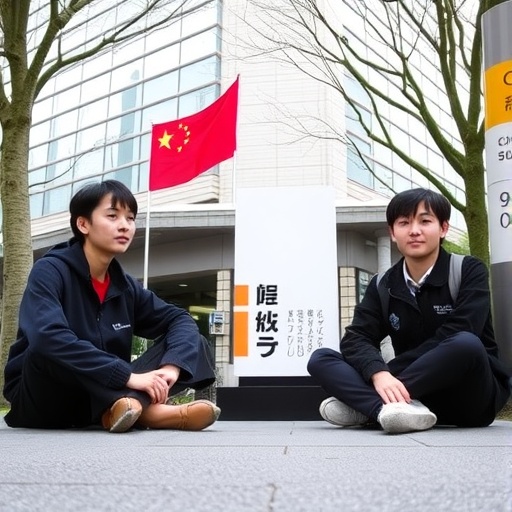
International students are commonly discussed as beneficiaries of education abroad—degree gains, language learning, employability, and intercultural skills. A new paper in ECNU Review of Education reframes the conversation by asking a different question: what do mobile students actually contribute to their host universities and societies?
The study, titled “How Do Chinese Graduate Students Contribute to Japanese Universities: An Agential Perspective,” examines Chinese graduate students in Japan and argues that they function as active agents rather than passive recipients. The authors—Lilan Chen (Waseda University), Shuoyang Meng (University of Tokyo), and Ming Li (University of Osaka)—position student mobility as a two-way knowledge flow.
Japan has pursued international student targets for decades, including large-scale goals of 100,000, 300,000, and more recently 400,000 inbound students. While prior scholarship emphasized why international students arrive and what they experience, less attention has been given to what they give back after enrollment.
To address this gap, the researchers use collaborative autoethnography, a qualitative approach that blends personal reflection, shared narrative, and collective interpretation. Rather than treating “contribution” as a single outcome, the method traces agency across academic and nonacademic spaces, and across formal and informal settings.
In formal academic arenas, participants expand research agendas by inserting China-relevant knowledge and transnational perspectives into Japanese scholarship. They also increase global academic visibility through English-language publications, conference presentations, and cross-border research collaborations.
International students further act as institutional conduits, linking Japanese and Chinese universities through lectures, translation, academic introductions, and collaborative opportunities. This work supports “knowledge diplomacy,” extending beyond bilateral ties toward wider global academic ecosystems.
The effects continue informally: students shape peers’ and supervisors’ research interests, encourage international publication strategies, and broker participation in multilingual research networks. Their lived experience positions them to connect scholars across linguistic and disciplinary divides.
Beyond academia, some participants contribute culturally and socially—teaching Chinese language, engaging in local cultural outreach, and participating in city-level exchange activities. In doing so, they mediate more nuanced understandings of China in everyday community contexts.
The paper also emphasizes bidirectional mobility effects. Experiences in Japan influence families, friends, and future applicants in China, reinforcing cycles of brain circulation and cross-cultural learning through ongoing transnational ties.
Finally, the authors argue that internationalization is not only a policy or institutional brand; it is produced through everyday academic, cultural, and interpersonal labor. Universities, they conclude, should recognize and support these roles through research networking, community engagement, intercultural education, and institutional internationalization initiatives.
Cite Scienmag News
Courtney Benton. (July 26, 2026). Chinese Graduate Students Reshape Japanese Universities as Active Partners. Scienmag. https://scienmag.com/chinese-graduate-students-reshape-japanese-universities-as-active-partners/
Courtney Benton. "Chinese Graduate Students Reshape Japanese Universities as Active Partners." Scienmag, 26 July 2026, https://scienmag.com/chinese-graduate-students-reshape-japanese-universities-as-active-partners/. Accessed 3 September 2026.
Courtney Benton. "Chinese Graduate Students Reshape Japanese Universities as Active Partners." Scienmag. July 26, 2026. https://scienmag.com/chinese-graduate-students-reshape-japanese-universities-as-active-partners/


