


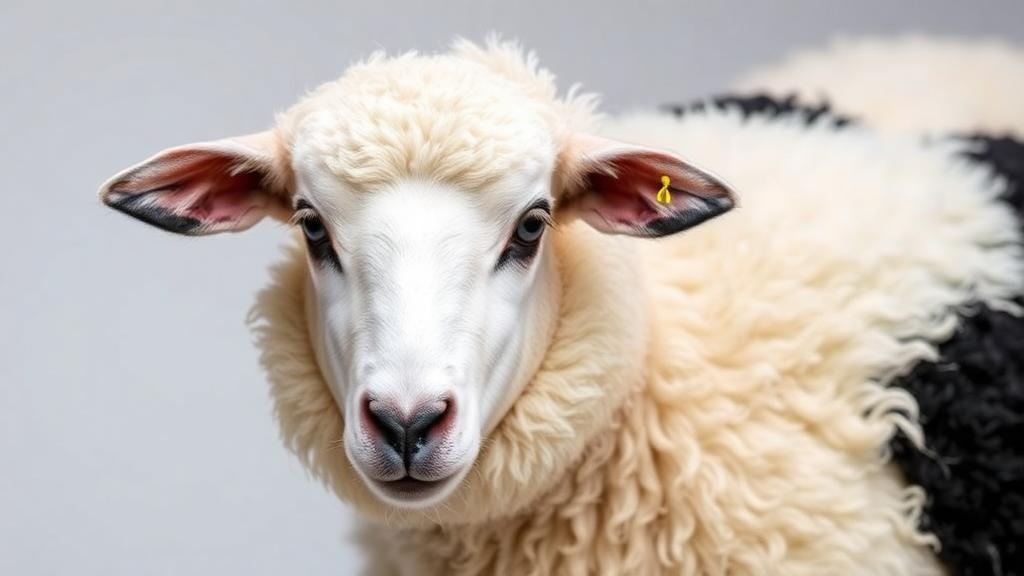
In the world of livestock genetics, few transformations are as visually striking as the one undergone by Junken meat sheep. Born with jet-black fleece, these animals gradually shed their dark coats and grow pure white body wool by roughly 179 days of age. For years, breeders have observed this developmental shift without a full molecular explanation. Now, a team of researchers in China has taken a major step toward decoding it, and their findings point to an unexpected player: a tiny chemical mark deposited on RNA molecules that may help orchestrate the entire color change.
The study, published in BMC Genomics, focused on N6-methyladenosine, commonly abbreviated as m6A. This modification is the most abundant internal chemical tag found on messenger RNA in eukaryotic cells. Rather than altering the genetic code itself, m6A acts like a set of sticky notes on the transcript, influencing how efficiently each message is read, how stable it remains, and how it is processed. Scientists have known for over a decade that m6A shapes development in organisms ranging from plants to mammals, but its role in the skin biology of livestock has remained largely uncharted territory.
To probe this frontier, the research team, led by Binpeng Xi and Jianbin Liu of the Xinjiang Academy of Agricultural and Reclamation Science, employed two complementary sequencing technologies. The first, MeRIP-seq, uses antibodies that specifically recognize the m6A mark, allowing researchers to immunoprecipitate methylated RNA fragments and map exactly where on the transcriptome these tags reside. The second, RNA-seq, measures the abundance of every transcript, revealing which genes are switched up or down. By running both methods on skin samples from three newborn black-fleeced lambs and three 179-day-old white-fleeced lambs, the team could compare not only gene expression but also the epitranscriptomic landscape that governs it.
The mapping results revealed a strikingly consistent architecture of methylation across both age groups. Most m6A peaks clustered within coding sequences and near stop codons, the regions where the cellular machinery translates RNA into protein. The team also detected the canonical GGACU motif, the sequence signature most commonly recognized by m6A-binding proteins, in both the newborn and older animals. This consistency suggests that the fundamental machinery of RNA methylation operates similarly at both stages of coat development, while the differences lie in which specific genes carry the marks.
Those differences proved substantial. Across three paired comparisons between individual lambs of the two age groups, the researchers identified between 1,273 and 1,716 differential m6A peaks, alongside 400 to 1,657 differentially expressed genes. Functional enrichment analysis of these changing genes and peaks highlighted biological processes intimately tied to the coat transition: hair follicle development, epidermal morphogenesis, extracellular matrix remodeling, and focal adhesion. Signaling pathways long implicated in pigmentation and skin renewal also featured prominently, including Wnt, TGF-beta, PI3K-Akt, Notch, and melanogenesis-related cascades. The convergence of methylation changes and expression shifts on these pathways provides compelling circumstantial evidence that RNA modification participates in reprogramming the skin as fleece color flips.
One of the study’s most technically interesting contributions is its integrative analysis of how methylation status and transcript abundance couple. The researchers observed distinct coupling patterns depending on the comparison. In one pairing, hypermethylation coincided with downregulated expression, a pattern consistent with m6A accelerating transcript decay. In the other two comparisons, the predominant pattern was the opposite: hypomethylation paired with increased expression, suggesting that removal of the mark stabilizes certain messages during the white-fleece phase. This comparison-dependent coupling underscores a key principle of epitranscriptomics: the functional consequence of an m6A mark depends on its position within the transcript and the cellular context in which it appears.
From this integrated dataset, the team prioritized a shortlist of candidate m6A-associated genes that may drive the color transition. The list includes FZD7, a receptor in the Wnt signaling pathway with established roles in hair follicle cycling; GAS1, a growth arrest factor involved in developmental signaling; COL4A1, a structural collagen of the basement membrane; PXDN, an enzyme involved in collagen cross-linking; LAMC3, a laminin chain component of the extracellular matrix; ARID1A, a chromatin remodeling factor; FA2H, an enzyme in fatty acid metabolism; and RAPGEFL1, a signaling scaffold. The presence of extracellular matrix and Wnt pathway genes on this list fits the biology of the transition, since shifting from black to white fleece requires not only changes in pigment production by melanocytes but also structural remodeling of the follicle environment in which those pigment cells operate.
To validate their sequencing results, the researchers performed quantitative real-time PCR on selected genes, confirming that the expression trends observed by RNA-seq held up under an independent measurement method. This verification step strengthens confidence in the dataset, though the authors are careful to note that the m6A sites themselves have not yet been individually validated by orthogonal techniques, and functional studies of the candidate genes remain to be done. The work is explicitly framed as a candidate-generation study, laying the groundwork for targeted follow-up experiments rather than closing the case.
The authors also flag an important caveat: in their design, age and coat-color stage are confounded, since every older lamb was both white-fleeced and 179 days old. The molecular differences they detected therefore reflect the developmental transition as a whole, and disentangling which changes are specifically responsible for pigment switching will require additional experiments, potentially including time-course sampling at intermediate ages or comparisons with sheep breeds that do not undergo a color change. This honest framing is a model of scientific caution in a field where epitranscriptomic datasets can invite overinterpretation.
Nevertheless, the implications extend well beyond a single sheep breed. Coat color is an economically significant trait in wool and meat production, and understanding its developmental regulation could inform breeding strategies. More broadly, the study adds livestock skin biology to the growing map of tissues where m6A shapes developmental programs, joining work on embryogenesis, neurodevelopment, and immune differentiation. As the tools for precise m6A site validation and genome editing mature, the candidate genes identified here offer a concrete starting point for functional dissection. The humble Junken lamb, transforming from black to white in its first six months of life, has now given scientists a molecular thread to pull, and the fabric it unravels may reshape how we think about the epigenetic control of visible traits in farm animals.
Subject of Research: m6A RNA modification and gene expression during developmental coat color transition in Junken meat sheep
Article Title: Integrated MeRIP-seq and RNA-seq analyses identify candidate m6A-associated genes during developmental coat color transition in Junken meat sheep
Article References: Xi, B., Zhao, S., Yu, Q., Zhou, H., Zhang, W., Chen, Y., Cheng, R., Wang, Z., Yang, H., & Liu, J. (2026). Integrated MeRIP-seq and RNA-seq analyses identify candidate m6A-associated genes during developmental coat color transition in Junken meat sheep. BMC Genomics. https://doi.org/10.1186/s12864-026-13311-8
Image Credits: AI Generated
DOI: 10.1186/s12864-026-13311-8
Keywords: m6A methylation, MeRIP-seq, RNA-seq, coat color transition, Junken meat sheep, hair follicle development, melanogenesis, Wnt signaling, epitranscriptomics, skin biology, livestock genetics, BMC Genomics
Cite Scienmag News
Juliet Wilcox. (October 4, 2026). Chemical Tags on RNA May Steer a Sheep’s Dramatic Black-to-White Coat Change. Scienmag. https://scienmag.com/chemical-tags-on-rna-may-steer-a-sheeps-dramatic-black-to-white-coat-change/
Juliet Wilcox. "Chemical Tags on RNA May Steer a Sheep’s Dramatic Black-to-White Coat Change." Scienmag, 4 October 2026, https://scienmag.com/chemical-tags-on-rna-may-steer-a-sheeps-dramatic-black-to-white-coat-change/. Accessed 4 October 2026.
Juliet Wilcox. "Chemical Tags on RNA May Steer a Sheep’s Dramatic Black-to-White Coat Change." Scienmag. October 4, 2026. https://scienmag.com/chemical-tags-on-rna-may-steer-a-sheeps-dramatic-black-to-white-coat-change/


