


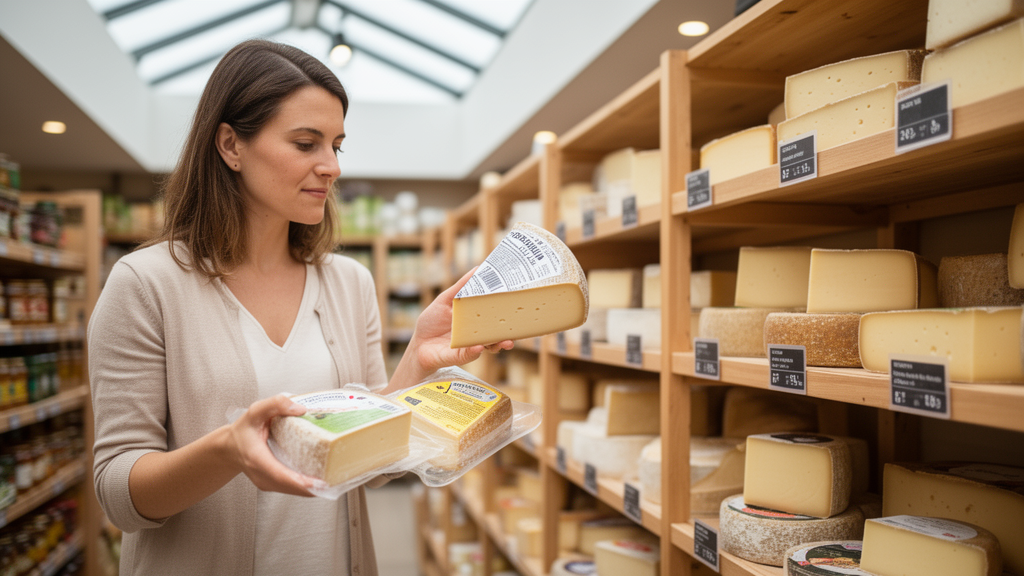
Italy’s most produced protected cheese may owe part of its market power to a small printed acronym. A new study of Italian consumers finds that the Protected Designation of Origin, or PDO, label on Grana Padano cheese commands the highest willingness to pay of the attributes tested, reaching an estimated 2.64 euros, yet the value of that label is far from uniform across shoppers and does not simply stack with other quality claims.
The research, published in Agricultural and Food Economics, set out to measure how consumers weigh three cues on a wedge of Grana Padano: the PDO certification, an animal welfare claim, and a sensory attribute described as savoury. The authors also asked how personal motivations, such as health orientation, convenience seeking and ethical sensitivity, and socio-demographic characteristics shape those valuations, and whether combining labels on the package reinforces or undermines the premium that shoppers attach to the origin certification.
Grana Padano offered a demanding test case. According to figures cited in the study, production in 2025 exceeded 6.05 million wheels, roughly 236,180 tonnes, an increase of more than seven percent over the previous year, with an estimated production value of about 2.2 billion euros. More than half of output is exported, and the cheese accounts for around 22 percent of Italy’s total milk production, making it the country’s largest PDO cheese by volume. The cheese is made year-round from raw, partially skimmed cow’s milk within a designated area of Northern Italy covering Lombardy, Veneto, Emilia-Romagna, Piedmont and parts of the autonomous provinces of Trento and Bolzano, and must mature for at least nine months.
To capture trade-offs among attributes, the researchers ran a ranking-based conjoint experiment. Data were collected in 2023 through an online questionnaire administered by a professional survey agency using a stratified sampling procedure designed to mirror the Italian population by gender, education, income and age. A minimum sample of 383 respondents was calculated from population parameters, and the final dataset contained 401 valid responses. Participants ranked eight product profiles, generated through an orthogonal fractional factorial design that reduced the cognitive burden of comparing a full set of attribute combinations. Each profile varied the price, the presence of the PDO label, the animal welfare claim and the savoury descriptor.
The team estimated preferences with rank-ordered logistic regression, a model suited to ranking data that treats the probability of a profile being placed first as a function of the partial utilities of its attributes. Willingness to pay for each attribute was derived from the marginal rate of substitution between that attribute and price. Three nested models were estimated: a baseline with main effects only, a second adding interactions among the product attributes, and a third, designated the primary reference for hypothesis testing, interacting the attributes with psychographic constructs and demographic variables. The psychographic constructs, covering marketing motivations, convenience and health, were measured on five-point Likert scales and showed satisfactory internal consistency, with Guttman’s lambda values of 0.66, 0.67 and 0.77 respectively.
The headline result is that PDO certification carried the highest willingness to pay in the fully specified model, at 2.64 euros, ahead of the animal welfare claim at 1.81 euros and the savoury attribute at 1.58 euros. Yet the simpler baseline model told a different story: without accounting for individual characteristics, the animal welfare claim generated the highest utility, followed by PDO certification, with the sensory attribute trailing. The authors attribute this shift to how the models handle preference heterogeneity, noting that baseline estimates aggregate individual variation and tend to overestimate willingness to pay for the PDO and welfare claims while underestimating it for the sensory attribute.
The interaction results carry the most practical weight. When PDO certification appeared alongside the sensory claim, the interaction was positive, indicating that geographical origin and expected taste reinforce one another in consumers’ minds. When PDO was paired with the animal welfare claim, however, the interaction was negative. Rather than adding a joint premium, the two cues appear to function as partially substitutable sources of quality information. The authors interpret this as evidence that consumers read the PDO primarily as a signal of geographical origin and traditional production rather than as a broader ethical guarantee, consistent with earlier findings that shoppers rarely associate origin labels with animal welfare.
Consumer motivations mattered more than demographics. Health-oriented consumers showed a positive marginal utility for the PDO label, suggesting they associate the certification with stricter production standards and product integrity, while convenience-oriented consumers valued it less, plausibly because they link traditional certified products with higher prices and less practicality. Marketing motivations showed no significant effect on PDO valuation. For the animal welfare claim, the strongest positive driver was animal welfare sensitivity, followed by environmental sensitivity, while convenience again had a negative association. Notably, education, income and age did not significantly shape willingness to pay for the PDO label, and gender mattered only for the welfare claim, where male consumers showed lower willingness to pay than female consumers, a pattern the authors note extends to dairy a gender gap previously documented mainly in meat.
On the central question of co-labeling, the evidence for synergy was weak. The hypothesis that combining PDO with animal welfare or sustainability certifications would raise consumer valuation and trust received little support, with the negative PDO-welfare interaction pointing instead to substitution. Still, the authors argue that pairing the origin label with credible animal welfare assurances could be a promising positioning strategy for ethically oriented consumer segments, even if it would not lift the whole market. They suggest that producers reinforce the link between PDO and health in communication, target welfare claims at ethically sensitive niches, and experiment with combined certifications in premium lines, while policymakers consider integrating visible welfare dimensions into certification schemes and standardised welfare labelling across dairy products.
The study’s limitations temper the numbers. It was conducted in a single national context, so cultural differences in how PDO labels are read remain untested, and the stated-preference design is hypothetical, meaning respondents may rank options they would reject at real prices, a source of potential overestimation known as hypothetical bias. The sensory attribute’s modest role may also reflect the experimental setting, in which credence attributes such as certification tend to draw attention because they reduce uncertainty before purchase. The authors call for cross-country replications, additional psychographic dimensions such as food involvement and institutional trust, and tests of alternative label combinations, including carbon footprint claims, to establish how robust these valuations are beyond the Italian cheese counter.
Subject of Research: Consumer willingness to pay for PDO certification, animal welfare and sensory attributes in Grana Padano cheese
Article Title: From label to table: Can co-labeling boost trust and value in PDO cheese?
Article References: Di Vita, G., Zanchini, R., De Boni, A., Cinzia, B., & Mora, C. (2026). From label to table: Can co-labeling boost trust and value in PDO cheese?. Agricultural and Food Economics, 14(1), Article 84. https://doi.org/10.1186/s40100-026-00528-0
Image Credits: AI Generated
DOI: 10.1186/s40100-026-00528-0
Keywords: Grana Padano, PDO certification, willingness to pay, conjoint analysis, animal welfare, food labels, consumer preferences, Italy, dairy, co-labeling, sensory quality, rank-ordered logit
Cite Scienmag News
Alan Morgan. (October 27, 2026). Cheese shoppers value origin labels most, but ethics reshape what they will pay. Scienmag. https://scienmag.com/cheese-shoppers-value-origin-labels-most-but-ethics-reshape-what-they-will-pay/
Alan Morgan. "Cheese shoppers value origin labels most, but ethics reshape what they will pay." Scienmag, 27 October 2026, https://scienmag.com/cheese-shoppers-value-origin-labels-most-but-ethics-reshape-what-they-will-pay/. Accessed 27 October 2026.
Alan Morgan. "Cheese shoppers value origin labels most, but ethics reshape what they will pay." Scienmag. October 27, 2026. https://scienmag.com/cheese-shoppers-value-origin-labels-most-but-ethics-reshape-what-they-will-pay/


