


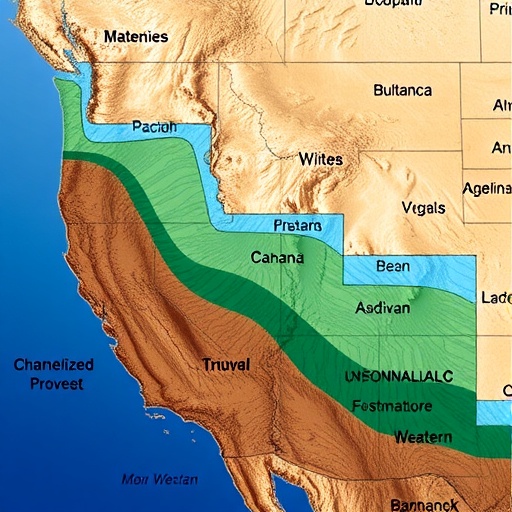
In a groundbreaking study set to redefine our understanding of continental dynamics, researchers Yang, Liu, and Cao have unveiled new insights into the intricate processes shaping the western margin of the North American craton. Published in Nature Communications in 2026, their work reveals that channelized lithospheric erosion is a dominant force sculpting the margin, a discovery poised to alter long-held geological paradigms and influence the study of Earth’s ancient tectonic frameworks.
The North American craton, known for its remarkable stability over billions of years, forms the ancient heart of the continent. Despite its apparent rigidity, the outer edges of the craton are far from inert. The margins have experienced significant geological modifications, but the mechanisms driving these changes have remained elusive until now. The new research discloses that lithospheric erosion occurs in focused channels—discrete zones where material from the base of the lithosphere is efficiently removed, effectively reshaping the craton’s boundary.
Channelized lithospheric erosion, as detailed by the authors, contrasts sharply with more diffuse erosion concepts previously considered. Instead of uniform thinning or broad-scale chemical alteration impacting the craton’s edges, this process entails highly localized zones where mantle dynamics, thermal regimes, and chemical interactions collaborate to excavate and weaken specific sections of lithospheric mantle. This channelization provides a plausible explanation for the peculiar tectonic and seismic patterns observed along the western craton margin.
Employing an integrative approach combining seismic tomography, geochemical analysis, and computational modeling, the study meticulously maps the spatial distribution of these erosional channels. Seismic imaging delineates low-velocity anomalies beneath the western craton margin, marking zones where lithospheric thinning and modification are most intense. These anomalies coincide with zones of enriched mantle xenoliths and geochemical signatures reflecting fluid-enhanced melting and metasomatism, linking physical processes to chemical transformation.
The implications of identifying discrete channels of lithospheric erosion extend into understanding the craton’s mechanical stability. The findings suggest that erosion is not merely a surface phenomenon driven by tectonic abrasion or surface erosion but is rooted deep within the mantle lithosphere. Fluid infiltration—particularly the migration of volatile-rich melts or fluids—facilitates localized weakening, fostering these erosional channels. This challenges the notion of cratonic lithosphere as a static, impervious block and highlights its dynamic interaction with mantle processes.
Moreover, the role of mantle convection patterns underlying the western margin reveals an intriguing relationship with these channelized zones. The study’s computational models demonstrate that mantle flow induces shear stress concentrated along narrow corridors, correlating with observed zones of lithospheric removal. This coupling of flow dynamics and lithosphere erosion underscores a feedback mechanism whereby mantle convection sculpts lithospheric architecture, which in turn influences mantle flow pathways.
An important aspect of this work lies in evaluating the consequences of channelized erosion for seismic hazard assessment. The western margin of the North American craton is seismically active, yet the origins of some intraplate earthquakes have long puzzled geologists. By identifying these erosional channels as zones with diminished lithospheric rigidity, the study provides a framework for understanding how localized weakening zones may serve as nucleation points for seismicity, enhancing predictive models.
The researchers also venture into the time scales involved, suggesting that channelized lithospheric erosion operates over millions of years but can produce sharp transitions in lithospheric thickness and properties within substantially shorter geological intervals. This temporal dimension offers new perspectives on the evolution of cratonic margins, highlighting episodic, accelerated modification events linked to mantle dynamic changes or surface tectonic forces such as rifting or orogeny.
From a geochemical viewpoint, the investigation uncovers that channelized erosion alters mantle composition above the channel. The removal of metasomatized lithospheric mantle exposes underlying asthenospheric mantle material, which is typically hotter and compositionally distinct. This process may account for anomalous volcanism and geochemical signatures found along the craton margin, bridging lithospheric dynamics with mantle chemistry and surface volcanism.
The study’s methodological innovations are notable. Coupling high-resolution seismic datasets with state-of-the-art geodynamic simulations has permitted unprecedented insight into the three-dimensional structure and evolution of the lithosphere-asthenosphere boundary at the western craton margin. This multi-disciplinary approach sets a new standard for lithosphere studies and may inspire similar explorations in other cratonic regions worldwide.
Crucially, Yang, Liu, and Cao’s research also challenges earlier models that emphasized large-scale delamination or gradual, uniform thermochemical erosion processes as primary drivers of craton margin modification. Instead, the evidence favors a model in which selective channelized erosion imparts complexity and heterogeneity to the lithospheric structure, potentially influencing regional tectonic behavior and continental stability.
Looking ahead, the identification of channelized lithospheric erosion opens avenues for further exploration into the links between deep Earth processes and surface geology. For example, understanding how erosion channels interact with fault systems or influence mineral resource distribution could yield practical benefits. Additionally, investigating whether similar channelized erosion is active beneath other craton margins around the globe may offer insights into continental evolution at the planetary scale.
In summation, the revelations presented in this 2026 Nature Communications article fundamentally enhance the geological narrative of one of Earth’s most ancient and enduring structures. The recognition that the western North American craton margin is actively shaped by channelized lithospheric erosion reframes our perception of cratonic stability and highlights the dynamic interplay between the lithosphere and the underlying mantle. This work punctuates the essence of modern geoscience: that Earth’s interior processes remain complex, highly variable, and astonishingly influential in shaping our planet’s surface.
As the scientific community digests these findings, their impact will likely ripple across multiple disciplines—from tectonics and geophysics to geochemistry and seismic hazard analysis—underscoring the importance of integrated, cross-scale investigative strategies. These insights not only illuminate the past but also enhance our ability to anticipate Earth’s future geological transformations with greater precision.
Cite Scienmag News
Violet Maxwell. (May 22, 2026). Channelized Erosion Reshapes Western North American Craton. Scienmag. https://scienmag.com/channelized-erosion-reshapes-western-north-american-craton/
Violet Maxwell. "Channelized Erosion Reshapes Western North American Craton." Scienmag, 22 May 2026, https://scienmag.com/channelized-erosion-reshapes-western-north-american-craton/. Accessed 4 September 2026.
Violet Maxwell. "Channelized Erosion Reshapes Western North American Craton." Scienmag. May 22, 2026. https://scienmag.com/channelized-erosion-reshapes-western-north-american-craton/


