


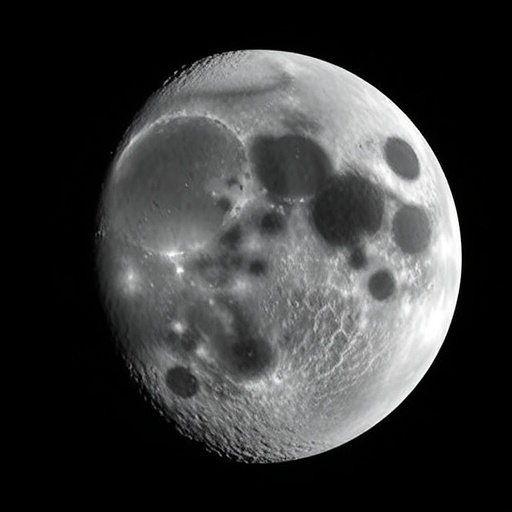
The exploration of celestial bodies has captured human imagination for centuries, but the ongoing missions to the Moon are bringing us closer than ever to understanding its enigmatic surface and subsurface structures. Among these, the Chang’E-6 mission stands out, heralding an exciting era of lunar exploration that utilizes advanced technologies to gather unprecedented data. This mission focuses on probing the stunning complexities of the Moon’s regolith—its surface layer—and revealing hidden geological structures that lie beneath. The study conducted by Zhang, Ding, and Su offers insights into these new discoveries via their in-situ Lunar Regolith Penetrating Radar.
The Chang’E-6 mission marks a significant achievement for lunar science, especially with its ambitious goal of exploring the Moon’s south pole region. This area is not only rich in potential resources but also presents a geological landscape that has been relatively unexplored compared to other lunar regions. The mission’s groundbreaking technology harnesses the capabilities of in-situ Lunar Regolith Penetrating Radar, which has proven to be a transformative tool in unraveling the Moon’s geological mysteries.
The significance of the Lunar Regolith Penetrating Radar cannot be understated. This sophisticated technology detects varying layers of lunar material by sending and receiving radar signals to identify structures buried beneath the surface. This method provides a non-invasive view into the subsurface, enabling scientists to ascertain the thickness and composition of different geological layers without the need for extensive drilling operations. In essence, this radar acts as an auditory tool, interpreting the echoes that bounce back to map the unseen features of the Moon’s geology.
The results culminating from the Chang’E-6 mission have illuminated some of the previously obscured aspects of lunar geology. Zhang and his collaborators report that their findings reveal a distinct subsoil layer characterized by varying density and composition. This significant discovery enhances our comprehension of the Moon’s geological history, suggesting that the lunar surface is marked by processes that are more complex than previously thought. Such information is pivotal for future missions aiming to mine the Moon for resources or establish sustainable bases for potential human habitation.
One of the intriguing aspects uncovered through the analysis is the existence of a sharply defined boundary between the regolith and the underlying bedrock. This finding suggests the possibility of a unique geological layering process likely influenced by numerous factors, including volcanic activity and impacts from meteorites throughout lunar history. Understanding these features is essential not only for our knowledge of the Moon but also for comparative planetary geology, which can provide insights into terrestrial processes and the evolution of other celestial bodies.
Moreover, the research provides compelling evidence supporting the theory of a dynamic subsurface environment on the Moon. The data collected indicate that geological activities might still be underway beneath the surface layers, challenging the traditional perspective of the Moon as a geologically inactive body. This revelation opens doors to further research that could unravel the timelines of various geological events and the Moon’s response to external forces over billions of years.
The team’s meticulous methodology in analyzing the radar data further solidifies the reliability of their findings. By using a combination of radar signal analysis and geological modeling, they crafted a framework that allows for the interpretation of the geological stratigraphy at the Chang’E-6 landing site. This cross-disciplinary approach not only enhances data credibility but also sets a precedent for how future studies in planetary exploration could be conducted.
The implications of these discoveries are far-reaching. As we push the boundaries of our expeditions beyond Earth, the need for sustainable practices becomes paramount. The capabilities exhibited by the Chang’E-6 mission demonstrate the potential for utilizing the Moon’s resources effectively and responsibly. Understanding the subsoil structure stands to inform strategies for resource extraction, ensuring that lunar mining can be conducted with minimal environmental impact.
Additionally, these findings lay the groundwork for future lunar missions, including those poised to send humans back to the Moon. The knowledge gleaned from the Chang’E-6 data collection illuminates safe landing zones and potential areas for habitat construction while illuminating safer navigation routes around the lunar surface. As international collaboration toward lunar exploration grows, the information amassed from missions such as Chang’E-6 could serve as a shared resource for scientific understanding and technological deployment.
This comprehensive study also spurs interest in technology transfer back to Earth, where advanced radar technologies can inform disciplines ranging from civil engineering to environmental monitoring. The methodology employed here, employing radar to assess subsurface structures, could have direct applications in understanding terrestrial geological formations, creating a direct loop of benefit from space exploration back to our home planet.
As we stand at the brink of a new space era, the findings from the Chang’E-6 mission exemplify how contemporary technological advancements can unlock the secrets housed in our cosmic neighbor. The intricate details provided by the Lunar Regolith Penetrating Radar unveil patterns and phenomena that may redefine not just lunar science, but also our understanding of Earth and other planets in our solar system. The potency of integrating innovative technology with exploratory missions underscores the essential nature of investment in space research, which serves as a conduit for groundbreaking discoveries that echo through the realms of science and beyond.
In conclusion, the Chang’E-6 mission—and the crucial work presented by Zhang, Ding, and Su—effectively demonstrates the power of advanced radar technology in exploring the Moon’s subsurface. The implications stretch across multiple domains, enriching our scientific knowledge while providing a foundational touchstone for future explorations. With each revelation, we inch closer to unraveling the enduring mysteries of the Moon, ultimately drawing us nearer to the stars while fostering an interconnected understanding of the celestial environments.
Zhang, Z., Ding, C., Su, Y. et al. Subsoil structure at the Chang’E-6 landing site revealed by in-situ Lunar Regolith Penetrating Radar. Commun Earth Environ 6, 640 (2025). https://doi.org/10.1038/s43247-025-02631-4
Cite Scienmag News
Violet Maxwell. (August 7, 2025). Chang’E-6 Reveals Lunar Subsoil Structure via Radar. Scienmag. https://scienmag.com/change-6-reveals-lunar-subsoil-structure-via-radar/
Violet Maxwell. "Chang’E-6 Reveals Lunar Subsoil Structure via Radar." Scienmag, 7 August 2025, https://scienmag.com/change-6-reveals-lunar-subsoil-structure-via-radar/. Accessed 4 September 2026.
Violet Maxwell. "Chang’E-6 Reveals Lunar Subsoil Structure via Radar." Scienmag. August 7, 2025. https://scienmag.com/change-6-reveals-lunar-subsoil-structure-via-radar/


