

Monday, October 26, 2026
Science
No Result
View All Result
  • Login
  • HOME
  • SCIENCE NEWS
  • CONTACT US
  • HOME
  • SCIENCE NEWS
  • CONTACT US
No Result
View All Result
Scienmag
No Result
View All Result
Home Science News Agriculture

Cerium oxide nanoparticle priming restores vigor in aged safflower seeds

October 26, 2026
in Agriculture
Alan Morgan
By Alan Morgan Scienmag Editorial Profile - Precision Agriculture
Reading Time: 2 mins read
0
Cerium oxide nanoparticle priming restores vigor in aged safflower seeds

Cerium oxide nanoparticle priming restores vigor in aged safflower seeds

65
SHARES
587
VIEWS
Share on FacebookShare on Twitter
ADVERTISEMENT

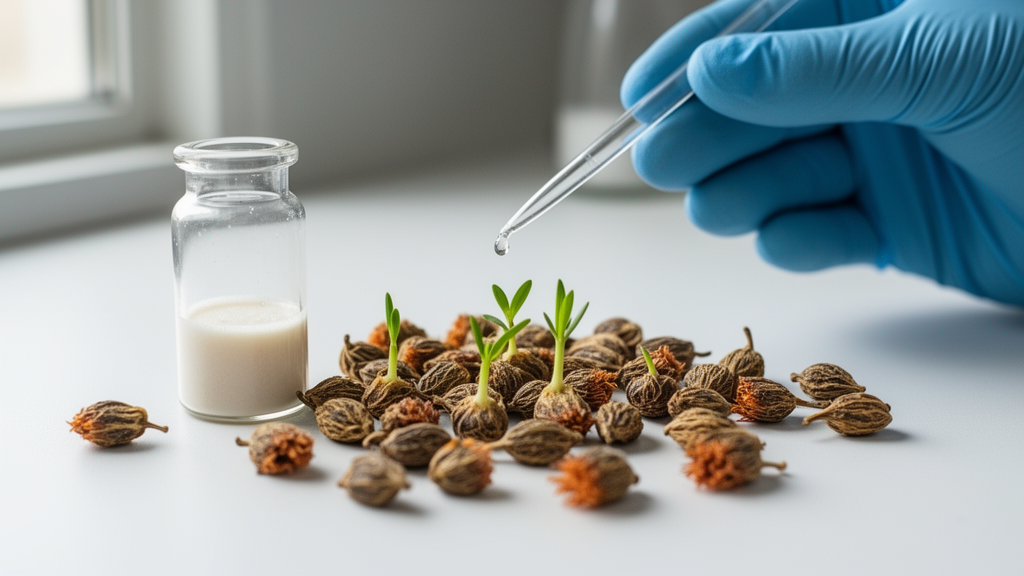
Safflower seeds are prized in traditional Chinese medicine, but their high oil content makes them unusually vulnerable to aging, a process that erodes germination capacity and ultimately threatens both the quality and yield of the crop. A new study published in BMC Plant Biology reports that priming aged safflower seeds with cerium oxide nanoparticles (CeO2NPs) substantially revived their performance, raising germination from 64.5 percent to 87.4 percent while markedly increasing seedling biomass and chlorophyll content. The work combined physiological measurements, lipidomic profiling, transcriptomic analysis and quantitative PCR to trace how the nanoparticles act on aged seeds.

In the treated seeds, CeO2NPs priming reduced ROS accumulation and boosted the activity of antioxidant enzymes, the cellular machinery that neutralizes these harmful molecules. This dual effect, less oxidative damage alongside stronger antioxidant defenses, offers a mechanistic explanation for the improved germination and early seedling growth observed after treatment. The lipidomic results point to a second layer of protection.

Aging compromises seed membranes, and the researchers found that CeO2NPs priming clearly raised the contents of membrane lipids known as DGDG and SQDG. By replenishing these structural lipid components, the nanoparticles appear to facilitate the repair of membrane damage in aged seeds, helping restore the integrity that germination depends on. At the level of gene expression, transcriptomic analysis showed that CeO2NPs significantly upregulated genes related to light-harvesting proteins, the pigment-associated complexes that capture solar energy for photosynthesis.

Quantitative PCR verification then confirmed that genes involved in sugar metabolism, fatty acid metabolism, the antioxidant system and light-harvesting protein synthesis were distinctly upregulated in the treated seeds. Together, these molecular changes align with the observed gains in chlorophyll content and seedling biomass, suggesting that the nanoparticles prime seeds for more effective photosynthetic capacity once germination begins. Taken as a whole, the study concludes that CeO2NPs priming enhances the vigor of aged safflower seeds through two linked routes: promoting photosynthetic capacity and improving antioxidant capacity.

Because safflower is a traditional medicinal material whose seed quality deteriorates readily, the findings identify nanoparticle priming as an innovative technique for improving the physiological performance of stored seeds. The authors note that the mechanisms by which CeO2NPs priming enhances aged seed vigor had previously remained poorly elucidated, and this multi-omics evidence base now connects the treatment to specific lipid, gene-expression and physiological outcomes.

Subject of Research: Cerium oxide nanoparticle priming to improve the vigor of aged safflower seeds

Article Title: Cerium oxide nanoparticles priming enhances aged safflower seed vigor via improved photosynthetic and antioxidant capacity

Article References: Zhong, L., Lv, T., Liu, J., Li, J., Pritchard, H. W., Colville, L., Zhou, T., Ren, C., Pei, J., & Yan, J. (2026). Cerium oxide nanoparticles priming enhances aged safflower seed vigor via improved photosynthetic and antioxidant capacity. BMC Plant Biology. https://doi.org/10.1186/s12870-026-10162-z

Image Credits: AI Generated

DOI: 10.1186/s12870-026-10162-z

Keywords: safflower, seed vigor, cerium oxide nanoparticles, seed priming, seed aging, reactive oxygen species, antioxidant enzymes, lipidomics, membrane lipids, photosynthesis, gene expression, BMC Plant Biology

Cite Scienmag News

Alan Morgan. (October 26, 2026). Cerium oxide nanoparticle priming restores vigor in aged safflower seeds. Scienmag. https://scienmag.com/cerium-oxide-nanoparticle-priming-restores-vigor-in-aged-safflower-seeds/

Alan Morgan. "Cerium oxide nanoparticle priming restores vigor in aged safflower seeds." Scienmag, 26 October 2026, https://scienmag.com/cerium-oxide-nanoparticle-priming-restores-vigor-in-aged-safflower-seeds/. Accessed 26 October 2026.

Alan Morgan. "Cerium oxide nanoparticle priming restores vigor in aged safflower seeds." Scienmag. October 26, 2026. https://scienmag.com/cerium-oxide-nanoparticle-priming-restores-vigor-in-aged-safflower-seeds/


Tags: antioxidant enzyme activity in seedsantioxidant enzymesBMC Plant Biologycerium oxide nanoparticlesCerium oxide nanoparticles in seed priminggene expressionlipidomic profiling of seed membraneslipidomicsmembrane lipid repair in aged seedsmembrane lipidsnanoparticle-mediated plant stress toleranceoxidative stress reduction in seedsphotosynthesisreactive oxygen speciessafflowersafflower seed aging and rejuvenationseed agingseed germination enhancementseed primingseed vigorseed vigor restoration techniquesseedling biomass increase through nanotechnologytraditional Chinese medicine seed qualitytranscriptomic analysis of seed rejuvenation
Share26Tweet16
Previous Post

Weight-loss surgery sustains diabetes remission for over a decade, trial shows

Next Post

Rare parotid abscess traced to brucellosis in a sheep farmer

Related Posts

Gene Ovh1HD1 Pinpointed as Key Driver of Oil-Producing Trichome Density in Oregano
Agriculture

Gene Ovh1HD1 Pinpointed as Key Driver of Oil-Producing Trichome Density in Oregano

October 26, 2026
Light-Responsive Gene Pathway Drives Purple Pigment Buildup in Pepper
Agriculture

Light-Responsive Gene Pathway Drives Purple Pigment Buildup in Pepper

October 26, 2026
Single Recessive Gene Behind Gynoecy Mapped in Sponge Gourd
Agriculture

Single Recessive Gene Behind Gynoecy Mapped in Sponge Gourd

October 26, 2026
Sichuan Pepper Aroma Boosts Appetite Through Brain and Body Pathways
Agriculture

Sichuan Pepper Aroma Boosts Appetite Through Brain and Body Pathways

October 26, 2026
Generative AI moves crop breeding from natural selection to molecular design
Agriculture

Generative AI moves crop breeding from natural selection to molecular design

October 26, 2026
Wheat Membrane Protein TaARFB1b-A Boosts Resistance to Fusarium Head Blight
Agriculture

Wheat Membrane Protein TaARFB1b-A Boosts Resistance to Fusarium Head Blight

October 26, 2026
Next Post
Rare parotid abscess traced to brucellosis in a sheep farmer

Rare parotid abscess traced to brucellosis in a sheep farmer

  • Mothers who receive childcare support from maternal grandparents show more optimized

    Mothers who receive childcare support from maternal grandparents show more parental warmth, finds NTU Singapore study

    27656 shares
    Share 11059 Tweet 6912
  • University of Seville Breaks 120-Year-Old Mystery, Revises a Key Einstein Concept

    1061 shares
    Share 424 Tweet 265
  • Bee body mass, pathogens and local climate influence heat tolerance

    682 shares
    Share 273 Tweet 171
  • Researchers record first-ever images and data of a shark experiencing a boat strike

    546 shares
    Share 218 Tweet 137
  • Groundbreaking Clinical Trial Reveals Lubiprostone Enhances Kidney Function

    531 shares
    Share 212 Tweet 133
Science

Embark on a thrilling journey of discovery with Scienmag.com—your ultimate source for cutting-edge breakthroughs. Immerse yourself in a world where curiosity knows no limits and tomorrow’s possibilities become today’s reality!

RECENT NEWS

  • Rare parotid abscess traced to brucellosis in a sheep farmer
  • Cerium oxide nanoparticle priming restores vigor in aged safflower seeds
  • Weight-loss surgery sustains diabetes remission for over a decade, trial shows
  • Gut bacteria may shape how children respond to soy isoflavones

Categories

  • Agriculture
  • Anthropology
  • Archaeology
  • Athmospheric
  • Biology
  • Biotechnology
  • Blog
  • Bussines
  • Cancer
  • Chemistry
  • Climate
  • Earth Science
  • Editorial Policy
  • Marine
  • Mathematics
  • Medicine
  • Pediatry
  • Policy
  • Psychology & Psychiatry
  • Science Education
  • Science News
  • Social Science
  • Space
  • Technology and Engineering

Subscribe to Blog via Email

Enter your email address to subscribe to this blog and receive notifications of new posts by email.

Join 5,151 other subscribers

© 2025 Scienmag - Science Magazine

Welcome Back!

Login to your account below

Forgotten Password?

Retrieve your password

Please enter your username or email address to reset your password.

Log In
No Result
View All Result
  • HOME
  • SCIENCE NEWS
  • CONTACT US

© 2025 Scienmag - Science Magazine

Discover more from Science

Subscribe now to keep reading and get access to the full archive.

Continue reading