


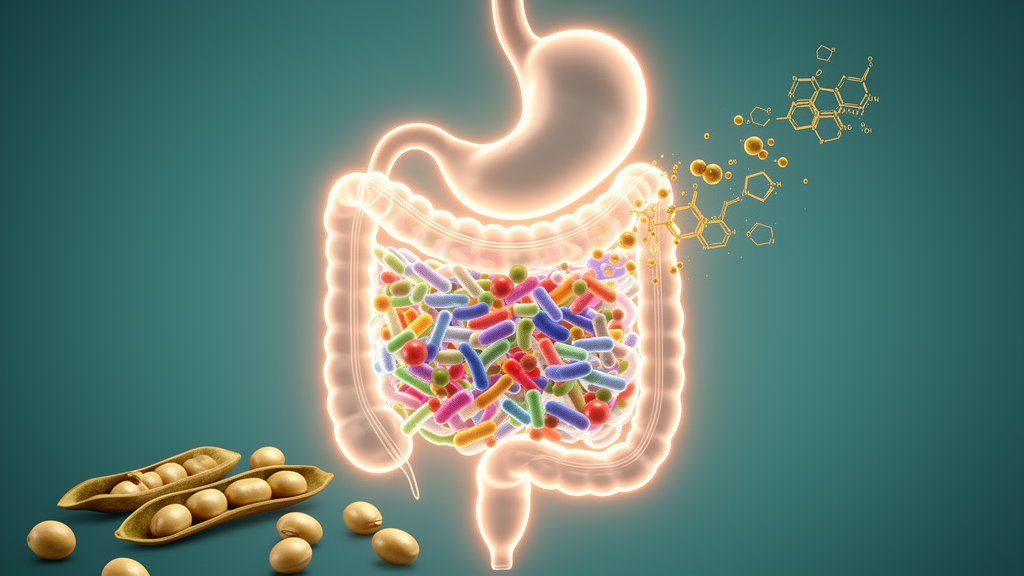
That is the central puzzle raised by a new Perspective article published in Frontiers in Nutrition, which argues that the ability of gut bacteria to convert the soy isoflavone daidzein into S-equol may be an overlooked modifier of how children's endocrine systems respond to dietary soy. The authors, a team from Hebei University of Chinese Medicine and the Second Hospital of Hebei Medical University in Shijiazhuang, China, propose that equol-producing capacity should be treated not as a fixed lifelong trait but as a developmentally dynamic metabotype, one that shifts as the gut microbiome matures, diets change and antibiotics intervene. Crucially, they also stress that the current evidence does not justify equol-based dietary restriction or routine clinical testing in healthy children.
The biochemistry behind the proposal is rooted in receptor pharmacology. Intestinal microorganisms can metabolize daidzein into S-equol, and human microbial production is stereoselective for the S-enantiomer. In receptor-binding assays, S-equol shows preferential binding to estrogen receptor beta over estrogen receptor alpha, and greater ER beta affinity than daidzein itself.
That preference, however, is not exclusivity. Transcriptional responses vary with receptor, cellular context and co-regulatory machinery, which means a single estradiol-relative potency ratio would be misleading. The authors are careful to distinguish receptor-binding affinity from clinical endocrine effect, noting that circulating metabolite concentrations do not establish receptor occupancy in a child's brain.
Still, the logic holds that comparable daidzein intakes could yield different biologically active metabolite profiles across individuals. How common is equol production in children? The honest answer, according to the article, is that nobody knows with confidence, and adult prevalence estimates should not be extrapolated downward.
In a longitudinal study of 90 infants assessed after a soy challenge, producer proportions at six months were zero percent in the breastfed group, 3.8 percent in the soy-formula group and 6 percent in the cow-milk-formula group, with production becoming more frequent with age. Among infants who initially produced equol and had subsequent observations, 66 percent tested negative at least once. These findings support repeated reassessment, but the small, feeding-defined groups cannot establish a causal effect of formula type or antibiotics.
In a separate Japanese study, 13.8 percent of children aged five to seven years were producers after supplementation, compared with 35.5 percent of their mothers. A 2025 study involving 1,110 schoolchildren obtained post-supplementation urinary equol-to-daidzein ratios in 972 participants and compared production with microbiota composition in a subset. Together, these observations favor age-specific assessment rather than a universal pediatric prevalence figure.
The article also issues a warning about inferring function from bacterial names alone. Enzymatic work in Slackia isoflavoniconvertens identified reductases acting on daidzein, dihydrodaidzein and tetrahydrodaidzein, while comparative genomics demonstrates variation in equol-associated gene clusters, including reductase and racemase genes, across organisms. An Adlercreutzia equolifaciens strain lacking the relevant operon did not produce equol at all.
In other words, neither detecting Slackia or Eggerthella in a stool sample nor assigning a universal gene cluster demonstrates actual production. Strain-level gene content, gene expression, available substrate and community context all separate taxonomic potential from measured metabolism, a distinction that matters enormously for anyone hoping to predict a child's metabolite exposure from microbiome sequencing data. The pubertal hypothesis is where the article becomes deliberately cautious.
Pubertal activation of the hypothalamic-pituitary-gonadal axis depends on gonadotropin-releasing hormone network regulation, including kisspeptin and the arcuate kisspeptin/neurokinin B/dynorphin circuitry. Evidence for ER alpha-mediated regulation is stronger than for the proposed arcuate ER beta-kisspeptin pathway. In mice, deleting ER alpha in Kiss1 neurons advanced pubertal onset but disrupted subsequent maturation, and deleting ER alpha in Tac2-expressing neurons also advanced female pubertal development.
ER beta may contribute elsewhere: neural and glial ER beta deletion delayed female mouse puberty and reduced preoptic kisspeptin measures, without corresponding changes in the mediobasal hypothalamus. The authors hypothesize that an ER beta-preferential ligand might modify the balance of ER alpha and ER beta signaling within puberty-regulating circuits, potentially altering Kiss1 and GnRH network activity. But the direction could vary with developmental window, brain region, dose and endogenous hormonal milieu, and no direct evidence establishes dietary S-equol activation of an arcuate ER beta-Kiss1 pathway as a cause of earlier puberty in children.
Human findings, in fact, caution against assuming acceleration in the opposite direction. In a study of 4,781 Chinese children, higher soy intake was associated with later pubertal timing, and the association was stronger among children with higher urinary equol in a 1,311-participant subset. This observation is compatible with metabolic effect modification but does not establish an equol-mediated mechanism.
The authors emphasize that urinary equol measured under habitual dietary conditions is a composite marker influenced by recent daidzein intake, timing of exposure, urinary dilution and microbial conversion, rather than a direct measure of stable equol-producing capacity. The stronger soy-puberty association among children with higher urinary equol should therefore not be read as evidence that a fixed producer phenotype determines pubertal timing. Whether equol-producing capacity modifies skeletal maturation in children remains unknown, even though ER alpha and ER beta are expressed in human growth plates, so skeletal outcomes are relegated to exploratory status.
The thyroid argument requires a separate mechanistic track, and the authors work hard to keep enzyme inhibition distinct from estrogenicity. Genistein and daidzein inhibited thyroid peroxidase in experimental systems, and iodide protected against enzyme inactivation under specified assay conditions. Rats exposed to genistein showed reduced TPO activity without corresponding changes in circulating thyroid hormones or thyroid-stimulating hormone, so in vitro TPO inhibition does not automatically imply clinically meaningful human thyroid dysfunction.
S-equol's receptor preference cannot establish stronger TPO inhibition than its precursor. A meta-analysis of adult randomized trials found no significant changes in free thyroid hormones and a small TSH increase of uncertain clinical importance, findings that cannot be transferred directly to children. Pediatric data are not absent: a study of 268 children reported modest associations between circulating parent isoflavones and thyroid measures, and a cross-sectional analysis including adolescents found urinary equol inversely associated with total thyroxine in boys aged 12 to 19 years.
Neither study established challenge-defined producer status, temporal causality or the proposed interaction between dietary exposure, functional capacity and iodine status. Soy formula serves as an exposure model rather than a presumption of harm in this framework. Formula feeding can provide substantial parent-isoflavone exposure while early infant equol production is often limited, so formula history cannot substitute for measured S-equol exposure.
A longitudinal study found no developmental-score differences between soy- and cow-milk-formula-fed infants during the first year. Another cohort detected differences in estrogen-responsive tissue trajectories in soy-fed girls but did not establish long-term clinical harm or an equol-specific mechanism. At age 14 years, a 2026 follow-up reported similar pubertal and reproductive-development measures across infant-feeding groups, although its observational design and follow-up participation limit causal inference.
The authors argue these findings do not support a simple claim of generalized endocrine damage, and that soy-formula cohorts remain useful developmental exposure models when metabolite production is measured rather than assumed. The constructive core of the Perspective is a prospective pediatric research framework. A single spot urinary iodine value should not classify an individual child as iodine-deficient, because within-child variation can be substantial.
The primary prediction is testable and falsifiable: comparable isoflavone exposure will show different outcome associations across repeatedly characterized equol-producing capacities, conditional on developmental and nutritional context. Replicated null interactions with precise estimates would weaken the proposal, whereas consistent exposure-capacity interactions should precede any attempt to recommend equol testing or metabotype-specific dietary limits. For now, the message to parents and clinicians is one of restraint: an intriguing biological hypothesis about why identical soy diets can produce different endocrine responses in different children, awaiting the longitudinal evidence that would either confirm or dismantle it.
Subject of Research: The role of gut microbiota-dependent S-equol production in modifying children's endocrine responses to dietary soy isoflavones
Article Title: Equol-producing capacity as an overlooked modifier of pediatric isoflavone responses
Article References: Fan, R., Xing, Y., Wang, K., Ma, X., & Zhang, H. (2026). Equol-producing capacity as an overlooked modifier of pediatric isoflavone responses. Frontiers in Nutrition, 13, Article 1993262. https://doi.org/10.3389/fnut.2026.1993262
Image Credits: AI Generated
DOI: 10.3389/fnut.2026.1993262
Keywords: S-equol, soy isoflavones, gut microbiota, pediatric nutrition, puberty, thyroid function, daidzein, estrogen receptor beta, precision nutrition, iodine, metabotype, soy formula
Cite Scienmag News
Morgan Morrow. (October 26, 2026). Gut bacteria may shape how children respond to soy isoflavones. Scienmag. https://scienmag.com/gut-bacteria-may-shape-how-children-respond-to-soy-isoflavones/
Morgan Morrow. "Gut bacteria may shape how children respond to soy isoflavones." Scienmag, 26 October 2026, https://scienmag.com/gut-bacteria-may-shape-how-children-respond-to-soy-isoflavones/. Accessed 26 October 2026.
Morgan Morrow. "Gut bacteria may shape how children respond to soy isoflavones." Scienmag. October 26, 2026. https://scienmag.com/gut-bacteria-may-shape-how-children-respond-to-soy-isoflavones/


