


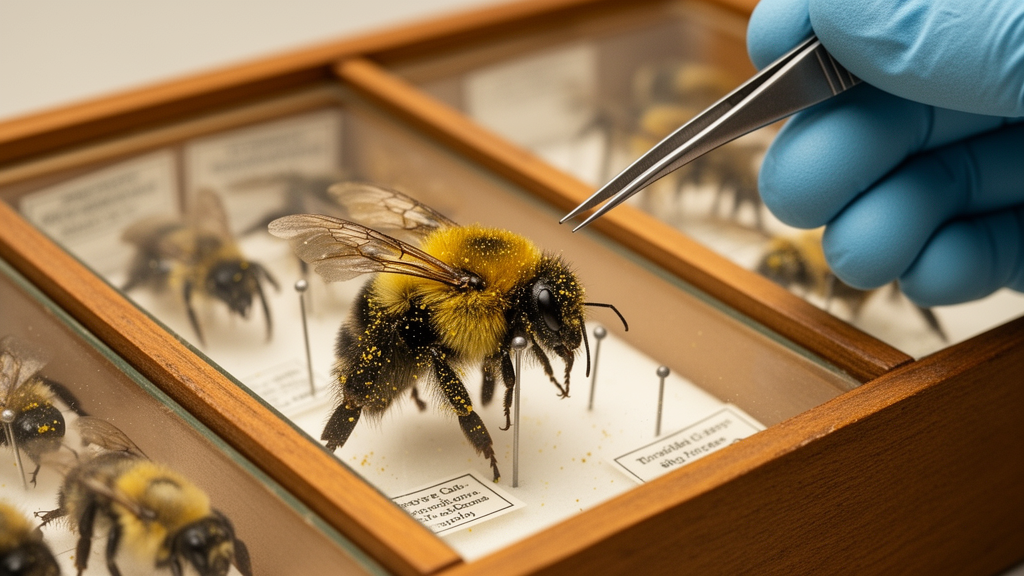
Pollen extracted from bumblebee specimens collected around Cuxhaven in northern Germany roughly 50 years apart shows that the flower-visiting patterns of these pollinators have shifted measurably between the late 1960s and 2019, with interactions moving away from many genera of the legume family Fabaceae. By applying DNA metabarcoding to pollen loads taken from museum specimens collected in 1968 and 1969 and from bumblebees caught at the same coastal sites in July 2019, researchers reconstructed plant-pollinator interactions across half a century and compared them with modern field data. The study, which also evaluated the performance of different plant DNA barcoding markers, is among the first to apply pollen metabarcoding to historic bumblebee pollen samples of this age and the only bumblebee metabarcoding study reporting results for multiple endangered Bombus species.
The historic material came from the bumblebee collection of the Zoological Museum Hamburg, where specimens gathered by Rainer Wagner for his 1969 study of the Cuxhaven area are deposited. Wagner had documented 13 non-parasitic bumblebee species in the region at that time and had already warned that increasing urbanization foreshadowed a bleak future for some of them. The researchers removed pollen packages, known as corbiculae, from the hind legs of 81 historic female worker bumblebees and successfully generated sequencing data for the chloroplast trnL-P6 loop marker from 65 of these samples. The historic specimens included Bombus pascuorum, B. veteranus, B. distinguendus, B. hortorum, B. lucorum and B. muscorum, several of which are now rare or considered absent from much of Lower Saxony.
For the modern comparison, the team sampled bumblebees on 31 July 2019 near the Cuxhaven coastline, within roughly 700 metres of the shore and including the protected Cuxhavener Küstenheiden heathland. Sampling sites ranged from disturbed suburban ground and wet pasture to sandy scrubland and heath, with gardens, farmland and broadleaf forest within a one-kilometre radius. The researchers caught 120 specimens, of which 117 entered the analysis, focusing on female workers with visible pollen loads. DNA barcoding of the mitochondrial COI gene, combined with morphological examination, identified the modern catch as 40 Bombus terrestris, 24 B. lapidarius, 23 B. pascuorum, 3 B. pratorum and 1 B. cryptarum. Pollen was removed from the corbiculae where available, and the bees’ bodies were dabbed with glycerol gelatin-covered toothpicks to collect pollen adhering to their hairs.
In the laboratory, the team applied strict contamination controls, treating surfaces and labware with UV light and DNA decontamination reagent, performing extractions and PCR setup in a sterile flow cabinet, and including PCR-negative blank controls amounting to roughly 20 percent of all sequenced PCRs. Because the historic samples contained very little DNA, positive extraction controls were deliberately excluded to avoid cross-contamination. The bioinformatic pipeline used the DADA2 algorithm to generate amplicon sequence variants, removed variants not found in at least two of three tagged PCR replicates per sample, and applied a two-step filtering process to subtract background contamination measured in the blanks. Read counts were ultimately converted to presence-absence data, since there is currently no consensus on whether trnL-P6 read numbers correlate with actual pollen quantities.
A key technical component of the study compared three plant DNA barcoding markers: the short trnL-P6 loop and the nuclear ribosomal internal transcribed spacer markers ITS1 and ITS2. Using minimally filtered data from the 2019 samples, the researchers detected 37 plant families, 96 genera and 61 species in total. The trnL-P6 loop detected the most plant families, 35 compared with 32 for ITS1 and 31 for ITS2, and produced the highest number of family-level detection signals across all samples at 637, versus 454 for ITS1 and 436 for ITS2. However, the ITS markers recovered far more taxa at finer resolution: ITS1 detected 77 genera and 52 species, ITS2 detected 65 genera and 45 species, while trnL-P6 managed only 42 genera and 13 species. The short trnL-P6 fragment can amplify degraded DNA, which likely explains its family-level breadth, but its resolution in families such as Asteraceae was limited, distinguishing only Achillea among 23 genera that ITS1 and ITS2 successfully separated.
The comparison also revealed that ITS1 outperformed ITS2. Aggregated across all samples, ITS1 produced approximately 20 percent more genus- and species-level identifications than ITS2, with 714 versus 562 presence detections, a trend that persisted even when taxa detected exclusively by ITS1 were excluded. The two ITS markers were otherwise roughly equivalent, with a Jaccard similarity of 0.84 at the genus level when all 2019 samples were pooled, and most differences involved plant taxa found in only a single specimen. When the researchers compared the markers specimen by specimen, excluding genera unique to one marker, the per-sample Jaccard similarity between ITS1 and ITS2 was 0.59, rising to 0.88 at a read cutoff of 870 reads. The authors conclude that ITS1 shows promise for pollen metabarcoding but note that further comparative studies, ideally including mock communities, are needed before it can be recommended over ITS2.
The ecological comparison between eras relied on the trnL-P6 marker, since the aged historic samples could not be amplified with the ITS markers in initial trials. The most frequently visited plant taxa in 2019 were generally also detected in the 1968/69 samples and vice versa, but the relative frequencies of interactions differed. Among well-covered plant families, Asteraceae, Ericaceae and Lythraceae showed proportionally more interactions in the recent samples, while Fabaceae and Oleaceae showed the smallest ratios of recent to historic interactions. Phaseolus and Lathyrus, both legume genera, were found almost exclusively on the historic bumblebees. The contrast was especially striking for Bombus pascuorum: interactions with Vicia and Trifolium, two legume genera, were rarely recovered in the recent data compared with the historic specimens of the same species.
The species composition itself had changed. Two of the historic species, B. distinguendus and B. muscorum, were not found in 2019; both are reported among the bumblebees with the narrowest dietary breadth, and B. distinguendus is assumed to be absent from most of Lower Saxony today after being recorded there between 1909 and 1969. B. veteranus, whose last record in the Cuxhaven area dates to 1969 and which the data confirmed to be associated with Fabaceae, was also absent from the modern catch. B. hortorum, known for an extreme dietary preference for Trifolium, was not captured in 2019 despite having declined in the area as early as the 1960s, a decline Wagner attributed to land-use change. The researchers caution that absence from their samples does not prove absence from the region: B. lucorum, a generalist forager that made up 4.5 percent of Wagner’s historic catch, was likely missed due to insufficient sampling, and the authors note that a higher number of hot days above 25 degrees Celsius in recent years could also have shortened colony lifecycles.
The shift away from Fabaceae matters for several reasons outlined by the authors. Host plant availability has been identified as the main driving factor of wild bee decline across 57 species, with the 29 Fabaceae-dependent species showing the highest declines. Herbaceous legumes such as Vicia and Trifolium are of principal importance for many rare bumblebees, and Fabaceae has been found to be the plant family most effective at mitigating the negative effects of urbanization. The bumblebee species caught in 2019, by contrast, are commonly reported from urban environments and display highly generalist foraging, consistent with their status as species that thrive in human-dominated landscapes. The authors suggest that the higher frequency of Calluna visitation in the modern data may reflect the establishment of the strictly protected heathland, which was not yet formally protected in 1969, and that increased drainage channels from intensified agriculture may explain more frequent Lythrum visitation, though a shift in flowering time could also have played a role and was not tested.
The study has limitations the authors themselves acknowledge. Most plant taxa were found on only a small subset of the analyzed samples, indicating that greater sampling depth is needed to fully characterize bumblebee foraging habits, and the overlap between historic and recent species is restricted to B. pascuorum, limiting direct species-level comparisons across time. Plant-pollinator interactions, they stress, must be supplemented with knowledge about shifts in flowering time, climate change, parasites and diseases, pesticides and competition before conservation measures can be designed. Nevertheless, the work demonstrates that natural history collections can open a molecular window into past trophic interactions, particularly for rare species that are difficult to locate in the field today, and that combining short and long DNA barcoding markers yields complementary insights: the trnL-P6 loop recovered greater taxonomic breadth, while the ITS markers delivered greater taxonomic depth.
Subject of Research: Pollen metabarcoding of historic and recent bumblebee specimens to detect shifts in plant-pollinator interactions and compare plant DNA barcoding markers
Article Title: Pollen metabarcoding of museum specimens and recently collected bumblebees ( Bombus ) indicates foraging shifts
Article References: Kolter, A., Husemann, M., Podsiadlowski, L., & Gemeinholzer, B. (2023). Pollen metabarcoding of museum specimens and recently collected bumblebees (Bombus) indicates foraging shifts. Metabarcoding and Metagenomics, 7, Article e86883. https://doi.org/10.3897/mbmg.7.86883
Image Credits: AI Generated
DOI: 10.3897/mbmg.7.86883
Keywords: bumblebees, pollen metabarcoding, museum specimens, Fabaceae, plant-pollinator interactions, DNA barcoding, ITS1, ITS2, trnL-P6, biomonitoring, Cuxhaven, pollinator decline
Cite Scienmag News
Julie Wynn. (October 26, 2026). Pollen DNA from museum bumblebees reveals 50-year shift away from Fabaceae foraging. Scienmag. https://scienmag.com/pollen-dna-from-museum-bumblebees-reveals-50-year-shift-away-from-fabaceae-foraging/
Julie Wynn. "Pollen DNA from museum bumblebees reveals 50-year shift away from Fabaceae foraging." Scienmag, 26 October 2026, https://scienmag.com/pollen-dna-from-museum-bumblebees-reveals-50-year-shift-away-from-fabaceae-foraging/. Accessed 26 October 2026.
Julie Wynn. "Pollen DNA from museum bumblebees reveals 50-year shift away from Fabaceae foraging." Scienmag. October 26, 2026. https://scienmag.com/pollen-dna-from-museum-bumblebees-reveals-50-year-shift-away-from-fabaceae-foraging/


