

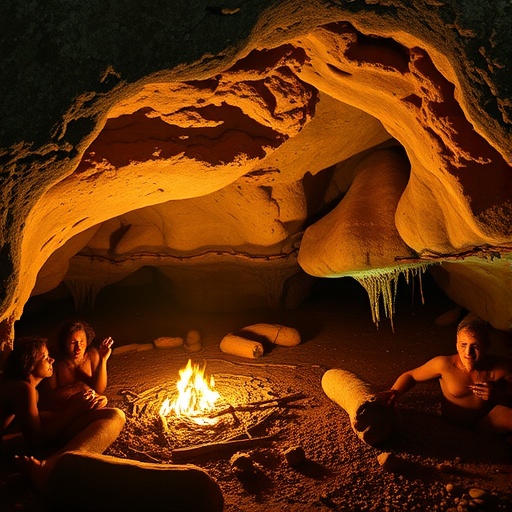
For over 20,000 years, deep inside a cave perched on Türkiye’s Mediterranean coast, Neanderthals and modern humans did something no one expected: they shared a culture so intimately that the stone tools they flaked, the animals they hunted, and even the seashells they wore as ornaments were virtually indistinguishable. The discovery at Üçağızlı II Cave, excavated grain by grain over five painstaking seasons, shreds the notion of a clear behavioral boundary between our own species, Homo sapiens, and our closest evolutionary cousins, the Neanderthals. Instead, it paints a picture of two distinct human groups inhabiting the same space, moving through the same world, and generating a deeply interconnected cultural fabric that spans the very moment modern humans began their historic spread out of Africa.
The Levant, that narrow geographic bridge between Africa and Eurasia, has long been theorized as the primary corridor for anatomically modern humans migrating out of Africa roughly 60,000 years ago. Yet fossil evidence from this critical interval has remained stubbornly scarce, leaving a gap in our understanding of how those early pioneers lived and who they encountered. The international team, which included researchers from Kyoto University, set out to fill that gap by systematically dissecting the layers at Üçağızlı II. Using millimeter-by-millimeter excavation techniques, they uncovered a continuous archaeological sequence that captures, in unprecedented resolution, the transition from Neanderthal occupation to early modern human presence.
Both populations left behind an almost identical material signature. The lithic technology—how raw stone was selected, prepared, and struck to produce flakes, blades, and points—shows no sudden break or novel toolkit. Neanderthals who lived at the site more than 50,000 years ago used the same Levallois-like reduction strategies and hunting implements as the modern humans who arrived later. The subsistence strategies mirrored one another too, targeting the same mountain gazelles and fallow deer, and heavily exploiting marine resources from the nearby shore. From a purely technological standpoint, the species were indistinguishable at this site.
What really jars long-standing narratives, however, is the non-utilitarian material. Both Neanderthals and early modern humans at Üçağızlı II deliberately collected and modified a specific type of marine seashell, Nassarius gibbosulus, which is far too small to serve as food and was clearly procured for symbolic use—likely as beads or body ornaments. Until now, such ornamentation was widely considered a hallmark exclusive to cognitively modern Homo sapiens, a signal of abstract thinking and social identity that Neanderthals might have lacked or only weakly expressed. Yet here the shells appear in Neanderthal layers, selected with the same discernment for size and perforation, indicating that symbolic behaviour was not only present in both groups but was potentially learned, shared, and maintained across the two species.
“Our findings indicate a deep level of cultural interaction,” says corresponding author Naoki Morimoto of Kyoto University. “These two distinct but closely related human groups were not just adapting to the same environment: they were probably sharing symbolic preferences.” The continuity is so striking that the researchers argue for a prolonged period of cultural exchange that transcended biological barriers—a scenario in which ideas about personal adornment and possibly ritual were flowing freely between populations.
The modern human fossils recovered from the cave date to between approximately 50,000 and 60,000 years ago, placing them squarely within the Out of Africa window that genetic studies have pinpointed as the launching point for all contemporary non-African populations. This raises the tantalizing possibility that the individuals at Üçağızlı II represent a close relative of the founding lineage that went on to populate Europe, Asia, and beyond. Alternatively, they could be survivors of an earlier, lesser-known migration of Homo sapiens into the Levant, a wave that predates the primary Out of Africa pulse and whose genetic signature may have faded in later populations. Either scenario carries profound implications for how we reconstruct the early chapters of our global family tree.
The fact that such a deeply interwoven cultural sequence persisted for over 20,000 years challenges models that cast Neanderthals as cognitively rigid or biologically incapable of the fluid social learning that defines humanity. If two human species could share not only landscapes but also the very symbols that structured their identities, the cognitive and social capacities of Neanderthals must have been far more aligned with ours than often depicted. The Üçağızlı II record, with its fine-grained stratigraphy, effectively rewrites the behavioural boundary between us and them, turning it into a shared continuum.
For archaeologists, the technical achievement of recovering this narrative is itself remarkable. The team’s high-resolution excavation documented every embedded artefact in three-dimensional space, allowing them to correlate stone tool typologies, faunal remains, and ornament production across distinct layers with a temporal precision rarely achieved at such deep time depths. Each millimeter represented centuries of human activity, and together they testify that the crossroads of continents was not a zone of confrontation or replacement but a lengthy experiment in coexistence and cultural consilience. The cave’s treasure is not gold or monumental art; it is the quiet, persistent record of two peoples deciding, for tens of millennia, to live the same way, wear the same shells, and face the same world with a single shared culture.
Article Title: Long-term cultural continuity across the Neanderthal–modern human sequence at Üçağızlı II Cave, northern Levant
News Publication Date: 6-Jul-2026
Web References: 10.1073/pnas.2609061123
References: Morimoto, N. et al. (2026) Long-term cultural continuity across the Neanderthal–modern human sequence at Üçağızlı II Cave, northern Levant. Proceedings of the National Academy of Sciences, doi: 10.1073/pnas.2609061123.
Image Credits: KyotoU / Naoki Morimoto
Keywords: Neanderthal, Homo sapiens, cultural continuity, Üçağızlı II Cave, Levant, symbolism, Nassarius shells, Out of Africa, stone tools, Pleistocene archaeology


