


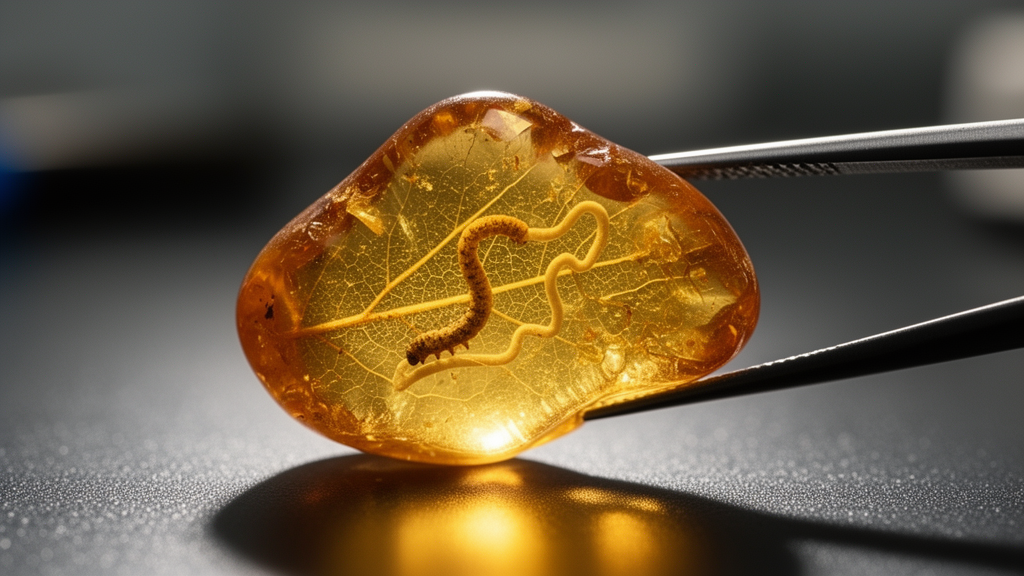
Amber has a reputation for preserving the improbable, but a new discovery pushes that reputation to its limits. In a study published in the journal Zitteliana, researchers describe the first fossil leaf-mining caterpillars ever found in amber: one from Upper Cretaceous Myanmar amber, dated to roughly 99 million years ago, and another from Eocene Baltic amber. The tiny larvae belong to the moth family Gracillariidae, a group whose caterpillars spend their lives tunneling inside leaves, and they have been named Phyllocnistis cretacea and Phyllonorycter inopinata. The finds are remarkable not only because caterpillars are exceedingly rare in the fossil record, but because a leaf-mining larva should, in principle, almost never end up in resin at all.
Lepidoptera, the order of butterflies and moths, is poorly represented among fossils. Their delicate wings and slender bodies rarely survive the destructive processes of oxidation, breakage, and abrasion, and amber inclusions suffer from a strong bias toward smaller specimens. This bias means microlepidopterans are overrepresented relative to their larger relatives. The authors of the study pursued a working hypothesis: that caterpillars, with their different feeding mode, habitat, and taphonomy, might allow identification and geological dating of moth taxa that have never been found as adults in amber. That strategy had already paid off once, when the first member of the moth family Geometridae from Baltic amber was identified from a caterpillar. Focusing on larvae, the researchers reasoned, could unlock a hidden window into moth evolution.
Leaf-mining Lepidoptera are of special scientific interest because they retain a primitive feeding mode found in many basal moth families. Gracillariidae are a prominent family of ditrysian leaf-miners, exceedingly diverse with 101 genera and 1866 species, and they are basal Ditrysia that kept the larval mining lifestyle. Economically, leaf-miners can become important pests of crop plants, especially in monocultures; the chestnut pest Cameraria ohridella is a familiar example from the same subfamily. Within Gracillariidae, molecular phylogenetic analysis now recognizes eight subfamilies rather than the three traditionally accepted. Imagos of putative Gracillariidae had been described from Baltic amber as Gracillariites lithuanicus and G. mixtus, but palaeontological evidence for the caterpillars themselves came only from their mines, rarely preserved in fossil leaves, mostly from the Paleogene and Neogene.
The oldest known mines of the subfamily Lithocolletinae are actually Cretaceous: Cameraria-like mines from the Dakota Formation of central Kansas, dating to the late Albian, and Phyllonorycter-like mines from the Ora Formation of the Negev Desert, from the Turonian. Mines of the sister subfamily Phyllocnistinae had been dated to 99 plus or minus 10 million years, and this divergence was used as a calibration point in molecular studies that placed the origin of the genus Phyllonorycter in the Palaeocene, about 62.3 million years ago. Against this backdrop, the new amber caterpillars provide something the leaf mines never could: direct fossil evidence of individual larval stages of these genera, complete with identifiable anatomy.
The Baltic amber caterpillar, the holotype of Phyllonorycter inopinata, is a single finding among 1152 Lepidopteran fossils from Baltic amber in the studied collection, of which 138 are caterpillars. The specimen shows the classic traits of a leaf-mining larva: a flat, small body, a prognathous head with modified mouthparts pointing forwards, reduced legs, and prolegs strongly reduced or absent. The researchers compared it to the larvae of more than thirty moth families with leaf-mining members, and also to leaf-mining flies, beetles, and sawflies. Most candidates differ in body size, outlines, head shape, segment form, or setae. The most similar caterpillars are found within Gracillariidae, especially with respect to the presence of prolegs only on abdominal segments A3 to A5, a distinctive feature of later instars of the family. Among the twelve extant genera of Lithocolletinae, larvae of Phyllonorycter are most alike, particularly in the triangular form of the larval head.
The holotype of Phyllonorycter inopinata is 5 millimeters long and subcylindrical, with a maximum width of 0.73 millimeters on the fourth abdominal segment. Its depressed, triangular, prognathous head is 0.36 millimeters long and 0.5 millimeters broad, with developed mandibles and antennae. The legs are tiny, between 0.15 and 0.2 millimeters long, and small prolegs are present on segments A3 to A5. Three lateral setae flank each segment on either side. The species name inopinata, meaning surprising, refers to the seemingly unlikely find of a leaf-mining caterpillar preserved in amber. Because it is the only known specimen, a differential diagnosis to other Phyllonorycter species is currently impossible, and comparison to similar extant species like P. leucographella or P. platani carries the same insecurities. Future finds from Baltic amber may enable a proper diagnosis. The holotype is deposited at the Bavarian State Collection of Zoology in Munich.
The Myanmar amber caterpillars tell an even older story. Caterpillars are rare in Myanmar amber: only six specimens appear among 287 Lepidopteran inclusions in the studied collection, three of which were studied here. The possibility that these larvae were non-lepidopteran was considered but ruled out, most obviously for the holotype of the new species with its clearly visible spinneret, the silk-spinning organ. The most similar in general resemblance are buprestid beetle larvae, which also occur in Myanmar amber, but these have a thicker head and thorax and lack setae. The holotype of Phyllocnistis cretacea is 7 millimeters long and flat, with a maximum width of 1.18 millimeters on the second thoracic segment. Its depressed, triangular, prognathous head is 0.53 millimeters long and 0.75 millimeters broad, with developed mandibles and minuscule antennae. A well-developed spinneret, 0.05 millimeters long, is present, while legs and prolegs are not developed. Each abdominal segment carries two lateral bulges, dorsal and ventral, each bearing a prominent seta bent backwards. Dorsal prothoracic plates of roughly triangular form are also present.
Two paratypes of Phyllocnistis cretacea complete the Cretaceous picture. Paratype I is 6.5 millimeters long and subcylindrical, with a partly retracted head hidden by chitinous membrane, developed mandibles and antennae, a visible leg 0.26 millimeters long, and no prolegs. Paratype II is 4 millimeters long, with the head partly retracted into the first thoracic segment, tiny mandibles and antennae, no legs or prolegs, and no visible setae; remarkably, feces produced by the caterpillar are preserved alongside it in the amber. The lack of prolegs casts some doubt on the identification, since late or last instars of Gracillariidae would be expected to show prolegs on segments A3, A4, and A5. However, the prolegs may simply be too tiny to detect given the preservation state, and reduction of leg and proleg development is common in mining Lepidoptera. The Myanmar amber is dated to the earliest Cenomanian, 99 million years ago, and the same piece preserves syninclusions of five beetle taxa, a wasp, psocids, trichomes, a wood fragment, arthropod feces, and chitin detritus.
The prognathous mouthparts of the caterpillars are the most evident character for feeding by mining, and the characteristic lateral bulges on every segment are especially well developed in many species of Phyllonorycter, though they also appear in unrelated miners like leaf-mining buprestid beetles, likely as convergent evolution maximizing body mass while keeping lateral flexibility. In Gracillariidae, the change from small, apodal, flat early instars to later instars with thoracic legs and abdominal prolegs is termed hypermetamorphosis, and there may be even more stages in some species. The fossil Phyllonorycter caterpillar may represent the third to fifth instar, and the presence of mandibles in both species argues against interpreting them as last instars. Exclusively internal feeding protects larvae from predators, weather, desiccation, and UV radiation while assuring a reliable food supply, but it constrains body size and often goes along with monophagy and host dependence. Gracillariidae are mainly hosted by Eurosids I, a broad group of angiosperm families, and numerous Phyllonorycter species use specific plant genera as hosts, from oaks and birches to roses, willows, and poplars.
The Cretaceous finding gives direct evidence for a minimal geological age of the genus Phyllocnistis, and by indirect conclusion based on their divergence, also for the genus Phyllonorycter in the sister clade Lithocolletinae. The 99-million-year-old caterpillars predate the previously accepted occurrence of the genus and place its origin closer to the radiation of their angiospermous host plants. The Eocene Baltic amber forest was tropical in climate, contrasting with the mostly temperate hosts of extant Phyllonorycter, though oaks must have been widely distributed there, as stellate oak trichomes are by far the most abundant plant remains in Baltic amber, occurring in about every second piece. Leaf miners seem to have little fossilization potential, since caterpillars would have to leave or be exposed from their mines to become embedded in resin. The well-developed spinneret and legs strengthen the hypothesis that these caterpillars left their mines for pupation outside the leaf, and the authors suggest that hypermetamorphosis in Gracillariidae might have been driven by facilitating pupation outside the mine. The findings confirm the conservative character of the leaf-mining habit for well-known extant leaf-miner taxa and open the door for future amber finds to reveal more of these unlikely survivors.
Subject of Research: Fossil leaf-mining caterpillars of Gracillariidae moths preserved in Upper Cretaceous Myanmar amber and Eocene Baltic amber
Article Title: In search for the unlikely: Leaf-mining caterpillars ( Gracillariidae , Lepidoptera ) from Upper Cretaceous and Eocene ambers
Article References: Fischer, T. C. (2021). In search for the unlikely: Leaf-mining caterpillars (Gracillariidae, Lepidoptera) from Upper Cretaceous and Eocene ambers. Zitteliana, 95, 135-145. https://doi.org/10.3897/zitteliana.95.63317
Image Credits: AI Generated
DOI: 10.3897/zitteliana.95.63317
Keywords: amber fossils, Gracillariidae, leaf miners, Myanmar amber, Baltic amber, Phyllocnistis cretacea, Phyllonorycter inopinata, Lepidoptera, Cretaceous, Eocene, hypermetamorphosis, palaeontology
Cite Scienmag News
Gavin Prescott. (October 17, 2026). Caterpillars Trapped in Amber Reveal 99-Million-Year-Old Leaf-Mining Moths. Scienmag. https://scienmag.com/caterpillars-trapped-in-amber-reveal-99-million-year-old-leaf-mining-moths/
Gavin Prescott. "Caterpillars Trapped in Amber Reveal 99-Million-Year-Old Leaf-Mining Moths." Scienmag, 17 October 2026, https://scienmag.com/caterpillars-trapped-in-amber-reveal-99-million-year-old-leaf-mining-moths/. Accessed 17 October 2026.
Gavin Prescott. "Caterpillars Trapped in Amber Reveal 99-Million-Year-Old Leaf-Mining Moths." Scienmag. October 17, 2026. https://scienmag.com/caterpillars-trapped-in-amber-reveal-99-million-year-old-leaf-mining-moths/


