


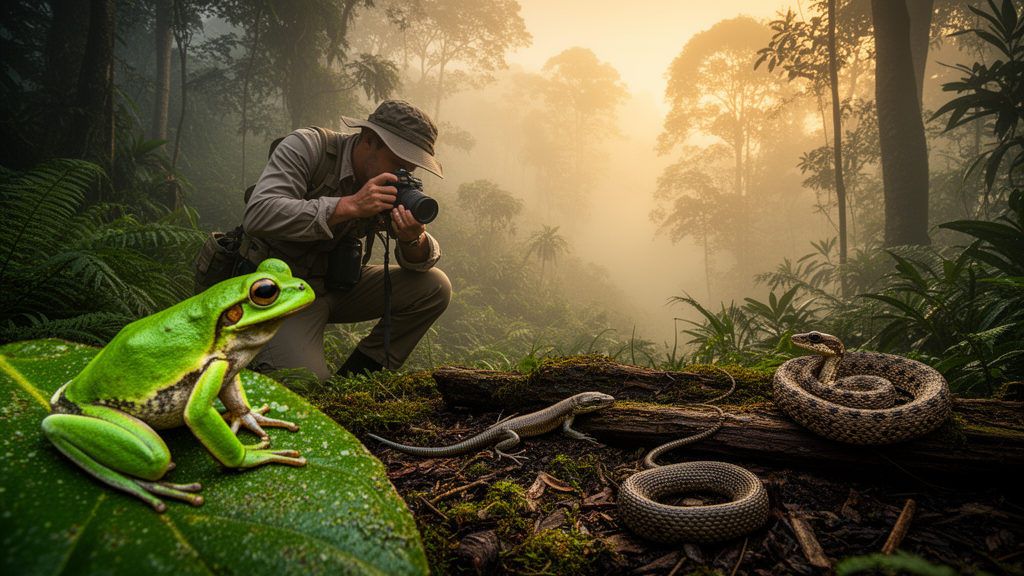
Deep in the Kuala Nerus district of Terengganu, Peninsular Malaysia, an isolated hill called Bukit Maras rises just 329 metres above a sea of oil palm, rubber and orchard plantations. Surrounded by human settlements and farmland, this roughly 2,200-hectare forest fragment could easily be mistaken for an ecological afterthought. Yet a new study published in the journal Herpetozoa has revealed that the hill shelters a surprisingly rich community of amphibians and reptiles, including one of the world’s most critically endangered tortoises, and its findings carry an urgent warning about what happens when forest fragments are converted to agriculture.
Between 2019 and 2023, a team of Malaysian researchers conducted the first systematic survey of the hill’s herpetofauna, documenting a total of 55 species: 23 amphibians and 32 reptiles. The assemblage spans six amphibian families and nine reptile families, from stream-dwelling frogs of the genera Limnonectes and Hylarana to gliding lizards of the genus Draco, colubrid snakes such as Dendrelaphus and Boiga, the reticulated python Malayopython reticulatus, and the Wagler’s pit viper Tropidolaemus wagleri. Only one species recorded during the surveys, the Asian giant tortoise Manouria emys, is listed as Critically Endangered on the IUCN Red List, while the remainder are currently classified as Least Concern. That single record, however, may be the study’s most consequential finding.
Bukit Maras is what ecologists call a forest
The distinction between the habitat types at Bukit Maras matters because amphibians and reptiles are not evenly distributed across tropical landscapes. Many species in Southeast Asian rainforests are tightly associated with closed-canopy conditions, leaf litter depth, humidity and the cool microclimates of forest streams. When forest is cleared, these conditions change abruptly: temperatures rise, humidity drops, watercourses silt up and the shaded strata that many frogs, geckos and snakes depend on simply disappear. The species-habitat network analysis in the new study reflects this pattern directly. Secondary forest plots held a richer and more distinct community than the agricultural plots, and the streams flowing through farmland supported a different, generally depauperate set of species compared with the streams still shaded by dipterocarp canopy within the secondary forest.
This kind of habitat partitioning has been documented repeatedly across the tropics, but the Bukit Maras data are notable because the hill is not a protected reserve. It is a privately exploited landscape in which roughly forty percent of the original forest has already been replaced by orchards of durian, banana, petai, oil palm and rubber. The remaining secondary forest regenerated only after land was abandoned about fifteen years ago, meaning much of the vegetation now supporting the richest herpetofaunal communities is itself young, recovering habitat. That the secondary forest already outperforms adjacent agriculture in species richness suggests that even relatively short periods of regrowth can restore substantial ecological value, but it also implies the community has not yet reached the composition of the untouched primary forest on the hill’s upper slopes, which the surveyors could not access.
The sampling methodology deserves attention when interpreting the results. Visual Encounter Surveys, in which teams of three to four observers walk transects by day and night, are effective for detecting active and conspicuous animals, while drift-fenced pitfall traps capture ground-dwelling species that move across the forest floor regardless of observer visibility. Acoustic recording of frog calls added a third detection channel, since many amphibian species are heard long before they are seen. Combining methods in this way reduces the bias inherent in any single technique, and the researchers invested a substantial 816 person-hours of survey effort across thirteen sampling points. The individual-based rarefaction and extrapolation curves, which estimate how species richness would grow with additional sampling, were approaching an asymptote for both amphibians and reptiles. In practical terms, this means the inventory is close to complete: continued sampling would likely add only a handful of species rather than dozens. That confidence strengthens the study’s value as a baseline, because the documented list probably captures most of the herpetofauna that currently persists on the hill.
The record of the Asian giant tortoise, Manouria emys, stands out against this otherwise Least Concern assemblage. The species, the largest tortoise in mainland Asia, has suffered severe population declines across its range from Southeast Asia to Indonesia, driven primarily by hunting for food and the pet trade and by the loss of the lowland forest it inhabits. Adult M. emys require large home ranges and intact forest floor habitat for nesting and foraging, so the species is particularly sensitive to fragmentation. Its persistence in a small, non-protected hill surrounded by plantations is remarkable, but a single record also signals a population that may be functionally isolated and demographically fragile. Without connectivity to other forest blocks, even a surviving individual or small group cannot be guaranteed recruitment, and the species could vanish from the hill without any dramatic visible event.
The concept of biotic homogenisation, raised by the study’s authors, is central to the conservation implications. When forest-dependent species are lost from converted landscapes, they are typically replaced by a smaller set of widespread generalists that thrive in open, disturbed conditions. Across a region, this process makes once-distinct local faunas increasingly similar, eroding the beta diversity that makes tropical landscapes biologically rich. The Bukit Maras data provide a snapshot of this process in action at a local scale: the agricultural plots already support a simplified community, and the authors project that complete conversion of the hill would produce a significant decline in overall species richness. Because the hill is a refugium embedded in an agricultural matrix, its loss would not merely remove 2,200 hectares of habitat but would eliminate one of the few remaining reservoirs of forest herpetofauna in an otherwise transformed district.
Terengganu provides sobering context for this dynamic. More than 308,000 hectares of native forest in the state have already been cleared for agriculture, chiefly oil palm, rubber and crop cultivation. Peninsular Malaysia’s lowland forests once formed continuous habitat across vast areas, but decades of logging, urban expansion and plantation development have fragmented the landscape into isolated hills and remnants. Paradoxically, these fragments can act as refugia for displaced wildlife, and previous research in Peninsular Malaysia has shown that isolated granite hills and forest islands can harbour unexpected diversity, including species new to science. Bukit Maras fits this pattern: a hill that survived clearance because of its terrain now supports a community that includes forest specialists with nowhere else to go locally.
The study’s timing is significant because Bukit Maras faces an imminent threat. Orchard expansion is actively encroaching on the remaining forest, and the secondary forest sites, including the least-disturbed stream site with its remnant dipterocarps, are flagged by the authors as vulnerable to further conversion. Because the hill is not within any protected area network, there is no legal buffer preventing continued clearing. The researchers frame their inventory explicitly as documentation before loss, a record of what exists now so that the baseline is not erased before it is ever measured. This is a common and increasingly urgent mode of biodiversity research in Southeast Asia, where the pace of land conversion frequently outstrips the pace of formal biological survey.
For conservation planning, the findings suggest several practical priorities. Protecting the secondary forest and the shaded stream corridors would preserve the habitat types that support the greatest diversity, and maintaining canopy cover over streams is particularly important for amphibians, many of which breed in or near flowing water and are sensitive to desiccation and siltation. The agricultural streams, lacking canopy, already show a modified community, illustrating how riparian buffer zones could mediate the impact of plantations on aquatic and semi-aquatic species. Connectivity between the hill’s forest patches and any surrounding remnants would also improve the prospects for wide-ranging species such as the giant tortoise. Finally, the voucher specimens deposited in the Universiti Malaysia Terengganu zoological collection, together with photographic records and acoustic data, create a permanent reference baseline against which future changes in the hill’s fauna can be measured, whether those changes reflect recovery, continued decline or the arrival of invasive generalists.
More broadly, the Bukit Maras study contributes to a growing body of evidence that disturbed and unprotected forest fragments in Southeast Asia are not biological wastelands. They hold real diversity, including species of global conservation concern, and their value increases as the surrounding lowland matrix becomes more inhospitable. The challenge for conservation is that these refugia are often on land with immediate economic value and no formal protection, meaning their persistence depends on decisions made by landowners and local authorities rather than on reserve boundaries. Documenting the fauna of such places, as the researchers have done here, is the first step in making those decisions with the full knowledge of what stands to be lost.
Subject of Research: Herpetofaunal diversity in a disturbed and isolated forest hill in Terengganu, Peninsular Malaysia
Article Title: Herpetofaunal diversity of the disturbed and isolated Bukit Maras in Terengganu, Peninsular Malaysia
Article References: Syafiq, M. F., Badli-Sham, B. H., Fariduddin, S. A., Mohd A Wahid, M. I., Aqmal-Naser, M., Amir, F. H., Kaliyappan, G., Sapri, N. N., Nordin, N. F., Shahril-Ridhwan, M., Azzimin, J., Kei Li, T., Shu Xin, N., Fahmi-Ahmad, M., Rizal, S. A., & Ahmad, A. B. (2026). Herpetofaunal diversity of the disturbed and isolated Bukit Maras in Terengganu, Peninsular Malaysia. Herpetozoa, 39, 27-38. https://doi.org/10.3897/herpetozoa.39.e122775
Image Credits: AI Generated
DOI: 10.3897/herpetozoa.39.e122775
Keywords: Bukit Maras, herpetofauna, amphibians, reptiles, Terengganu, forest fragmentation, conservation, Manouria emys, Herpetofaunal, diversity, disturbed, isolated
Cite Scienmag News
Margaret Porter. (October 17, 2026). Isolated Malaysian hill reveals 55 reptile and amphibian species before forests vanish. Scienmag. https://scienmag.com/isolated-malaysian-hill-reveals-55-reptile-and-amphibian-species-before-forests-vanish/
Margaret Porter. "Isolated Malaysian hill reveals 55 reptile and amphibian species before forests vanish." Scienmag, 17 October 2026, https://scienmag.com/isolated-malaysian-hill-reveals-55-reptile-and-amphibian-species-before-forests-vanish/. Accessed 17 October 2026.
Margaret Porter. "Isolated Malaysian hill reveals 55 reptile and amphibian species before forests vanish." Scienmag. October 17, 2026. https://scienmag.com/isolated-malaysian-hill-reveals-55-reptile-and-amphibian-species-before-forests-vanish/


