

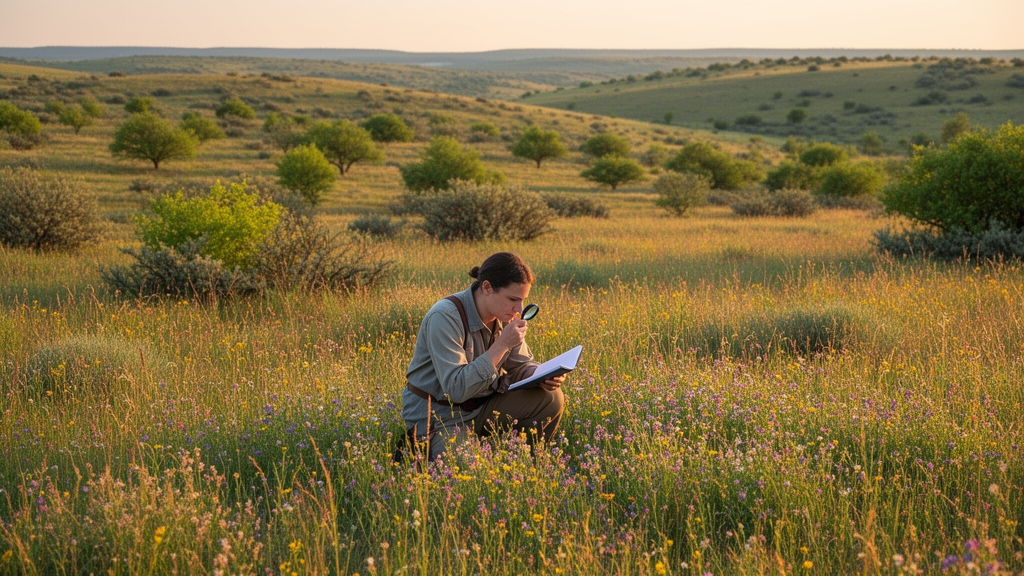
Five years ago, the International Association for Vegetation Science launched its third peer-reviewed journal and its first gold open access venture, Vegetation Classification and Survey. Now, in an editorial opening the sixth volume, the journal’s editors take stock of everything published since 2020 and chart a course for the years ahead. The verdict is cautiously optimistic: 119 articles spanning every continent, steadily rising citation metrics, and a growing role for vegetation science in global change research. Yet the editors also identify clear gaps, from underrepresented continents to a shortage of methodological papers, and they set out concrete recommendations for the community they serve.
The numbers reveal a journal that has grown in substance as well as reputation. Publication output has remained remarkably stable at roughly 24 articles per year, but the average article length increased significantly from 10.0 pages in 2020 to 14.4 pages in 2023 and 2024, a statistically significant trend. The content divides neatly into thirds: about one third regular articles, one third contributions to the two permanent collections, and one third papers in special collections. The Permanent Collection on Ecoinformatics hosts vegetation-plot databases and the tools to use them, while the Permanent Collection on Phytosociological Nomenclature handles the formal naming rules of the Braun-Blanquet tradition. Eleven distinct article types are on offer, including formats no other journal provides, such as Long Database Reports published in collaboration with the Global Index of Vegetation-Plot Databases and Nomenclatural Proposals handled jointly with the IAVS working group on phytosociological nomenclature.
Special collections have emerged as a signature strength. Four have been completed and three are ongoing, often tied to sessions at scientific conferences. In 2024 alone, the journal closed out two major regional efforts: a Neotropical Vegetation collection spanning twelve countries from Mexico to the Dutch Caribbean, and African Vegetation Studies, with seven research papers documenting classification, mapping and modelling work across the continent. The editors draw a pointed conclusion from the African collection: important classification studies are underway in different parts of the continent, but much work remains to achieve a comprehensive and internationally consistent vegetation classification there. A collection on Asian grasslands is nearly finished, one on European forests is in progress, and a new call on the vegetation of islands and archipelagos is still open for submissions.
At the heart of the journal lie the plot-based classification studies, and the editorial dissects forty of them in unusual methodological detail. These studies, distributed over all continents, show Europe dominating both absolutely and relative to area, while Asia, Africa and North America were least represented. When it came to naming conventions, 23 studies used the Braun-Blanquet approach, seven used the EcoVeg approach, and ten relied on informal names. The two formal systems were largely separated geographically, with Asia the only continent hosting studies of both kinds, though in different countries. The editors encourage authors from countries without a tradition of broad-scale classification to adopt formal names even in local studies, arguing that this will ease future regional to continental syntheses.
Plot size, a deceptively technical detail with major consequences, varied enormously across the forty studies, from one square metre to 10,000 square metres. Thirty of the forty studies used a single plot size, in line with long-standing recommendations, but the standard grain chosen ranged from one square metre in some azonal communities to 1,000 square metres applied to all vegetation types in Namibia. The editors conclude that single-size sampling is becoming more widespread but that international standardisation is still lacking. They also flag a growing challenge: when researchers mine legacy data from large vegetation-plot databases such as the European Vegetation Archive and the global sPlot database, they need strategies to cope with differing national plot-size preferences and to apply methods less sensitive to plot-size variation than most current approaches.
How species importance is measured in the field is another quiet revolution in progress. The Braun-Blanquet cover-abundance scale, in its many variants, remains the most used measure in the journal’s papers, mirroring its dominance in the global sPlot database, where about two thirds of plots use it. But direct estimation of percentage cover is gaining ground, and the editors expect it to prevail, because ordinal indices have been shown to introduce relevant additional error when back-transformed to percentage cover for numerical analysis. Broad-scale syntheses will still depend on historical plots recorded on ordinal scales, so the editors urge methodological strategies to mitigate that bias, while recommending that new sampling adopt direct percentage cover whenever possible. Taxonomic completeness lags too: 31 of the 40 studies recorded only vascular plants, and just nine included bryophytes, lichens or other non-vascular taxa, even though cryptogams are crucial in mires, tundra and boreal forests.
The statistical machinery behind classification is also laid bare. All forty plot-based papers used unsupervised classification methods, sometimes combined with supervised expert systems, and the vast majority were hierarchical, whether agglomerative, mostly beta-flexible clustering, or divisive, mostly TWINSPAN with occasional ISOPAM. Diagnostic species were most commonly identified with the phi coefficient, with a few papers applying IndVal. Notably, only five papers failed to list diagnostic species, and the editors warn that future manuscripts omitting them may be rejected outright. Synoptic tables summarising species frequencies per vegetation unit were provided by 38 of the 40 papers, which the editors consider a basic requirement. Study size varied dramatically, from a few dozen plots to several thousand, with a mean of 2,395 but a median of only 248, and the editors say they want revised classifications based on larger datasets from regions that already have comprehensive systems.
The bibliometric trajectory tells a striking story. CiteScore rose from 2.0 in 2022 to 2.5 in 2023, and the forecast for 2024 stands at 3.6. The journal’s first official Journal Impact Factor is expected in June 2025, but the editors calculate a forecast of 2.7 from Web of Science data, based on 120 citations to 44 citable items as of mid-January 2025. Both forecasts exceed what the editors predicted a year earlier, when correlations suggested a CiteScore of 3.2 and an Impact Factor of just 1.6. Using the Field-Weighted Citation Impact from Scopus, which adjusts for article age, discipline and article type, the editors identified nine papers cited at least twice as often as expected. The standout is the EIVE 1.0 paper on ecological indicator values for European vascular plants, with an FWCI above 15, placing it in the first percentile of its field; it was cited 41 times, nearly four times more than the next most impactful articles.
The analysis of what drives citations produced some telling results. Article type was the strongest predictor: the three VCS Methods papers averaged an FWCI of 5.16, nine times that of typical Research Papers and forty times that of Short Database Reports. Article length mattered too, with a doubling of pages associated with 1.62 times more citation impact, and more authors and inclusion in special collections also boosted impact. The 2024 Editors’ Award went to a study from the African collection that classified the natural vegetation along a 1,400-kilometre transect in Namibia using nearly 2,000 plots of 1,000 square metres, then applied random forests to model current distributions and project them under climate change scenarios. The authors found that broad-leaved savannas dominated by Combretum collinum and Terminalia sericea will likely expand, while several other zonal vegetation types might go extinct by 2080 under high emission pathways, a demonstration of how classification can feed directly into global change research.
Looking ahead, the editors want more submissions in three areas: methodological papers, which prove to be the most-cited content; comprehensive Review and Synthesis articles, such as the influential climate-based biome classification by Loidi and colleagues; and broad-scale plot-based classification studies built on large datasets, particularly from North America and the underrepresented parts of Asia, Africa, South America and Europe. They also see promise in linking the Braun-Blanquet and EcoVeg approaches toward a common international framework, and in applying existing classifications to macroecology, diversity studies, vegetation mapping and niche modelling. With a strengthened editorial board of fifteen associate editors, a unique free linguistic editing service, and rising metrics, the journal enters its second five years aiming to help vegetation classification converge into a globally coherent science.
Subject of Research: Five-year editorial analysis of the journal Vegetation Classification and Survey covering publication trends, plot-based classification methods and bibliometric performance
Article Title: Vegetation Classification and Survey: five years and looking ahead
Article References: Biurrun, I., Dengler, J., & Willner, W. (2025). Vegetation Classification and Survey: five years and looking ahead. Vegetation Classification and Survey, 6, 1-11. https://doi.org/10.3897/vcs.148065
Image Credits: AI Generated
DOI: 10.3897/VCS.148065
Keywords: vegetation classification, plant communities, Braun-Blanquet approach, EcoVeg approach, vegetation plots, phytosociology, bibliometrics, open access publishing, sPlot database, biomes, global change research, IAVS
Cite Scienmag News
Scienmag. (October 17, 2026). Five Years of Vegetation Classification and Survey: A Journal Maps the World’s Plant Communities. https://scienmag.com/five-years-of-vegetation-classification-and-survey-a-journal-maps-the-worlds-plant-communities/
Scienmag. "Five Years of Vegetation Classification and Survey: A Journal Maps the World’s Plant Communities." Scienmag, 17 October 2026, https://scienmag.com/five-years-of-vegetation-classification-and-survey-a-journal-maps-the-worlds-plant-communities/. Accessed 17 October 2026.
Scienmag. "Five Years of Vegetation Classification and Survey: A Journal Maps the World’s Plant Communities." Scienmag. October 17, 2026. https://scienmag.com/five-years-of-vegetation-classification-and-survey-a-journal-maps-the-worlds-plant-communities/


