


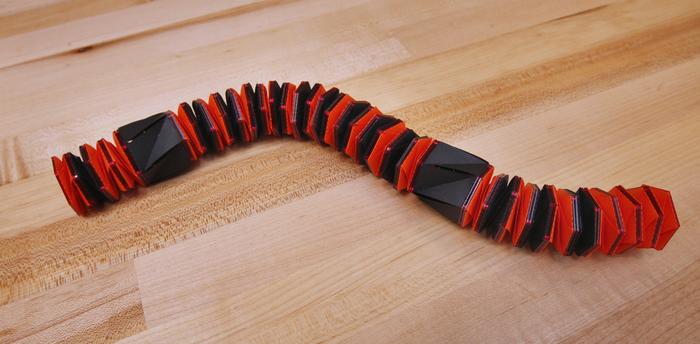
Engineers at Princeton and North Carolina State University have combined ancient paperfolding and modern materials science to create a soft robot that bends and twists through mazes with ease.

Credit: Frank Wojciechowski/Princeton University
Engineers at Princeton and North Carolina State University have combined ancient paperfolding and modern materials science to create a soft robot that bends and twists through mazes with ease.
Soft robots can be challenging to guide because steering equipment often increases the robot’s rigidity and cuts its flexibility. The new design overcomes those problems by building the steering system directly into the robot’s body, said Tuo Zhao, a postdoctoral researcher at Princeton.
In an article published May 6 in the journal PNAS, the researchers describe how they created the robot out of modular, cylindrical segments. The segments, which can operate independently or join to form a longer unit, all contribute to the robot’s ability to move and steer. The new system allows the flexible robot to crawl forward and reverse, pick up cargo and assemble into longer formations.
“The concept of modular soft robots can provide insight into future soft robots that can grow, repair, and develop new functions,” the authors write in their article.
Zhao said the robot’s ability to assemble and split up on the move allows the system to work as a single robot or a swarm.
“Each segment can be an individual unit, and they can communicate with each other and assemble on command,” he said. “They can separate easily, and we use magnets to connect them.”
Zhao works in Glaucio Paulino’s lab in the Department of Civil and Environmental Engineering and the Princeton Materials Institute. Paulino, the Margareta Engman Augustine Professor of Engineering, has created a body of research that applies origami to a wide array of engineering applications from medical devices to aerospace and construction.
“We have created a bio-inspired plug-and-play soft modular origami robot enabled by electrothermal actuation with highly bendable and adaptable heaters,” Paulino said. “This is a very promising technology with potential translation to robots that can grow, heal, and adapt on demand.”
In this case, the researchers began by building their robot out of cylindrical segments featuring an origami form called a Kresling pattern. The pattern allows each segment to twist into a flattened disk and expand back into a cylinder. This twisting, expanding motion is the basis for the robot’s ability to crawl and change direction. By partially folding a section of the cylinder, the researchers can introduce a lateral bend in a robot segment. By combining small bends, the robot changes direction as it moves forward.
One of the most challenging aspects of the work involved developing a mechanism to control the bending and folding motions used to drive and steer the robot. Researchers at North Carolina State University developed the solution. They used two materials that shrink or expand differently when heated (liquid crystal elastomer and polyimide) and combined them into thin strips along the creases of the Kresling pattern. The researchers also installed a thin stretchable heater made of silver nanowire network along each fold. Electrical current on the nanowire heater heats the control strips, and the two materials’ different expansion introduces a fold in the strip. By calibrating the current, and the material used in the control strips, the researchers can precisely control the folding and bending to drive the robot’s movement and steering.
“Silver nanowire is an excellent material to fabricate stretchable conductors. Stretchable conductors are building blocks for a variety of stretchable electronic devices including stretchable heaters. Here we used the stretchable heater as the actuation mechanism for the bending and folding motions” said Yong Zhu, the Andrew A. Adams Distinguished Professor in the Department of Mechanical and Aerospace Engineering at N.C. State and one of the lead researchers.
Shuang Wu, a postdoctoral researcher in Zhu’s lab, said the lab’s previous work used the stretchable heater for continuously bending a bilayer structure. “In this work we achieved localized, sharp folding to actuate the origami pattern. This effective actuation method can be generally applied to origami structures (with creases) for soft robotics,” Wu said.
The researchers said that the current version of the robot has limited speed, and they are working to increase the locomotion in later generations.
Zhao said the researchers also plan to experiment with different shapes, patterns, and instability to improve both the speed and the steering.
Modular Multi-degree-of-freedom Soft Origami Robots with Reprogrammable Electrothermal Actuation was published online May 6 in the Proceedings of the National Academy of Sciences. Support for the research was provided in part by the National Science Foundation and the National Institutes of Health.
Journal
Proceedings of the National Academy of Sciences
Method of Research
Experimental study
Subject of Research
Not applicable
Article Title
Modular Multi-degree-of-freedom Soft Origami Robots with Reprogrammable Electrothermal Actuation
Article Publication Date
6-May-2024
Cite Scienmag News
Ophelia Keating. (May 6, 2024). Caterbot? Robatapillar? It crawls with ease through loops and bends. Scienmag. https://scienmag.com/caterbot-robatapillar-it-crawls-with-ease-through-loops-and-bends/
Ophelia Keating. "Caterbot? Robatapillar? It crawls with ease through loops and bends." Scienmag, 6 May 2024, https://scienmag.com/caterbot-robatapillar-it-crawls-with-ease-through-loops-and-bends/. Accessed 3 September 2026.
Ophelia Keating. "Caterbot? Robatapillar? It crawls with ease through loops and bends." Scienmag. May 6, 2024. https://scienmag.com/caterbot-robatapillar-it-crawls-with-ease-through-loops-and-bends/

