


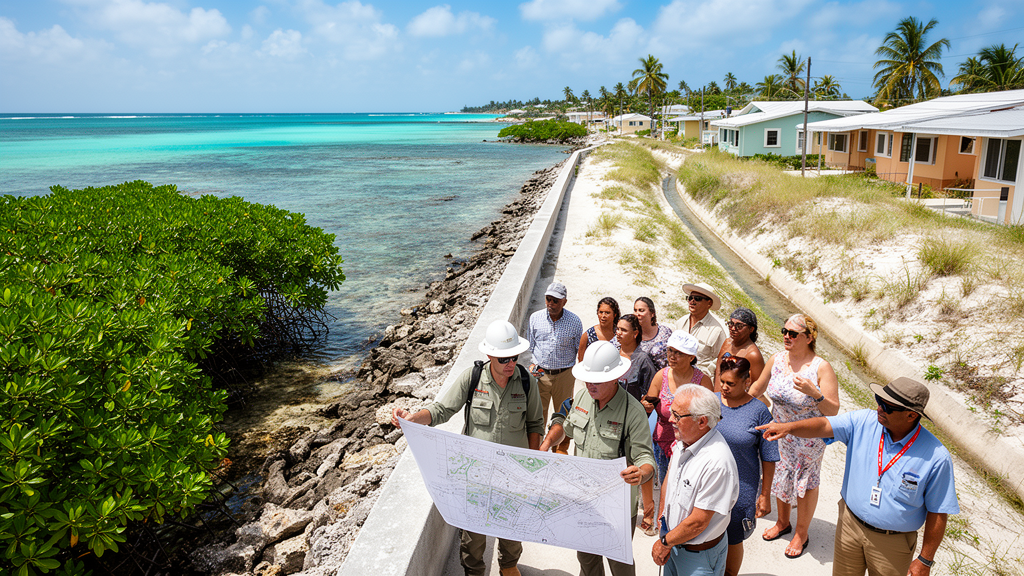
A systematic review of climate-induced coastal risks and adaptation strategies across the Caribbean concludes that durable coastal resilience requires a combination of engineered protection, healthy coastal ecosystems and participatory governance supported by region-specific hazard information. The assessment also finds that regional strategies are often developed under institutional constraints without the integrated, multi-level approaches needed for sustainable resilience.
Following PRISMA guidelines, the researchers screened 665 records and examined 43 studies. The studies were assessed in three adaptation categories: hard engineering, ecosystem-based approaches and other adaptive strategies. The review considered patterns in effectiveness, suitability, acceptability, equity, opportunities and limitations. This is an evidence synthesis of studies from across the Caribbean, not a new field trial, so its conclusions identify recurring relationships and implementation challenges rather than demonstrating that one adaptation package will work in every location.
Hard engineering solutions provide immediate protection, according to the review. However, poorly planned or isolated structures can cause long-term ecological disruption, sediment imbalances and flooding problems, while generating high maintenance costs. The findings therefore caution against judging engineered measures only by the protection they provide at the outset. Their broader effects and continuing requirements must be considered when they are incorporated into coastal planning.
Healthy ecosystem-based approaches contribute to risk reduction and can provide multifunctional environmental benefits. Their performance is conditional, however, and depends on ecosystem condition, hazard intensity, local environmental conditions and long-term management. The review identifies these dependencies as important for assessing whether an ecosystem-based measure is suitable in a particular setting. It also finds that the potential of ecosystem-based adaptation has not been fully realized because the integration of engineered and ecosystem-based measures within participatory governance remains incomplete. Institutional fragmentation and inconsistent enforcement are among the constraints that restrict implementation.
Regional case studies reviewed in the assessment show that effective governance, data-driven planning and community engagement can strengthen coastal resilience. The review points to integrated early warning systems, hazard mapping and institutional coordination as elements of this approach. These measures are presented in connection with region-specific hazard information and coordinated decision-making, rather than as a universally transferable template. The authors conclude that sustainable coastal resilience in the Caribbean requires a co-created, multi-level strategy combining engineered defences, healthy coastal ecosystems and participatory governance. The scope of the evidence supports this integrated direction, but the variation in local hazards, environmental conditions, institutional capacity and management needs limits any single regional prescription.
Subject of Research: Systematic assessment of climate-induced coastal risks and adaptation strategies in the Caribbean Basin
Article Title: Assessment of climate-induced coastal risks and adaptation strategies in the Caribbean Basin
Article References: Ayoub, S., Nalakurthi, N. V. S. R., Renaud, S. S., Ahmed, T., Riaz, K., Trench, C., Villarroel-Lamb, D., & Gharbia, S. S. (2026). Assessment of climate-induced coastal risks and adaptation strategies in the Caribbean Basin. Natural Hazards, 122(22), Article 691. https://doi.org/10.1007/s11069-026-08451-9
Image Credits: AI Generated
DOI: 10.1007/s11069-026-08451-9
Keywords: Caribbean, coastal resilience, climate adaptation, hard engineering, ecosystem-based adaptation, coastal hazards, participatory governance, hazard mapping, early warning systems, Assessment, climate-induced, coastal
Cite Scienmag News
Courtney Benton. (October 20, 2026). Caribbean review finds coastal resilience requires integrated planning. Scienmag. https://scienmag.com/caribbean-review-finds-coastal-resilience-requires-integrated-planning/
Courtney Benton. "Caribbean review finds coastal resilience requires integrated planning." Scienmag, 20 October 2026, https://scienmag.com/caribbean-review-finds-coastal-resilience-requires-integrated-planning/. Accessed 21 October 2026.
Courtney Benton. "Caribbean review finds coastal resilience requires integrated planning." Scienmag. October 20, 2026. https://scienmag.com/caribbean-review-finds-coastal-resilience-requires-integrated-planning/


