


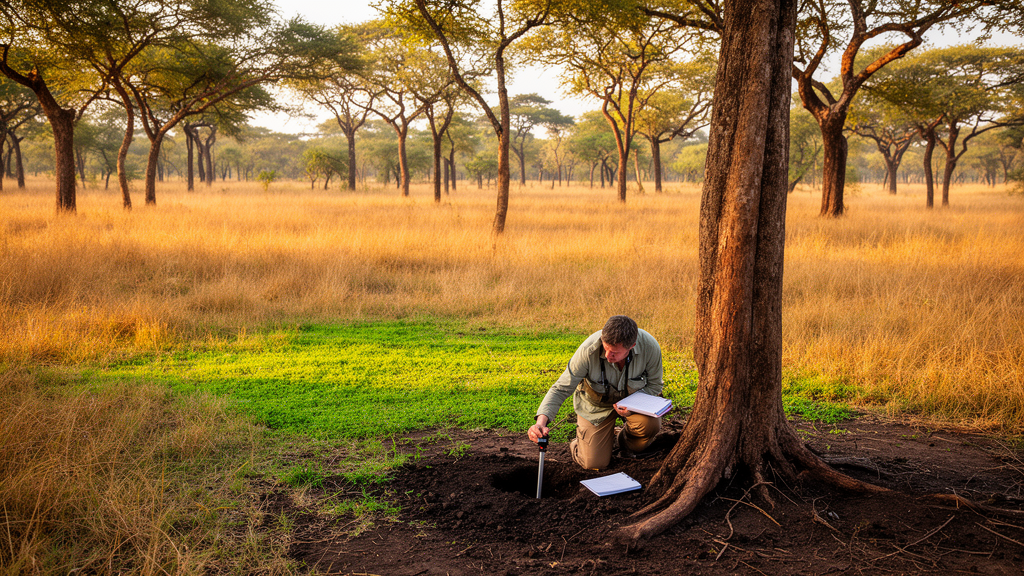
A field phytosociological study of the Biosphere Reserve of Pendjari in Benin identified 11 plant associations across wetland and dryland vegetation, with soil moisture and drainage associated with the main differences in species composition. The study sampled 202 plots and recorded 249 plant species in the reserve, which includes Pendjari National Park and the Pendjari Hunting Zone.
Researchers used the Braun–Blanquet method to survey plant communities in 2013. They investigated semi-deciduous forest, gallery forest, woodland and savanna, recording plant cover, vegetation structure, topography, soil conditions, flooding and site coordinates. Sampling plots were 30 m by 30 m in woodland, 20 m by 25 m in gallery forests and 10 m by 10 m for the herbaceous layer. Plant specimens for most species were confirmed at the National Herbarium of Benin.
Multivariate analyses separated the sampled plots into a wetland group of 73 relevés and a dryland group of 129 relevés. The wetland group contained 177 species and included riparian forest, floodplain woodland and savanna on moist to wet soils, including sites subject to temporary flooding. The dryland group contained 206 species and represented savanna and woodland on plateau soils. The authors reported that soil-moisture status was associated with the first major division in the ordination, while drainage, relief and vegetation cover were associated with variation within the two groups.
The analysis distinguished six wetland associations and five dryland associations. Wetland associations included Hyparrhenio glabriusculae–Mitragynetum inermis, Terminalio macropterae–Mitragynetum inermis, Sorghastro bipennati–Vachellietum hockii, Brachiario jubatae–Terminalietum macropterae, Borassetum aethiopi and Coletum laurifoliae. Their placement was associated with contrasts in flooding duration, drainage and proximity to streams. For example, Coletum laurifoliae occurred along the Pendjari River where flooding exceeded six months, whereas Sorghastro bipennati–Vachellietum hockii occurred on temporarily flooded sites with a flooding period no longer than two months.
Dryland vegetation comprised Terminalietum leiocarpae, Andropogono gayani–Combretetum glutinosi, Andropogono gayani–Terminalietum avicennioidis, Burkeo africanae–Detarietum microcarpi and Andropogono gayani–Senegalietum dudgeonii. The Terminalietum leiocarpae association had the highest recorded species richness, with 136 species and an average of 41 ± 11.2 species per relevé. The lowest was Andropogono gayani–Senegalietum dudgeonii, with 33 species and an average of 24 ± 2.1 species per relevé. Mean richness across the remaining associations ranged from 23.7 ± 2.4 to 39.4 ± 7.8 species per relevé.
Floristic similarity also varied among communities. Jaccard similarity indices below 50% indicated differences among the wetland communities; the closest pair had an index of 0.46. Several dryland communities showed greater overlap, with a maximum value of 0.66 between the communities characterized by Crossopteryx febrifuga and by Vitellaria paradoxa and Andropogon gayanus. These comparisons indicate that some dryland communities shared more species with one another than wetland communities did.
Soil sampling was conducted at 20 cm depth, with five samples taken in each representative plot. The authors measured particle size, pH, organic matter, organic carbon, total nitrogen and available phosphorus. Riparian associations Borassetum aethiopi and Coletum laurifoliae were associated with river-associated soil group B, which had 3% clay and 47% sand. Floodplain associations occurred on hydromorphic soil groups I and C, with pHwater of 7.00, organic matter of 4.15%–4.55% and organic carbon of 2.49%–2.52%. Plateau associations were associated mainly with ferruginous and ferralitic soil groups, where sand reached 70% and organic matter ranged from 1.1% to 1.6%.
Some associations showed structural differences associated with their habitats. Coletum laurifoliae had a tree layer with 80%–90% cover and a sparse herbaceous layer, whereas the Terminalio macropterae–Mitragynetum inermis association had a tree canopy of 25%–75% and herbaceous cover of 50%–85%. The Burkeo africanae–Detarietum microcarpi association occurred on rocky hill slopes, while Andropogono gayani–Terminalietum avicennioidis was recorded on deep sandy-clay plateau soils.
The study was limited to one sampling campaign in 2013 and did not establish associations for the reserve’s pond ecosystems. The researchers also did not investigate seasonal changes in floristic patterns during the dry season, and disturbance regimes, including fire and elephant impacts, were not evaluated. The findings therefore describe plant associations and their measured environmental patterns within the sampled reserve, rather than demonstrating long-term vegetation change or a causal effect of any single environmental factor.
Subject of Research: Phytosociological differentiation of wetland and dryland plant associations in the Pendjari Biosphere Reserve, Benin
Article Title: Ecological and structural differentiation of the Sudanian woodlands in the Biosphere Reserve of Pendjari, Benin
Article References: Assèdé, E. S. P., Biaou, S. S. H., Orou, H., Oumorou, M., Geldenhuys, C. J., Chirwa, P. W., & Sinsin, B. (2023). Ecological and structural differentiation of the Sudanian woodlands in the Biosphere Reserve of Pendjari, Benin. Vegetation Classification and Survey, 4, 139-165. https://doi.org/10.3897/vcs.91126
Image Credits: AI Generated
DOI: 10.3897/VCS.91126
Keywords: Pendjari Biosphere Reserve, Benin, phytosociology, plant associations, Sudanian woodlands, soil moisture, wetland vegetation, dryland vegetation, vegetation survey, plant species richness, Ecological, structural
Cite Scienmag News
Margaret Porter. (October 21, 2026). Field study identifies 11 plant associations across wetland and dryland vegetation in Pendjari, Benin. Scienmag. https://scienmag.com/field-study-identifies-11-plant-associations-across-wetland-and-dryland-vegetation-in-pendjari-benin/
Margaret Porter. "Field study identifies 11 plant associations across wetland and dryland vegetation in Pendjari, Benin." Scienmag, 21 October 2026, https://scienmag.com/field-study-identifies-11-plant-associations-across-wetland-and-dryland-vegetation-in-pendjari-benin/. Accessed 21 October 2026.
Margaret Porter. "Field study identifies 11 plant associations across wetland and dryland vegetation in Pendjari, Benin." Scienmag. October 21, 2026. https://scienmag.com/field-study-identifies-11-plant-associations-across-wetland-and-dryland-vegetation-in-pendjari-benin/


