


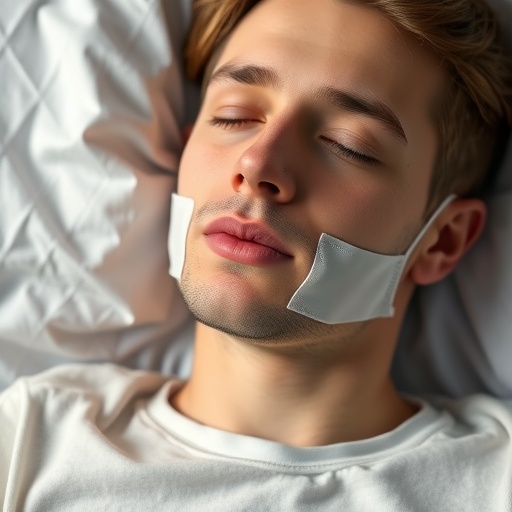
In recent years, mouth taping has surged in popularity across social media platforms such as TikTok and Instagram. Promoted by influencers and select celebrities, this unconventional practice involves sealing the mouth shut with adhesive tape during sleep to encourage nasal breathing. Advocates claim it enhances sleep quality, improves oral health, and even offers anti-aging benefits. Despite the widespread buzz, new scientific evidence warns this trend may pose serious health risks, especially for individuals with underlying sleep disorders.
A comprehensive systematic review published in the reputable journal PLOS One provides illuminating insights into the safety and efficacy of mouth taping, particularly for those experiencing sleep-disordered breathing and obstructive sleep apnea (OSA). A collaborative effort between Lawson Research Institute, London Health Sciences Centre Research Institute (LHSCRI), and Western University’s Schulich School of Medicine & Dentistry, the study delved into 86 previously published research papers. It further conducted an in-depth evaluation of 10 key studies encompassing data from 213 patients, revealing alarming results that challenge the purported health benefits touted on social media.
Mouth breathing during sleep is a well-recognized symptom of several health conditions, including nasal obstructions and OSA. However, forcibly preventing this natural compensatory mechanism by taping the lips can exacerbate respiratory distress. The review highlights that individuals who tape their mouths shut risk obstructing normal airflow, especially if nasal passages become blocked at night. Such blockage can lead to increased respiratory effort, oxygen deprivation, and in extreme cases, suffocation. This is particularly concerning for patients unaware that they suffer from sleep apnea, a condition responsible for intermittent airway collapse causing disrupted breathing and poor sleep quality.
From a physiological perspective, nasal breathing plays a critical role in air filtration, humidification, and nitric oxide production, which assists in vascular regulation and immune defenses. While shifting to nasal breathing might offer benefits under certain circumstances, rigidly enforcing it through mouth taping without medical evaluation dismisses the body’s intricate respiratory reflexes. The review emphasizes the absence of strong, consensual scientific evidence supporting mouth taping’s health advantages, contradicting claims of improved sleep architecture, dental health, or skin rejuvenation circulating online.
Dr. Brian Rotenberg, an otolaryngologist and sleep surgeon deeply involved in the research, expressed significant concern about the trend’s viral popularity. He underscored that social media often amplifies unverified health advice without adequately addressing potential dangers or contraindications. “What initially seemed like a trending health hack turned out to have substantial risks, especially for sufferers of sleep apnea who might not even be aware of their condition,” Dr. Rotenberg stated. This lack of awareness could lead to worsened symptoms and increased susceptibility to serious cardiovascular complications such as hypertension and heart disease, both closely linked to untreated sleep-disordered breathing.
The study’s findings also draw attention to the broader issue of how pseudoscience propagates in the digital age. With misinformation spreading rapidly, consumers often lack access to reliable, evidence-based guidance. Jess Rhee, a medical resident associated with the project, stresses the importance of grounding health decisions in rigorous scientific research. She notes that while the allure of easy fixes is understandable, reliance on anecdotal social media endorsements can impede diagnosis and treatment of underlying medical conditions. Rhee’s perspective highlights the pressing need for public health education initiatives that counteract misguided wellness fads and promote professional consultation.
Methodologically, the researchers utilized content analysis to systematically evaluate a spectrum of clinical trials, observational studies, and case series related to mouth taping and breathing disorders. The heterogeneity of study designs and patient populations posed challenges but also underscored the lack of high-quality, randomized controlled trials validating the practice. This deficiency further supports caution against adopting mouth taping as a generalized intervention without personalized medical oversight.
The paper’s implications extend beyond individual behavior to healthcare policy and clinical practice. Sleep specialists and primary care providers may encounter patients attempting mouth taping without disclosing it, complicating diagnostic assessments. Recognizing these emerging trends enables clinicians to proactively inquire about such practices and educate patients on safer alternatives. Moreover, the research invites further investigation into tailored therapies that support nasal breathing without risking airway compromise.
From a translational science standpoint, this study exemplifies the critical intersection of laboratory research, clinical evidence, and public health communication. It illustrates the responsibility of research institutions to monitor emerging wellness trends and generate data that safeguard populations from inadvertent harm. The collaboration among Lawson Research Institute, LHSCRI, and Western University demonstrates the power of academic partnerships in addressing contemporary health challenges exacerbated by viral misinformation.
In conclusion, while the concept of improving breathing patterns during sleep remains valid, mouth taping as a self-administered practice is fraught with risks that overshadow purported benefits. Individuals experiencing sleep disturbances or suspecting obstructive breathing should consult healthcare professionals for appropriate diagnostics and evidence-based treatments. Until more definitive research emerges, mouth taping should be approached with caution, and the public must be alerted to the potential perils associated with this trendy but potentially hazardous sleep hack.
News Publication Date: 21-May-2025
Web References:
- London Health Sciences Centre Research Institute (LHSCRI)
- Lawson Research Institute
- Western University
Cite Scienmag News
Kristina Jarvis. (May 21, 2025). Canadian Sleep Expert Questions Validity of Viral Mouth-Taping Trend. Scienmag. https://scienmag.com/canadian-sleep-expert-questions-validity-of-viral-mouth-taping-trend/
Kristina Jarvis. "Canadian Sleep Expert Questions Validity of Viral Mouth-Taping Trend." Scienmag, 21 May 2025, https://scienmag.com/canadian-sleep-expert-questions-validity-of-viral-mouth-taping-trend/. Accessed 3 September 2026.
Kristina Jarvis. "Canadian Sleep Expert Questions Validity of Viral Mouth-Taping Trend." Scienmag. May 21, 2025. https://scienmag.com/canadian-sleep-expert-questions-validity-of-viral-mouth-taping-trend/


