


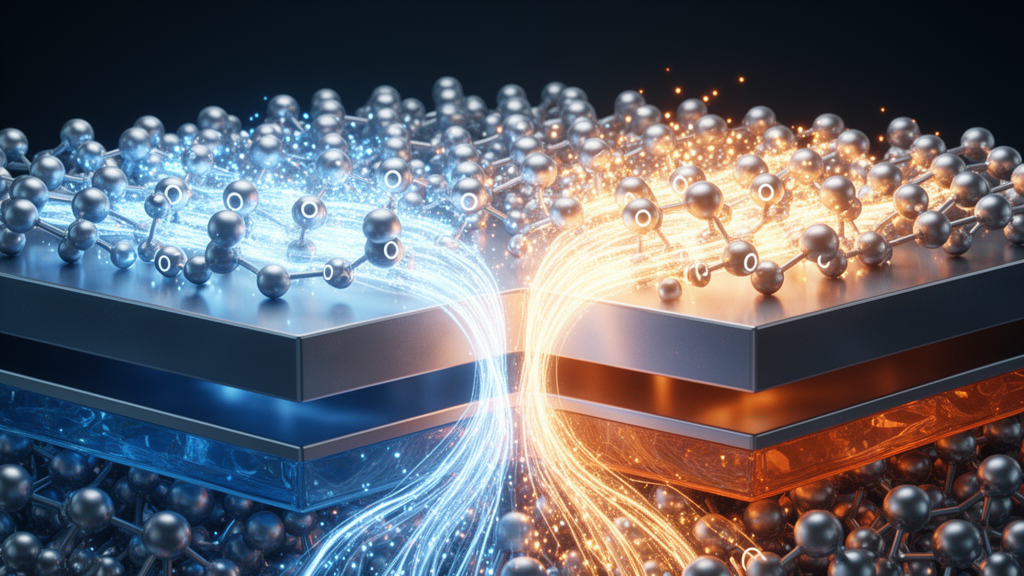
Researchers have built a photocatalyst that uses chemical bonds, rather than simple physical contact, to shuttle energetic charge carriers between two semiconductors. In a study published in the Journal of Materials Science on 26 October 2026, the team decorated cadmium zinc sulfide (CdZnS) nanoparticles onto the surface of bismuth oxyiodide (BiOI) microsheets, creating interfacial cadmium–oxygen bonds where the two materials meet. These bonds act as dedicated charge transfer channels, and the authors report that they boost both hydrogen evolution and the degradation of the pollutant ciprofloxacin.
Both experimental measurements and theoretical calculations confirmed the construction of S-scheme CdZnS/BiOI heterostructures and the formation of interfacial Cd–O bonds between the surface oxygen species of BiOI and the cadmium species of CdZnS. In such a heterojunction, two semiconductors with staggered band positions are joined so that photogenerated carriers redistribute across the interface, and the newly created bonds provide a physical pathway through which that redistribution can occur.
The S-scheme arrangement matters because it determines which charge carriers survive long enough to drive useful chemistry. Under illumination, photoexcited electrons move directionally from the conduction band of BiOI to the valence band of CdZnS, driven by the interfacial electric field established at the bonded junction. This pathway pairs the carriers in each material so that the less useful ones recombine at the interface.
As a result, electrons accumulate in the conduction band of CdZnS while holes are retained in the valence band of BiOI. Because the recombination-prone carriers are eliminated at the interface, the surviving electrons and holes possess extended lifetimes, leaving them available for the subsequent reduction and oxidation reactions that constitute photocatalysis. The authors attribute the measured activity gains to this bond-mediated charge transfer rather than to incidental effects of simply combining the two semiconductors.
The performance improvements were substantial for both reactions the team targeted. The optimized composite, containing 30 percent CdZnS on BiOI, produced hydrogen at a yield of 1.22 mmol per gram per hour. This represents a 7.6-fold increase compared with bare BiOI and a 2.1-fold increase compared with bare CdZnS, according to the reported figures.
The same material degraded 93 percent of ciprofloxacin within 60 minutes, with a rate constant of 0.045 per minute. That rate constant corresponds to a 3.8-fold improvement over bare BiOI and a 2.0-fold improvement over bare CdZnS. Both reactions were therefore enhanced by the same underlying design principle: the Cd–O bonds create an efficient interfacial charge transfer channel that strengthens spatial separation of photogenerated carriers.
The researchers systematically investigated the underlying photocatalysis mechanisms, linking the measured activity directly to the S-scheme transfer pathway enabled by the interfacial bonds. The work was carried out by Junqin Zhang, Jianfeng Dai, Huaijing Chen, Yanming Wang, Xiaofeng Sun, Zao Yi, Tao Xian, Yile Dai, Guorong Liu, Hua Yang and colleagues, and falls within the chemical routes to materials research area.
The reported results are specific to the CdZnS/BiOI system and to the two reactions examined: hydrogen evolution and ciprofloxacin degradation under the conditions described in the study. Within that scope, the findings show that deliberately creating chemical bonds at a heterojunction interface can serve as a charge transfer channel, raising carrier separation efficiency and extending the lifetimes of the electrons and holes that perform photocatalytic work.
Subject of Research: Interfacial Cd–O bond engineering in S-scheme CdZnS/BiOI heterojunction photocatalysts for hydrogen evolution and ciprofloxacin degradation
Article Title: Creation of Cd‒O bonds as interfacial charge transfer channels in S-scheme CdZnS/BiOI heterostructures for boosting photocatalytic H2 evolution and ciprofloxacin degradation
Article References: Zhang, J., Dai, J., Chen, H., Wang, Y., Sun, X., Yi, Z., Xian, T., Dai, Y., Liu, G., & Yang, H. (2026). Creation of Cd‒O bonds as interfacial charge transfer channels in S-scheme CdZnS/BiOI heterostructures for boosting photocatalytic H2 evolution and ciprofloxacin degradation. Journal of Materials Science. https://doi.org/10.1007/s10853-026-14024-9
Image Credits: AI Generated
DOI: 10.1007/s10853-026-14024-9
Keywords: photocatalysis, S-scheme heterojunction, CdZnS, BiOI, Cd–O bonds, charge transfer, hydrogen evolution, ciprofloxacin degradation, interfacial electric field, carrier separation, heterostructures, Creation
Cite Scienmag News
Denise Maddox. (October 26, 2026). Cadmium–oxygen bonds forge fast charge channels in S-scheme photocatalyst. Scienmag. https://scienmag.com/cadmium-oxygen-bonds-forge-fast-charge-channels-in-s-scheme-photocatalyst/
Denise Maddox. "Cadmium–oxygen bonds forge fast charge channels in S-scheme photocatalyst." Scienmag, 26 October 2026, https://scienmag.com/cadmium-oxygen-bonds-forge-fast-charge-channels-in-s-scheme-photocatalyst/. Accessed 26 October 2026.
Denise Maddox. "Cadmium–oxygen bonds forge fast charge channels in S-scheme photocatalyst." Scienmag. October 26, 2026. https://scienmag.com/cadmium-oxygen-bonds-forge-fast-charge-channels-in-s-scheme-photocatalyst/


