

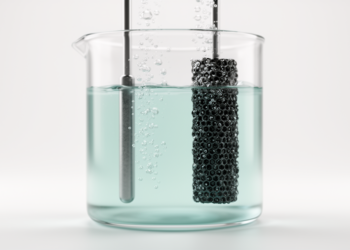
Review Charts Design of Metal-Free Oxide–Graphene Catalysts for Seawater Electrolysis
A new open-access review examines how noble-metal-free oxide–graphene nanocomposites can be designed as electrocatalysts for direct seawater electrolysis.
A new open-access review examines how noble-metal-free oxide–graphene nanocomposites can be designed as electrocatalysts for direct seawater electrolysis.
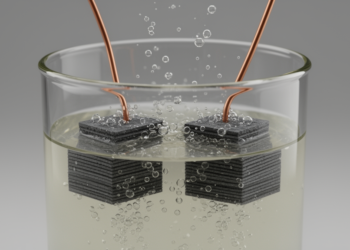
Researchers built layer-by-layer MXene-palladium multilayer electrodes that oxidize methanol instead of water at the anode, producing hydrogen in a full ...

Interfacial Cd–O bonds in S-scheme CdZnS/BiOI heterostructures act as charge transfer channels that raise hydrogen evolution to 1.22 mmol g−1 ...

Researchers achieved an 82.5 percent exfoliation yield for zirconium disulfide nanosheets using aqueous ionic liquids, enhancing their electrocatalytic activity for ...
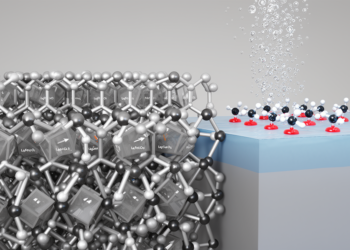
A laboratory study of La₂FeCuO₆ found a distorted monoclinic double-perovskite structure, a 3.45 eV band gap, ferrimagnetic-like behavior and moderate, ...

Nitrogen-doped titanium oxide nanowires synthesized with ammonium nitrate showed a 2.2-fold increase in photocatalytic hydrogen evolution over undoped titanium oxide, ...
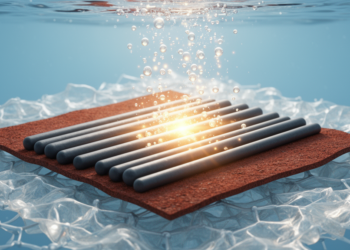
A laboratory study reports that a WO3/Fe2O3/graphene oxide nanocomposite produced 25.26 mmol g−1 of hydrogen under visible light over 10 ...
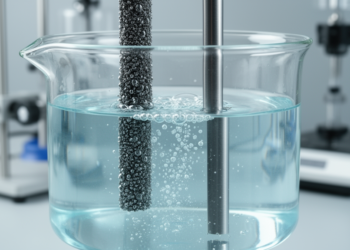
A laboratory study found that a 2:1 NiCo LDH/TiO2 catalyst reached 86.8 mV overpotential at 10 mA·cm−2 in 1 M ...

Operando Raman spectroscopy and molecular dynamics reveal that ordered interfacial water layers actively control CO2 reduction selectivity at industrial current ...
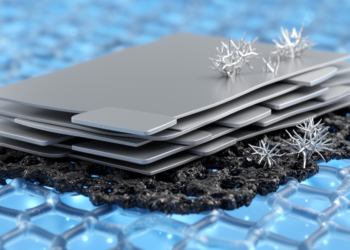
Researchers in China have engineered a MXene and sulfur-doped graphene coating that suppresses dendrites, hydrogen evolution and corrosion in aqueous ...


Embark on a thrilling journey of discovery with Scienmag.com—your ultimate source for cutting-edge breakthroughs. Immerse yourself in a world where curiosity knows no limits and tomorrow’s possibilities become today’s reality!