


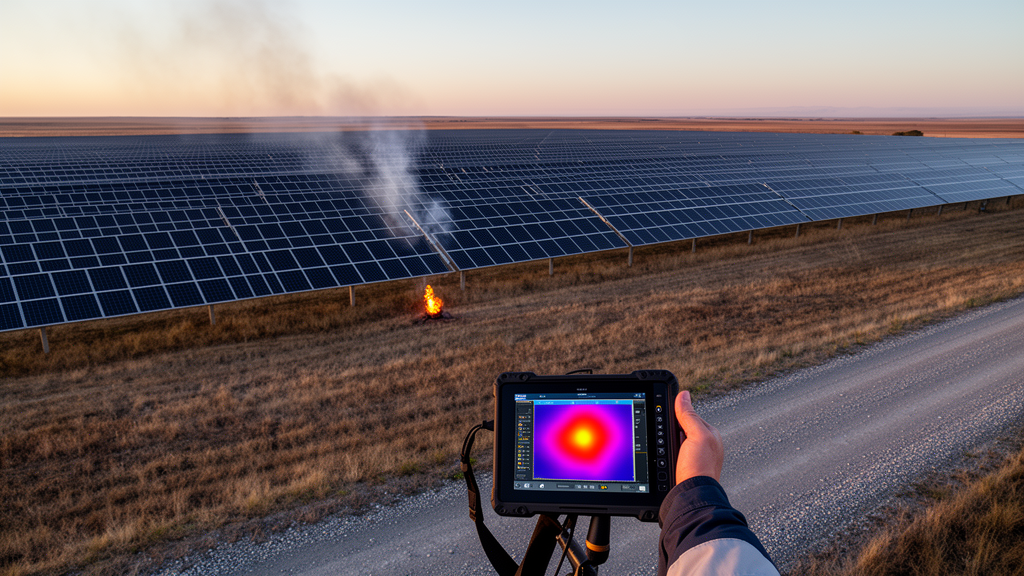
Photovoltaic power plants pack together flammable polymers and electrical components prone to arcing, which makes early fire detection a safety-critical monitoring task. A new study published in Scientific Reports presents PVFire-YOLO, a real-time neural detection framework designed to catch fires while they are still small, weakly contrasted patches of smoke or flame. The work addresses a problem that plagues conventional detectors in solar installations: the glossy surfaces of photovoltaic modules produce specular reflections that fabricate fire-like visual cues, degrading detection accuracy precisely where early warning matters most.
The framework combines three technical components. A patch-aware parallel attention block amplifies weak responses from small targets against reflective backgrounds, helping the network distinguish genuine incipient flames and smoke from mirrored light on module glass. A gather-and-distribute neck performs information fusion across four feature-pyramid levels, closing the semantic gap that limits conventional neck architectures, in which features at different resolutions carry inconsistent information. Finally, a four-scale adaptive spatial feature-fusion head learns per-pixel scale weights and adds a high-resolution branch dedicated to targets smaller than 100 pixels, the size range where incipient fires typically first appear in plant surveillance imagery.
To train and evaluate the detector, the researchers built PV-Fire, described as the first annotated flame-and-smoke corpus with a photovoltaic-specific background distribution. The dataset allows models to learn the visual statistics of solar plants, including the reflective surfaces and equipment layouts that generate false alarms in generic fire-detection systems. Evaluation was conducted both on this new corpus and on the public D-Fire benchmark, allowing comparison with detectors trained outside the photovoltaic domain.
Against fourteen baseline detectors, PVFire-YOLO reached a mean average precision of 87.4 percent at an intersection-over-union threshold of 0.5 on PV-Fire and 84.4 percent on D-Fire. On small targets specifically, the model raised average precision by 5.2 points over its own baseline architecture, indicating that the attention and fusion components contribute most where targets are hardest to see. The reflection-induced false-positive rate fell to 3.1 percent at higher recall, addressing the trade-off in which detectors that catch more real fires also flag more spurious events.
Speed figures support the real-time claim in the framework’s name. PVFire-YOLO ran at 79 frames per second on a desktop graphics card and 21 frames per second on an embedded edge device, the class of hardware typically installed at remote plant sites. The authors report the work as an applied computational-intelligence study, positioning the detector for deployment in operational photovoltaic monitoring. As with any benchmark-based evaluation, field performance across varying lighting, weather and plant geometries would need to be established through deployment experience, and the published version of the paper remains subject to further editorial updates pending the final Version of Record.
Subject of Research: Real-time small-target fire detection in photovoltaic plants using an attention-enhanced multiscale fusion neural detector
Article Title: Real time small target fire detection in photovoltaic plants using attention enhanced multiscale fusion
Article References: Guo, W., Meng, X., Wang, J., Cai, C., & Cui, H. (2026). Real time small target fire detection in photovoltaic plants using attention enhanced multiscale fusion. Scientific Reports. https://doi.org/10.1038/s41598-026-74289-7
Image Credits: AI Generated
DOI: 10.1038/s41598-026-74289-7
Keywords: photovoltaic, fire detection, PVFire-YOLO, attention mechanism, feature fusion, small target detection, computer vision, deep learning, PV-Fire dataset, real-time detection, solar plant safety, false positives
Cite Scienmag News
Blake Davidson. (October 26, 2026). Attention-enhanced AI detector spots incipient fires in solar plants. Scienmag. https://scienmag.com/attention-enhanced-ai-detector-spots-incipient-fires-in-solar-plants/
Blake Davidson. "Attention-enhanced AI detector spots incipient fires in solar plants." Scienmag, 26 October 2026, https://scienmag.com/attention-enhanced-ai-detector-spots-incipient-fires-in-solar-plants/. Accessed 26 October 2026.
Blake Davidson. "Attention-enhanced AI detector spots incipient fires in solar plants." Scienmag. October 26, 2026. https://scienmag.com/attention-enhanced-ai-detector-spots-incipient-fires-in-solar-plants/


