

Monday, October 26, 2026
Science
No Result
View All Result
  • Login
  • HOME
  • SCIENCE NEWS
  • CONTACT US
  • HOME
  • SCIENCE NEWS
  • CONTACT US
No Result
View All Result
Scienmag
No Result
View All Result
Home Science News Technology and Engineering

PMS-PZT ceramic hits 1.13 m/s vibration with only 20 °C heating

October 26, 2026
in Technology and Engineering
Denise Maddox
By Denise Maddox Scienmag Editorial Profile - Mechanical Engineering
Reading Time: 2 mins read
0
PMS-PZT ceramic hits 1.13 m/s vibration with only 20 °C heating

PMS-PZT ceramic hits 1.13 m/s vibration with only 20 °C heating

65
SHARES
587
VIEWS
Share on FacebookShare on Twitter
ADVERTISEMENT

High-power piezoelectric ceramics face a stubborn trade-off: materials that convert electrical energy into mechanical vibration strongly tend to waste energy as heat when driven hard, while low-loss materials respond weakly. A study published in the Journal of Materials Science reports a ceramic composition that balances these demands. Researchers systematically examined 0.05Pb(Mn1/3Sb2/3)O3-0.95Pb(Zr1-xTix)O3, abbreviated PMS-PZT, varying the zirconium-to-titanium ratio across x = 0.44 to 0.52 and characterizing phase structure, microstructure, and electromechanical properties at each step.

At this ratio, the ceramic delivered a piezoelectric coefficient d33 of 370 pC/N alongside a mechanical quality factor Qm of 1612 in the p-mode and a planar electromechanical coupling factor kp of 0.64. According to the authors, the optimized high-power performance is mainly associated with enhanced polarization and electromechanical activity near the phase boundary, while the hardening characteristics of the PMS-PZT system are retained. This produces what they describe as a favorable balance between piezoelectric response and mechanical loss, rather than an elimination of the underlying trade-off.

The thermal behavior under load is arguably the most consequential result for practical devices. The reported figures are laboratory measurements on ceramic samples rather than performance figures from assembled devices. The abstract does not report device-level testing, so translating the measured d33, Qm, and vibration velocity into deployed hardware would require further validation.

For engineers designing high-power acoustic and electromechanical systems, the work offers a compositional map rather than a finished component. The systematic sweep across Zr/Ti ratios identifies x = 0.50 as the optimum, and the characterization of dielectric loss stability under high fields provides data relevant to predicting how such ceramics would behave in sustained operation. The combination of a high Curie temperature, stable losses under high electric fields, and limited temperature rise at high vibration velocity marks the MPB composition as a candidate for further development in high-power piezoelectric applications.

The study's scope is limited to the compositional range x = 0.44 to 0.52 in the PMS-PZT ternary system, and the reported optimum reflects that systematic variation.

Subject of Research: High-power PMS-PZT piezoelectric ceramics with high vibration velocity and thermal stability

Article Title: High vibration velocity and excellent thermal stability in PMS-PZT piezoelectric ceramics for high-power applications

Article References: Zhang, Y., Liu, X., Tang, M., Xu, Z., & Yan, Y. (2026). High vibration velocity and excellent thermal stability in PMS-PZT piezoelectric ceramics for high-power applications. Journal of Materials Science. https://doi.org/10.1007/s10853-026-13887-2

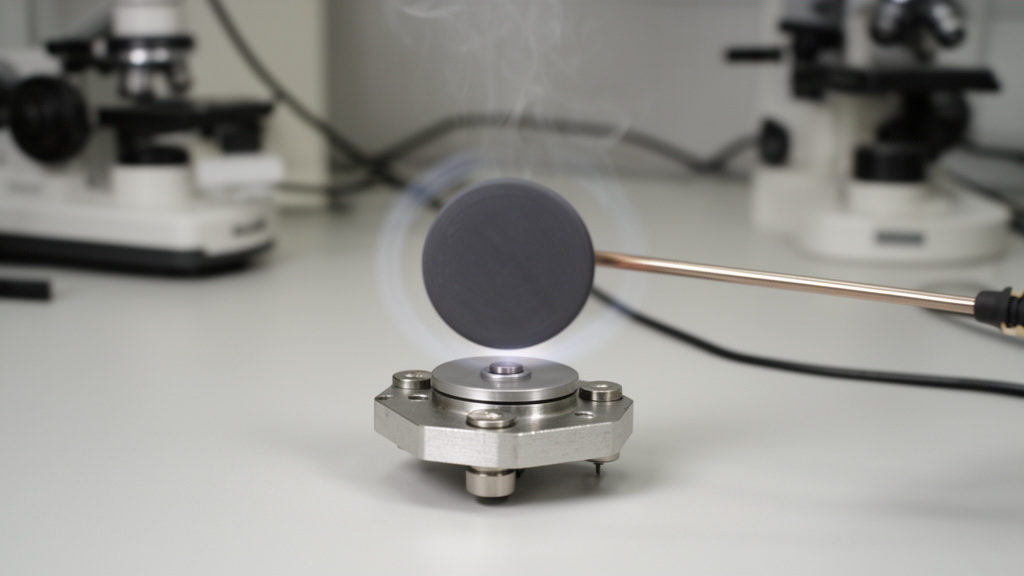
Image Credits: AI Generated

DOI: 10.1007/s10853-026-13887-2

Keywords: piezoelectric ceramics, PMS-PZT, morphotropic phase boundary, mechanical quality factor, vibration velocity, thermal stability, dielectric loss, Curie temperature, high-power applications, Journal of Materials Science, High, vibration

Cite Scienmag News

Denise Maddox. (October 26, 2026). PMS-PZT ceramic hits 1.13 m/s vibration with only 20 °C heating. Scienmag. https://scienmag.com/pms-pzt-ceramic-hits-1-13-m-s-vibration-with-only-20-c-heating/

Denise Maddox. "PMS-PZT ceramic hits 1.13 m/s vibration with only 20 °C heating." Scienmag, 26 October 2026, https://scienmag.com/pms-pzt-ceramic-hits-1-13-m-s-vibration-with-only-20-c-heating/. Accessed 26 October 2026.

Denise Maddox. "PMS-PZT ceramic hits 1.13 m/s vibration with only 20 °C heating." Scienmag. October 26, 2026. https://scienmag.com/pms-pzt-ceramic-hits-1-13-m-s-vibration-with-only-20-c-heating/


Tags: ceramic vibration at low heatingCurie temperaturedielectric losselectromechanical properties of piezo ceramicsenergy loss and heat in piezo materialshighhigh-power applicationsHigh-power piezoelectric ceramicshigh-temperature piezoelectric performanceJournal of Materials Sciencemechanical quality factormechanical quality factor in ceramicsmicrostructure analysis of PMS-PZTmorphotropic phase boundaryoptimization of piezoelectric coefficientphase boundary effects in PZT ceramicspiezoelectric ceramicsPMS-PZTPMS-PZT compositionpolarization enhancement near phase boundarypractical applications of high-power piezo ceramicsthermal stabilityVibrationvibration velocity
Share26Tweet16
Previous Post

3D-Printed Aneurysm Model Lets Medical Students Try Neurointervention Hands-On

Next Post

Doppler Pulsatility Index After Stroke Thrombectomy Flags Bleeding Risk

Related Posts

Better imputation accuracy does not buy better predictions in real-world health data
Technology and Engineering

Better imputation accuracy does not buy better predictions in real-world health data

October 26, 2026
Cadmium–oxygen bonds forge fast charge channels in S-scheme photocatalyst
Technology and Engineering

Cadmium–oxygen bonds forge fast charge channels in S-scheme photocatalyst

October 26, 2026
Attention-enhanced AI detector spots incipient fires in solar plants
Technology and Engineering

Attention-enhanced AI detector spots incipient fires in solar plants

October 26, 2026
Fabricated References Spread Beyond Medicine, Audit of 500,000 Papers Finds
Technology and Engineering

Fabricated References Spread Beyond Medicine, Audit of 500,000 Papers Finds

October 26, 2026
New AI model sharpens subway passenger flow forecasts across three Chinese metros
Technology and Engineering

New AI model sharpens subway passenger flow forecasts across three Chinese metros

October 26, 2026
Hybrid LPBF-LDED printing of SS304 shows fine microstructure and corrosion trade-offs
Technology and Engineering

Hybrid LPBF-LDED printing of SS304 shows fine microstructure and corrosion trade-offs

October 26, 2026
Next Post
Doppler Pulsatility Index After Stroke Thrombectomy Flags Bleeding Risk

Doppler Pulsatility Index After Stroke Thrombectomy Flags Bleeding Risk

  • Mothers who receive childcare support from maternal grandparents show more optimized

    Mothers who receive childcare support from maternal grandparents show more parental warmth, finds NTU Singapore study

    27656 shares
    Share 11059 Tweet 6912
  • University of Seville Breaks 120-Year-Old Mystery, Revises a Key Einstein Concept

    1061 shares
    Share 424 Tweet 265
  • Bee body mass, pathogens and local climate influence heat tolerance

    682 shares
    Share 273 Tweet 171
  • Researchers record first-ever images and data of a shark experiencing a boat strike

    546 shares
    Share 218 Tweet 137
  • Groundbreaking Clinical Trial Reveals Lubiprostone Enhances Kidney Function

    531 shares
    Share 212 Tweet 133
Science

Embark on a thrilling journey of discovery with Scienmag.com—your ultimate source for cutting-edge breakthroughs. Immerse yourself in a world where curiosity knows no limits and tomorrow’s possibilities become today’s reality!

RECENT NEWS

  • Organoids and assembloids reshape how researchers model glioblastoma
  • Doppler Pulsatility Index After Stroke Thrombectomy Flags Bleeding Risk
  • PMS-PZT ceramic hits 1.13 m/s vibration with only 20 °C heating
  • 3D-Printed Aneurysm Model Lets Medical Students Try Neurointervention Hands-On

Categories

  • Agriculture
  • Anthropology
  • Archaeology
  • Athmospheric
  • Biology
  • Biotechnology
  • Blog
  • Bussines
  • Cancer
  • Chemistry
  • Climate
  • Earth Science
  • Editorial Policy
  • Marine
  • Mathematics
  • Medicine
  • Pediatry
  • Policy
  • Psychology & Psychiatry
  • Science Education
  • Science News
  • Social Science
  • Space
  • Technology and Engineering

Subscribe to Blog via Email

Enter your email address to subscribe to this blog and receive notifications of new posts by email.

Join 5,151 other subscribers

© 2025 Scienmag - Science Magazine

Welcome Back!

Login to your account below

Forgotten Password?

Retrieve your password

Please enter your username or email address to reset your password.

Log In
No Result
View All Result
  • HOME
  • SCIENCE NEWS
  • CONTACT US

© 2025 Scienmag - Science Magazine

Discover more from Science

Subscribe now to keep reading and get access to the full archive.

Continue reading