


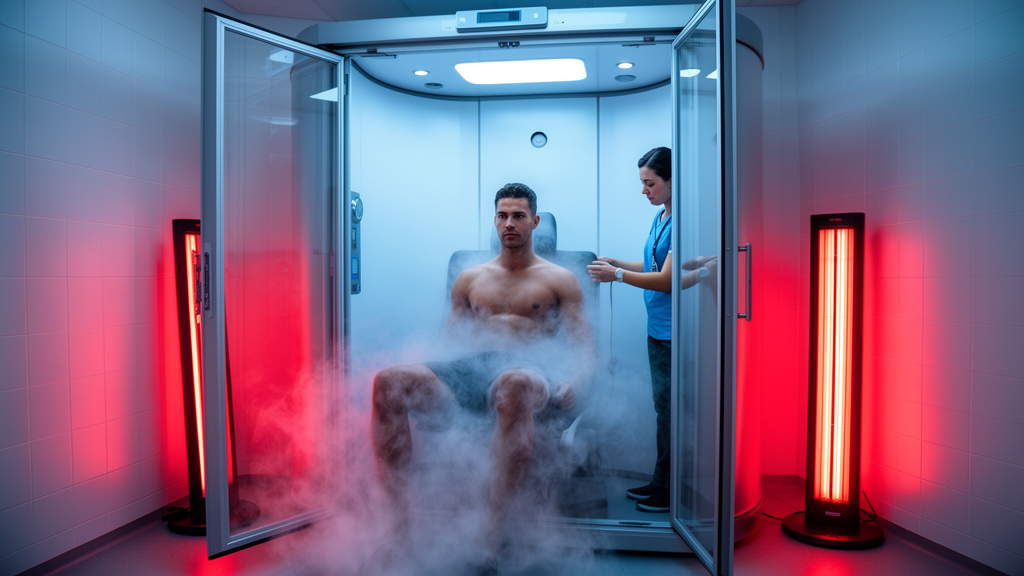
Whole-body cryotherapy and LED-containing photobiomodulation show relatively consistent favorable effects on delayed-onset muscle soreness in the 24 to 48 hours after hard exercise, while laser-based light therapy and photobiomodulation are associated with lower creatine kinase, a biochemical marker of muscle damage. That is the central conclusion of a systematic review and Bayesian network meta-analysis published in Frontiers in Bioengineering and Biotechnology by researchers at Shenyang Sport University in China, who pooled 35 randomized controlled trials to compare more than a dozen recovery and regeneration strategies simultaneously.
The research team, led by Jianxin Li and corresponding author Ming Wei, searched PubMed, Embase, the Cochrane Library and Web of Science from database inception to May 2026, identifying 4,811 records. After removing 1,295 duplicates and screening 188 full-text reports, they included 35 randomized controlled trials involving healthy adults, university students, recreational exercisers and amateur or competitive athletes. The protocol was registered with PROSPERO, and the analysis followed the PRISMA 2020 statement and its network meta-analysis extension.
Delayed-onset muscle soreness, or DOMS, is the familiar ache that builds in the hours after high-intensity, eccentric or unaccustomed exercise and often becomes most pronounced between 24 and 72 hours. It is not attributable to a single mechanism: microscopic sarcomeric damage, impaired excitation-contraction coupling, altered cell membrane permeability, disrupted calcium homeostasis, release of inflammatory mediators and nociceptive sensitization all contribute. In training and competition, soreness can come with reduced muscle strength, restricted joint range of motion and impaired exercise performance, affecting training continuity and load management between sessions.
Because reliance on subjective soreness ratings alone cannot fully characterize muscle damage, the researchers evaluated three complementary outcomes. Creatine kinase, or CK, serves as an indirect biochemical marker of altered skeletal muscle cell membrane permeability and muscle-damage-related biochemical responses, while interleukin-6, or IL-6, is associated with exercise-induced inflammation, immune regulation and the endocrine functions of skeletal muscle. Data were extracted at 24 and 48 hours after exercise, converted where necessary to a 0-100 mm visual analog scale for DOMS, U/L for CK and pg/mL for IL-6, and separate network models were built for each outcome at each time point.
The interventions compared spanned cold-water immersion, contrast-water therapy, local cryotherapy, whole-body cryotherapy, compression therapy, kinesiology taping, vibration therapy, electrical stimulation, stretching, massage, acupuncture, photobiomodulation, low-level laser therapy, shock wave therapy and low-intensity focused ultrasound. Notably, the team split light-based treatments into two mutually exclusive nodes: laser-only low-level laser therapy (LLLT), using 810-nm laser diodes, and LED-containing photobiomodulation regimens (PHO), encompassing diode-based and combined laser-LED protocols, some of which also incorporated a static magnetic field. Passive recovery, usual care, no treatment and placebo or sham conditions were pooled as a combined CON/PBO reference to connect the networks.
For soreness, whole-body cryotherapy showed the largest credible reductions against CON/PBO at both time points: a mean difference of -38.92 (95% credible interval -69.08 to -9.15) on the 100 mm scale at 24 hours and -40.03 (95% CrI -67.74 to -12.44) at 48 hours. Photobiomodulation was also favorable at both points, with mean differences of -18.20 (95% CrI -32.91 to -3.72) and -19.46 (95% CrI -33.55 to -5.99). Low-intensity focused ultrasound posted the single largest 48-hour estimate, -65.81 (95% CrI -92.30 to -39.66), but this rested primarily on one small study, and the whole-body cryotherapy estimates likewise came from a single small crossover trial. Both findings were supported by very-low-certainty evidence and should not be interpreted as establishing comparative superiority.
For creatine kinase, LLLT and PHO were the interventions whose credible intervals excluded zero at both time points. At 24 hours, LLLT showed a mean difference of -249.70 U/L (95% CrI -502.23 to -1.08) and PHO -199.48 U/L (95% CrI -329.27 to -80.63). At 48 hours, the LLLT estimate grew to -499.96 U/L (95% CrI -831.59 to -203.59), the largest effect in the CK networks, with PHO at -252.50 U/L (95% CrI -420.45 to -87.47). Estimates for most other interventions were imprecise and included the null, and head-to-head comparisons between active treatments, such as PHO versus cold-water immersion, were too uncertain to establish superiority among them.
The IL-6 findings were markedly less certain. Cold-water immersion and electrical stimulation were associated with lower IL-6 at 24 hours, and LLLT and cold-water immersion at 48 hours, but the networks were sparse, built from few and generally small studies, and node-splitting was not estimable because no contrast had sufficient independent direct and indirect evidence. The authors treat these results as exploratory, hypothesis-generating evidence about inflammatory modulation rather than an independent basis for recommending any intervention. They also caution that IL-6 is not simply a pro-inflammatory marker but a myokine with complex roles in energy metabolism, immune regulation and tissue repair, so a decrease should not be simplistically equated with better recovery.
Methodological rigor shaped how far the conclusions could be pushed. Risk-of-bias assessment with the revised Cochrane RoB 2 tool found that only one of 25 parallel-group trials was at low overall risk, with 12 raising some concerns and 12 at high risk; none of the 10 crossover trials was judged low risk, and outcome measurement, largely reflecting absent or unclear blinding for subjective soreness ratings, was the most frequent source of high risk. Confidence in the network estimates, assessed with the CINeMA framework, was rated very low for all 13 evaluable DOMS and CK comparisons. Sensitivity analyses excluding crossover trials or separating control from placebo broadly preserved the direction of the principal estimates, though with widened intervals, and leave-one-out analyses confirmed that several nodes, including low-intensity focused ultrasound, depended on single studies.
The divergence between the soreness and biomarker findings carries the analysis’s key message: pain relief and muscle-damage-related biochemical responses are not necessarily synchronous. Cold-related interventions may ease soreness partly by lowering local tissue temperature, slowing sensory nerve conduction velocity, attenuating nociceptive input and reducing swelling through vasoconstriction, while photobiomodulation may influence the mitochondrial respiratory chain, ATP generation, redox balance and inflammatory signaling to attenuate changes in muscle cell membrane permeability. Exploratory network meta-regression across 33 univariable models found no consistent study-level covariate explaining the differences. The authors conclude that no single method showed a consistent advantage across all three outcomes, and that choosing a recovery strategy should weigh the target outcome, the recovery time window, evidence certainty and network structure, while remembering that less soreness does not mean muscle damage or function has recovered in parallel.
Subject of Research: Comparative effects of post-exercise recovery interventions on delayed-onset muscle soreness and muscle damage markers
Article Title: Effects of different recovery and regeneration modalities on delayed-onset muscle soreness and post-exercise muscle damage markers: a systematic review and network meta-analysis
Article References: Li, J., Wang, S., Wei, M., & Liu, W. (2026). Effects of different recovery and regeneration modalities on delayed-onset muscle soreness and post-exercise muscle damage markers: a systematic review and network meta-analysis. Frontiers in Bioengineering and Biotechnology, 14, Article 1956053. https://doi.org/10.3389/fbioe.2026.1956053
Image Credits: AI Generated
DOI: 10.3389/fbioe.2026.1956053
Keywords: delayed-onset muscle soreness, network meta-analysis, whole-body cryotherapy, photobiomodulation, creatine kinase, interleukin-6, exercise recovery, muscle damage, low-level laser therapy, randomized controlled trials, Bayesian analysis, sports science
Cite Scienmag News
Denise Maddox. (October 26, 2026). Whole-Body Cryotherapy and Light Therapy Show Consistent Effects on Post-Exercise Soreness and Damage Markers. Scienmag. https://scienmag.com/whole-body-cryotherapy-and-light-therapy-show-consistent-effects-on-post-exercise-soreness-and-damage-markers/
Denise Maddox. "Whole-Body Cryotherapy and Light Therapy Show Consistent Effects on Post-Exercise Soreness and Damage Markers." Scienmag, 26 October 2026, https://scienmag.com/whole-body-cryotherapy-and-light-therapy-show-consistent-effects-on-post-exercise-soreness-and-damage-markers/. Accessed 26 October 2026.
Denise Maddox. "Whole-Body Cryotherapy and Light Therapy Show Consistent Effects on Post-Exercise Soreness and Damage Markers." Scienmag. October 26, 2026. https://scienmag.com/whole-body-cryotherapy-and-light-therapy-show-consistent-effects-on-post-exercise-soreness-and-damage-markers/


